







The semiconductor landscape is currently undergoing a structural transformation as the “Data-Centric Shift” moves the industry’s center of gravity from smartphones toward High-Performance Computing (HPC) and AI infrastructure.
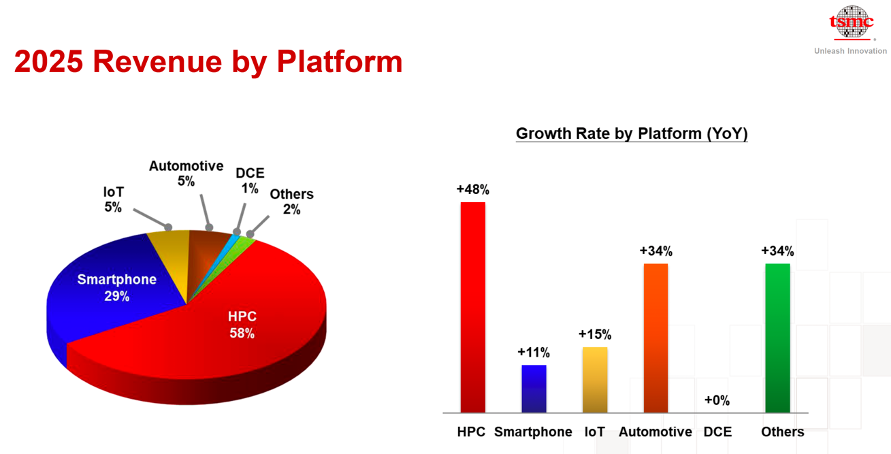
This transition is clearly validated by TSMC’s 2025 filings, which show the HPC platform officially dominating the market, accounting for 58% of total revenue. This macro shift is the primary engine fueling the Interface IP market, which reached a valuation of $2.438 billion in 2025 and is projected to grow at a robust 13.2% CAGR to $4.537 billion by 2030. This growth is anchored by high-speed serial protocols that have become the dominant choice for modern SoC design.
Wired Interface IP Revenues by Protocol, 2021-2030
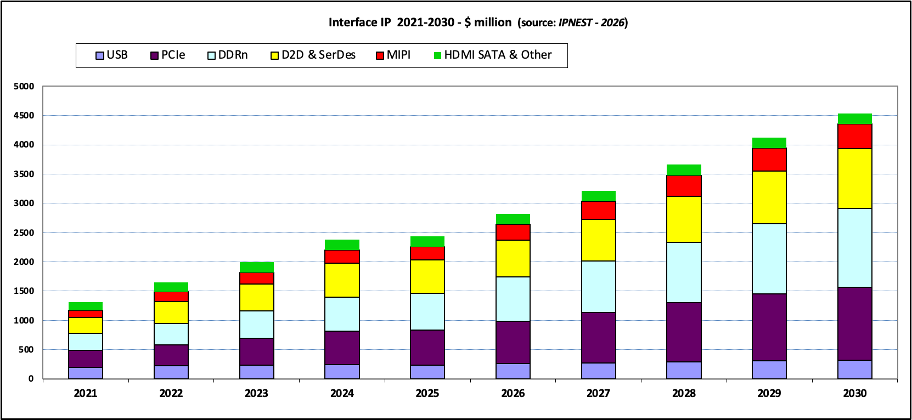
This visual confirms that the market is no longer just expanding in volume; it is expanding in value as the cost of developing advanced IP skyrockets. For example, a 3nm PCIe 7 PHY solution now commands a license premium between $4.0M and $4.5M, a massive leap from the historical costs of legacy protocols.
The Evolving Vendor Hierarchy
While Synopsys remains the undisputed leader with a 57% market share, the 2025 data reveals interesting structural shifts. Despite its dominance in USB (75.4%), PCIe (63.1%), and MIPI (80.4%), Synopsys saw a marginal revenue drop in 2025 as leading-edge accelerator designs began prioritizing highly customized, bespoke interconnect solutions over standardized blocks to meet stringent AI bandwidth and power requirements.
Cadence has firmly established itself as the primary challenger, growing its market share to 17% with significant gains in the DDR and PCIe sectors. Meanwhile, specialized players like Credo and Rambus continue to carve out niches in high-speed SerDes and security IP, leveraging a “multi-pole” strategy to monetize through both licensing and hardware connectivity products.
The Qualcomm-Alphawave Disruption
Perhaps the most significant competitive event of the past year was the Qualcomm-Alphawave merger, completed in December 2025. This move transforms a high-growth IP challenger into a critical engine for Qualcomm’s broader data center and AI platform strategy. Early indicators from Qualcomm’s leadership suggest they will pursue a “dual-use” model, continuing to license Alphawave’s merchant IP to external customers while leveraging it internally for next-generation custom silicon.
Top 5 Interface IP Revenue, 2026-2030
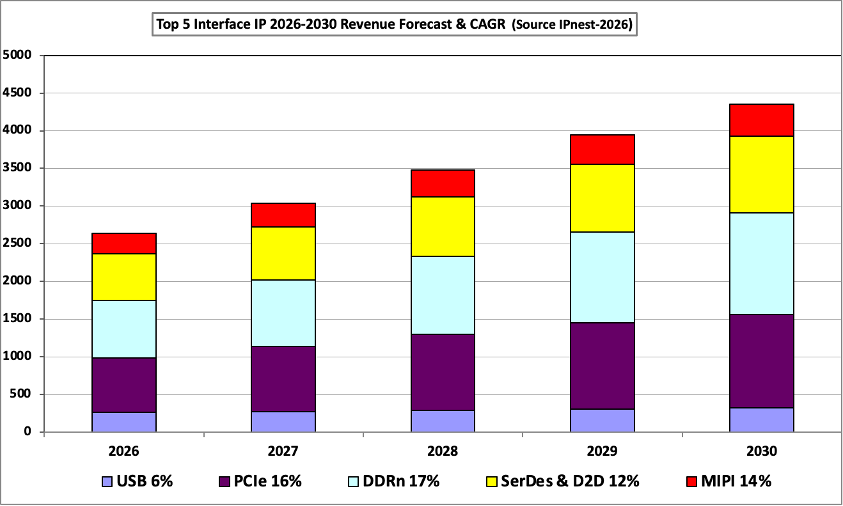
This “Top 5” view highlights where the real revenue battleground lies: USB, PCIe, DDR, SerDes/D2D, and MIPI. Together, these five protocol families are forecasted to account for $4.356 billion in total value by 2030. Within this group, the Chip-to-Chip (D2D) segment is the fastest-growing outlier, boasting a 23.7% CAGR as chiplet partitioning becomes a first-order architectural decision for hyperscalers.
Strategic Intelligence for a New Era
In an environment defined by rapid protocol refreshes such as the transition from 400G to 1.6T Ethernet and the emergence of UCIe-standardized chiplets, relying on outdated market assumptions is a significant risk. Successful navigators of this $4 billion market require more than high-level trends; they need vendor rankings, license pricing guidance and many other important details that drive real-world procurement and design decisions.
The 18th edition of the “Interface IP Survey” provides the details. Authored by Dr. Eric Esteve, a world-renowned Design IP expert, and Kalar Rajendiran, a veteran semiconductor executive, this latest report synthesizes years of primary research and interviews with more than 45 major IP vendors and foundries.
To purchase, Contact Daniel Nenni: dnenni@semiwiki.com
For industry professionals aiming to secure first-pass success in the 2026–2030 era, the full Interface IP 2025 Survey and 2026-2030 Forecast is the definitive resource for competitive intelligence.
Also Read:
AI Booming is Fueling Interface IP 23.5% YoY Growth
Design IP Market Increased by All-time-high: 20% in 2024!
Share this post via:



ChipAgent Raises $134Million and Why it Matters