





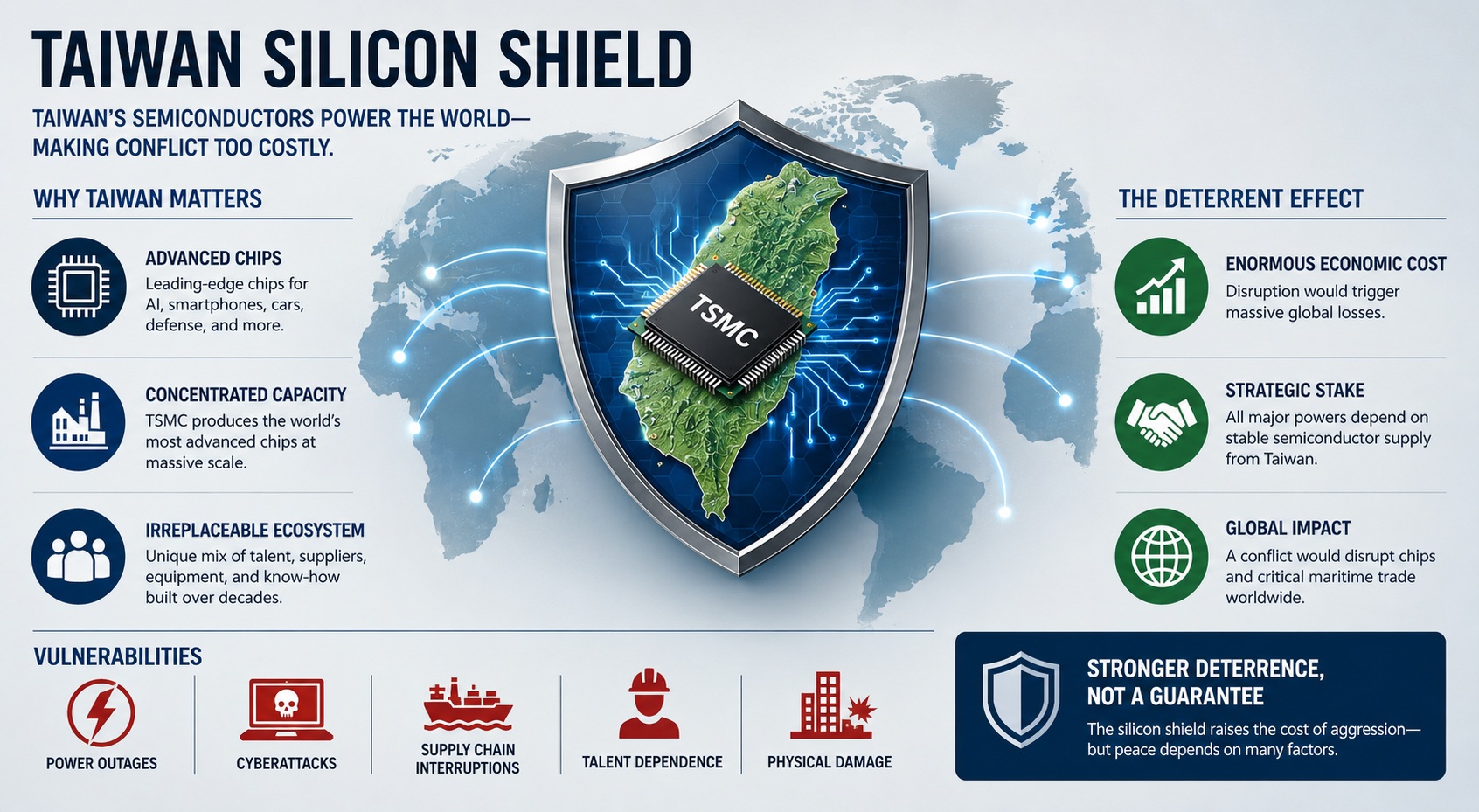
The “Silicon Shield” describes the idea that Taiwan’s central role in advanced semiconductor manufacturing raises the economic and strategic cost of military action against the island. The shield is not a literal defense system. It is a form of structural deterrence created by technological concentration: governments and firms depend on Taiwanese fabrication capacity, especially the leading-edge logic chips produced by Taiwan Semiconductor Manufacturing Company (TSMC). Because these chips enable artificial intelligence accelerators, smartphones, cloud servers, telecommunications equipment, vehicles, and advanced weapons, a conflict that disabled Taiwan’s semiconductor sector would transmit severe shocks through the global economy.
The shield originates in the semiconductor industry’s vertically disaggregated architecture. Many American and European firms specialize in chip design, electronic-design automation software, semiconductor intellectual property, manufacturing equipment, or materials, while relying on dedicated foundries for physical production. TSMC’s pure-play foundry model allows competing fabless companies to manufacture designs without building their own fabrication plants. This model also creates economies of scale: process research, equipment utilization, yield learning, and customer demand are concentrated in one manufacturing platform. In 2025, TSMC reported more than 17 million twelve-inch-equivalent wafers of annual available capacity and produced thousands of products across hundreds of process technologies. Much of its core fabrication network remains in Taiwan, despite new facilities abroad. My first book “Fabless: The Transformation of the Semiconductor Industry” is based on this. I had a ringside seat to this transformation during my 40+ semiconductor career and it was quite the experience, absolutely.
Today, TSMC dominates the leading edge process technologies required for AI at 3nm and 2nm with scant alternatives due to time-to-market, cost, capacity, and the supporting ecosystem. 1.4nm is the next battle ground, unfortunately Samsung is struggling with struggling with 2nm and Rapidus does not have enough capacity to make a difference. Intel 14A, however, is definitely a contender for the NOT TSMC market. The Intel 14A and TSMC A14 PDKs will be ready for tape-out in Q1 2027 with HVM in 2028. The race is on!
Technically, advanced semiconductor capacity cannot be reproduced quickly. A leading-edge fab costs tens of billions of dollars, requires highly specialized extreme-ultraviolet lithography, ultrapure chemicals, stable electricity and water, precision metrology, and a dense network of engineers and suppliers. Physical equipment alone is insufficient. High-volume manufacturing depends on tacit process knowledge, statistical process control, defect reduction, and years of yield optimization. A nominally identical production line in another country may therefore take substantial time to achieve comparable throughput, reliability, and cost.
This concentration creates deterrent value because all major powers would suffer from disruption. The United States depends on Taiwanese manufacturing for chips designed by firms such as Apple, Nvidia, AMD, and Qualcomm. China also depends on imported advanced processors and on electronics supply chains connected to Taiwan. Japan, South Korea, and Europe would face shortages affecting industrial machinery, automobiles, communications, and defense production. In addition, the Taiwan Strait is itself a major commercial corridor; CSIS estimated that about $2.45 trillion in goods transited it in 2022. A blockade or invasion would therefore damage semiconductor production and wider maritime trade simultaneously.
However, the silicon shield has important limitations. Economic interdependence does not automatically prevent war when political leaders prioritize sovereignty, nationalism, or regime legitimacy over commercial losses. Semiconductor facilities are also fragile. Electricity interruption, cyberattack, damaged ports, loss of specialist personnel, or interrupted imports of gases, chemicals, wafers, and spare parts could halt production without factories being physically destroyed. The shield may even create a strategic vulnerability by making Taiwan a uniquely valuable node whose control or denial could appear militarily significant.
Its operation also depends on expectations. Deterrence is strongest when potential aggressors believe disruption would be prolonged, foreign intervention plausible, and captured fabs unusable. Since advanced plants rely on international equipment, software updates, and customer cooperation, occupying the facilities would not automatically transfer a functioning semiconductor ecosystem.
Diversification further changes the shield’s strength. TSMC is expanding manufacturing in the United States and Japan, while governments are subsidizing domestic semiconductor ecosystems. Such investments improve supply-chain resilience but will not rapidly duplicate Taiwan’s complete cluster of advanced fabrication, packaging, suppliers, and engineering talent. Overseas fabs may reduce the world’s exposure to a single geographic point while leaving Taiwan essential for the most advanced processes and high-volume scaling.
Bottom line: Close your eyes and imagine a world without leading edge semiconductors. Most of us have lived long enough to know what that would be like. Now imagine that the only country with leading edge semiconductors is China and the rest of the world is back to the dark ages. Yes, that is how strong the Silicon Shield is, absolutely.
(Politically incorrect observations and opinions are welcome in the comments section since only registered members can see them.)
Also Read:
TSMC CoWoS versus Intel EMIB Semiconductor Packaging
TSMC’s Raises the Bar on CAPEX!
TSMC A16 Backside Power at VLSI 2026
Share this post via:



Comments
4 Replies to “The Silicon Shield Has Never Been Stronger!”
You must register or log in to view/post comments.