




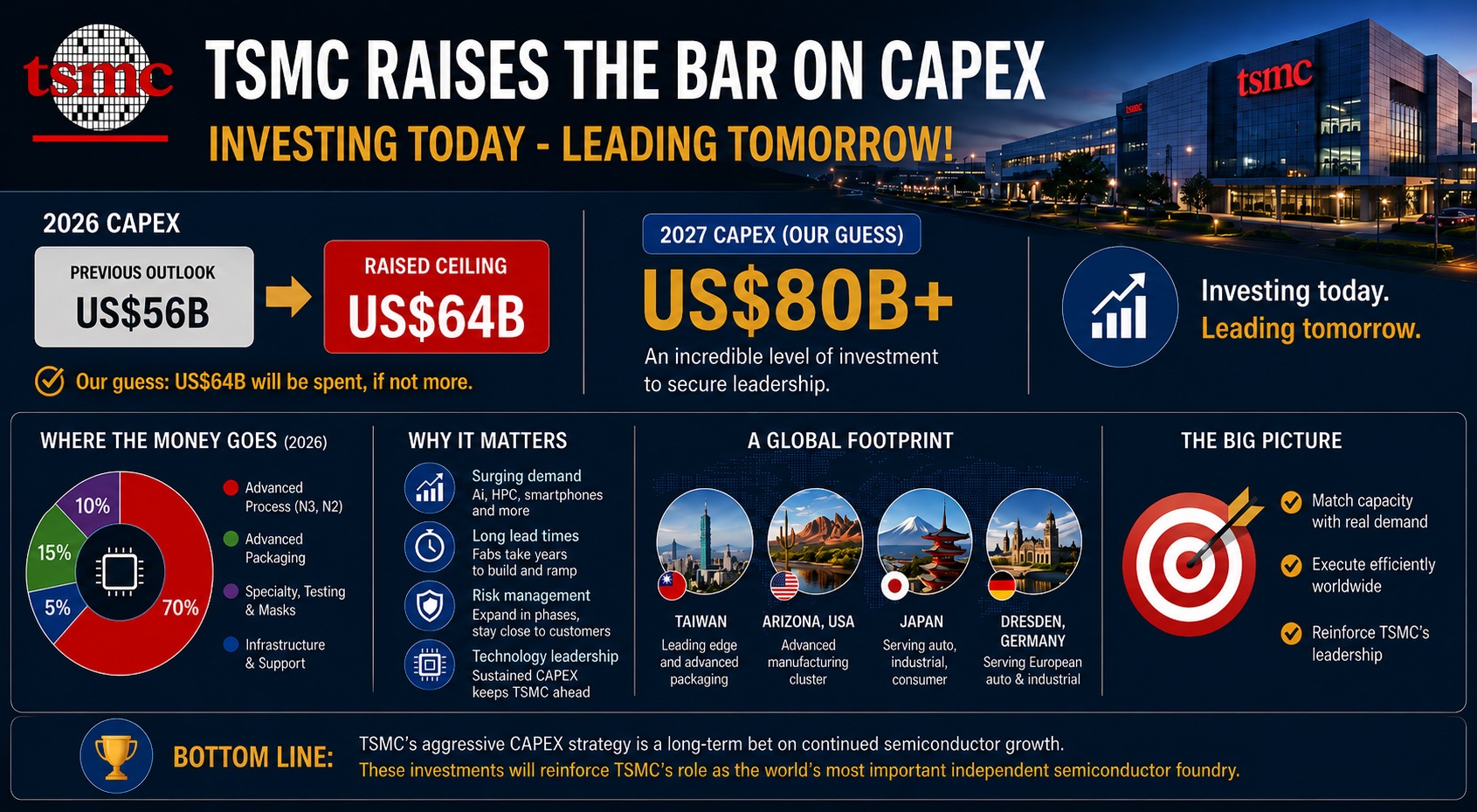

On the latest investor call the big story was the increase in CAPEX for 2026 and the expected CAPEX for 2027. TSMC raised the CAPEX ceiling for 2026 from US$56 billion to US$64 billion. My guess would be US$64 billion will be spent if not more. We have been discussing this in the SemiWiki Forum and my guess for the 2027 TSMC CAPEX is an incredible US$76 billion to US$80 billion.
This is a clear message to customers and competitors that leading edge capacity is guaranteed.
“Our business in the second quarter was supported by strong demand for our leading-edge process technologies,” said Wendell Huang, Senior VP and Chief Financial Officer of TSMC. “Moving into third quarter 2026, we expect our business to be supported by continued strong demand for our leading-edge process technologies, including the steep ramp-up of our 2-nanometer technology.”
TSMC operates in one of the most capital-intensive industries in the world. Its ability to maintain technological leadership depends not only on research and development but also on sustained capital expenditure, commonly called CAPEX. These investments fund new fabrication plants, advanced lithography equipment, cleanrooms, utilities, packaging facilities, and upgrades to existing production lines. For TSMC, CAPEX is therefore both a financial commitment and a strategic tool for defending its leadership in semiconductor manufacturing.
TSMC’s recent spending plans reflect the rapid growth of artificial intelligence, high-performance computing, smartphones, and other data-intensive applications. At the beginning of the year, for 2026, the company indicated capital expenditure of approximately US$52 billion to US$56 billion, with spending expected toward the upper end of that range. That has since been revised to US$60 billion to US$64 billion and I feel spending will again be at the upper range. Most of the budget is directed toward advanced process technologies, particularly N3 and N2 capacity, while the remainder supports specialty technologies, advanced packaging, testing, mask production, and related infrastructure. This allocation shows that TSMC is investing across the entire manufacturing chain rather than concentrating only on wafer fabrication.
Capacity expansion is essential because semiconductor plants require long construction and qualification periods. A new fab can take 3-5 years to build, equip, test, and bring into volume production. TSMC must therefore make investment decisions well before customer demand is fully visible. Underinvestment could create shortages and cause major customers to seek alternative suppliers. Overinvestment, however, could leave expensive equipment underused and weaken returns. TSMC manages this risk by expanding capacity in phases, maintaining close relationships with customers, and prioritizing technologies where demand is expected to remain structurally strong.
Taiwan remains the center of TSMC’s most advanced manufacturing network. The company is expanding leading-edge production there, including 2-nanometer capacity, because Taiwan offers an established supplier ecosystem, experienced engineers, efficient infrastructure, and strong operational coordination. TSMC is also increasing advanced packaging capacity, especially technologies such as CoWoS, which are important for combining powerful processors with high-bandwidth memory in AI systems. Packaging has become a major bottleneck, so investment in backend capacity is now almost as strategically important as investment in advanced wafers.
At the same time, TSMC is building a more geographically diversified production footprint. In Arizona, it is developing a large manufacturing cluster intended to support advanced chip production in the United States. Its total US investment has reached US$165 billion and has just announced another US$100B on the investor call for a total of US$265 billion covering multiple fabs and supporting facilities. TSMC is also expanding in Japan through its Kumamoto operations, which focus on technologies needed by automotive, industrial, consumer, and image-sensor customers. In Germany, its planned Dresden venture is designed mainly to serve European automotive and industrial demand.
This global expansion provides several benefits. It places production closer to major customers, improves supply-chain resilience, and responds to government concerns about semiconductor security. It may also help TSMC access subsidies, infrastructure support, and strategic partnerships. However, overseas fabs are generally more expensive to build and operate than facilities in Taiwan. Higher labor, construction, compliance, and supply-chain costs can reduce margins, while shortages of experienced workers may slow production ramp-ups. TSMC must balance geographic resilience with operational efficiency.
Bottom line: TSMC’s CAPEX and capacity expansion strategy is a long-term bet on continued semiconductor growth. The company is investing aggressively because advanced chips are becoming central to AI, cloud computing, communications, vehicles, and industrial automation. Its success will depend on matching capacity with real customer demand, executing overseas projects efficiently, and preserving technology leadership. If managed well, these investments will strengthen TSMC’s competitive position and reinforce its role as the world’s most important independent semiconductor foundry, absolutely.
Also Read:
TSMC A16 Backside Power at VLSI 2026
Why Huawei Says It Will Match TSMC’s Most Advanced Chips by 2031
Share this post via:



Comments
There are no comments yet.
You must register or log in to view/post comments.