





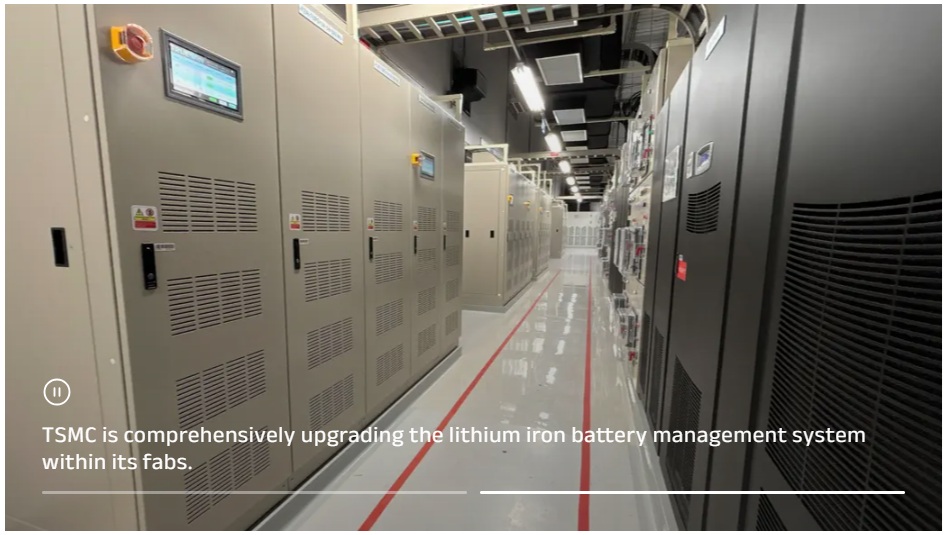
As semiconductor manufacturing becomes increasingly dependent on uninterrupted power and energy efficiency, battery reliability has emerged as a critical operational issue for advanced fabs. Taiwan Semiconductor Manufacturing Company, better known as TSMC, is addressing this challenge through an ambitious global initiative called the “Lithium Iron Battery Generation Upgrade Project.” The program represents one of the semiconductor industry’s most comprehensive battery modernization efforts, covering approximately 408,000 lithium iron phosphate batteries installed across the company’s domestic and international fabrication facilities.
The project is designed to improve both operational resilience and environmental safety. TSMC has been gradually replacing traditional lead-acid batteries in uninterruptible power supply systems with lithium iron batteries because of their higher efficiency, longer lifecycle, and lower environmental impact. The transition also supports the company’s broader sustainability goals, including reduced electricity consumption and lower carbon emissions. Earlier initiatives using LFP batteries reportedly enabled annual electricity savings of approximately 17.1 million kilowatt-hours.
TSMC’s battery upgrade journey has unfolded in several stages. The company first introduced first-generation lithium iron batteries in 2017 after conducting extensive in-fab production verification. These systems primarily monitored battery voltage through sampling boards to maintain safe operation. In 2018, TSMC adopted second-generation systems in response to the International Electrotechnical Commission’s IEC 62619 safety standards for industrial lithium battery applications. The upgraded Battery Management System (BMS) added monitoring capabilities for temperature, state of charge, and battery health, enabling improved operational oversight.
The real transformation began in 2019 when TSMC started developing third-generation lithium iron battery systems with suppliers and technical experts. These new systems significantly expanded monitoring functionality by adding real-time current tracking and integrating directly with the fab’s Supervisory Control and Data Acquisition infrastructure. Through this integration, battery data can be transmitted continuously to centralized monitoring platforms for remote diagnostics and predictive analysis.
The third-generation BMS can precisely monitor critical battery parameters, including voltage, current, temperature, state of charge, and state of health. According to TSMC, the system can immediately identify abnormal operating conditions and pinpoint fault locations, improving emergency response efficiency by approximately 25 percent. In high-volume semiconductor manufacturing environments, where even a brief power disruption can affect wafer production worth millions of dollars, this level of visibility and rapid response capability is especially important.
Safety validation has become another cornerstone of the project. In 2024, TSMC conducted thermal runaway experiments on lithium iron batteries to evaluate battery behavior under extreme conditions and verify the effectiveness of BMS protection mechanisms. Thermal runaway is one of the primary safety concerns associated with large-scale battery systems because overheating in a single cell can potentially trigger cascading failures. By performing controlled testing, TSMC aimed to confirm that its upgraded systems could prevent hazardous events and maintain stable operations in demanding industrial settings.
By the first quarter of 2026, TSMC had fully upgraded all first- and second-generation lithium iron battery management systems to the third-generation standard across its facilities. The company is also deploying an additional layer of protection through lithium iron battery breaker interlocking trip devices. These devices are designed to automatically disconnect power when the BMS detects abnormalities, minimizing the risk of equipment damage or fire-related incidents. Installation of the trip devices is expected to be completed by 2027.
The significance of the project extends beyond battery management. Semiconductor fabs are among the world’s most energy-intensive manufacturing environments, and ensuring reliable power infrastructure is increasingly important as AI-related chip production expands globally. TSMC’s investment in advanced UPS battery systems aligns with its larger environmental and operational strategy, including commitments to renewable energy adoption and sustainable manufacturing practices.
The “Lithium Iron Battery Generation Upgrade Project” illustrates how advanced manufacturing companies are beginning to treat energy storage systems not merely as backup infrastructure, but as intelligent, networked safety platforms. By combining advanced battery chemistry, real-time analytics, SCADA integration, and automated protection mechanisms, TSMC is setting a new benchmark for operational safety and energy resilience in semiconductor manufacturing. As fabs become larger, more automated, and increasingly dependent on uninterrupted power, projects like this may become standard practice across the global semiconductor industry.
Also Read:
ASML High-NA EUV is Not Ready for High-Volume Production
Siemens EDA Expands AI and Advanced Packaging Collaboration with TSMC
imec IC-Link and TSMC 3DFabric Alliance Expansion Signals New Era of System-Level Scaling
Share this post via:



Comments
There are no comments yet.
You must register or log in to view/post comments.