





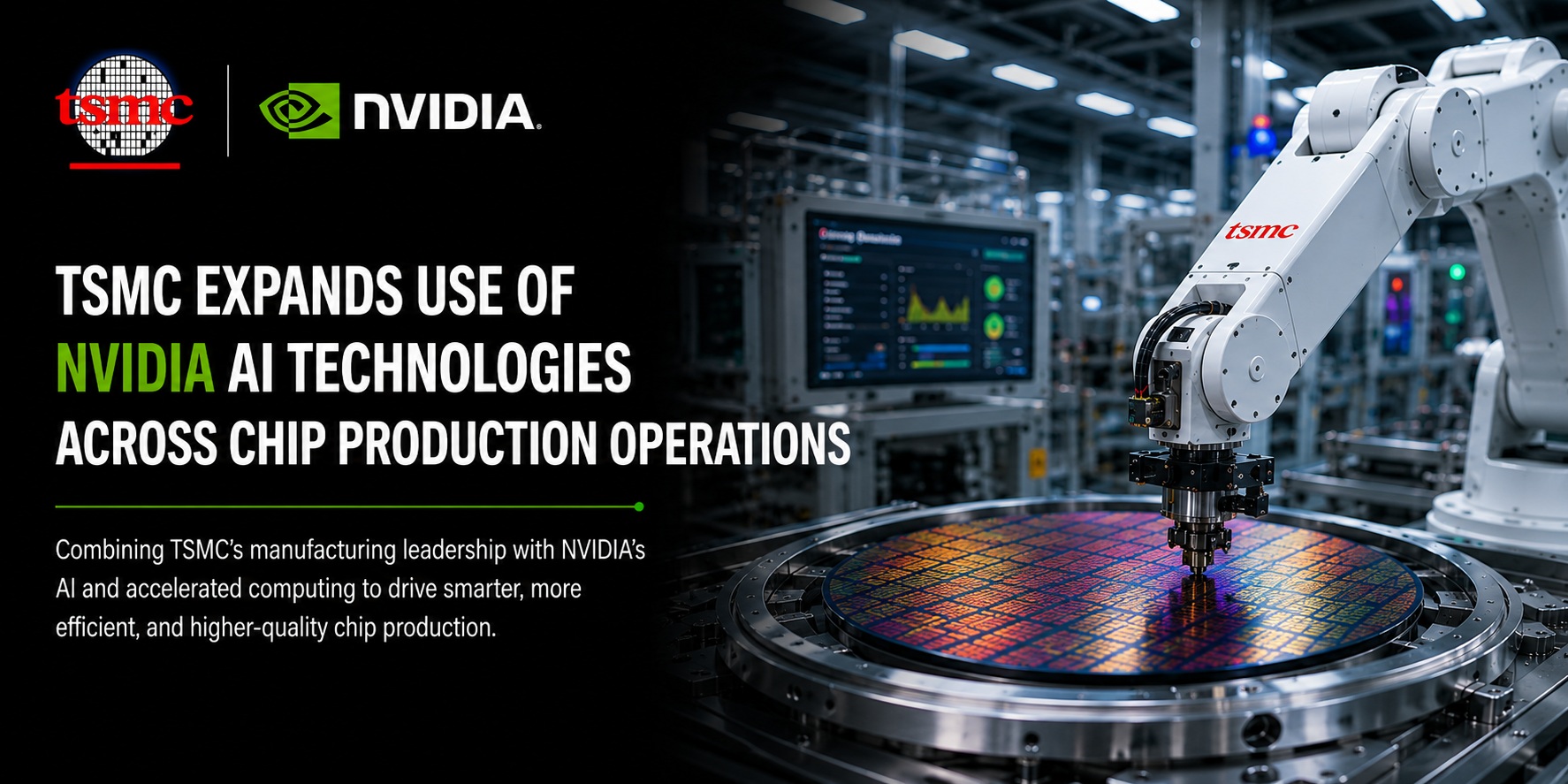
TSMC, the world’s largest contract semiconductor manufacturer, is significantly expanding its deployment of NVIDIA artificial intelligence and accelerated computing technologies throughout its chip design and manufacturing operations. The initiative represents one of the most comprehensive applications of AI within advanced semiconductor fabrication, spanning lithography, process simulation, defect inspection, production scheduling, and factory optimization. The collaboration underscores how AI is becoming a critical enabler of next-generation semiconductor manufacturing as process technologies advance toward the angstrom era.
Modern semiconductor manufacturing has become extraordinarily complex, with advanced nodes requiring billions of transistors, hundreds of process steps, and nanometer-level precision. Traditional CPU-based computing environments often struggle to handle the computational demands associated with process development, computational lithography, and factory optimization. To address these challenges, TSMC is leveraging NVIDIA CUDA-X libraries, GPU-accelerated computing platforms, and AI models to accelerate critical workloads across the semiconductor production lifecycle.
One of the most significant areas of deployment is computational lithography. TSMC is utilizing NVIDIA cuLitho technology to accelerate the simulation and optimization processes required for advanced chip patterning. Computational lithography plays a vital role in translating circuit designs into physical patterns that can be printed onto silicon wafers. According to NVIDIA, TSMC has achieved improvements ranging from 20% to 50% in cycle time and cost effectiveness when using GPU-accelerated lithography workflows compared with conventional CPU-based approaches. These gains are particularly important as the industry moves toward increasingly sophisticated process technologies that require extensive optical proximity correction and mask optimization.
Beyond lithography, TSMC is applying AI and accelerated computing to transistor and process simulation. Semiconductor process development requires detailed modeling of materials, device structures, and manufacturing interactions. NVIDIA’s cuEST library enables significantly faster electronic structure and chemistry simulations, reportedly accelerating semiconductor material design calculations by as much as 50 times. Faster simulations allow engineers to evaluate more design alternatives, optimize materials, and reduce development cycles for future process nodes.
Factory operations are another major focus area. TSMC is deploying NVIDIA H200 GPU infrastructure and CUDA-based scheduling technologies to optimize production workflows and improve fab utilization. Semiconductor fabs generate enormous volumes of operational data, including equipment status, wafer movement, process parameters, and yield metrics. AI-powered scheduling and optimization systems can analyze these data streams in real time to improve throughput, reduce bottlenecks, and enhance overall manufacturing efficiency.
Quality control is also benefiting from AI integration. TSMC is using NVIDIA Metropolis and the NVIDIA TAO Toolkit to develop advanced vision AI systems for automated defect inspection. These systems are designed to detect nanometer-scale defects on wafers and photomasks with greater accuracy while reducing the need for repeated data labeling and model retraining. Automated inspection is increasingly important as feature sizes shrink and defect detection becomes more difficult using traditional methods. Improved defect identification directly contributes to higher yields and reduced manufacturing costs.
Another strategic initiative involves the development of digital twins for semiconductor manufacturing. TSMC and NVIDIA are collaborating on FabTwin, a virtual factory environment built using NVIDIA Omniverse technology. Digital twins enable engineers to simulate fab layouts, equipment configurations, material flows, and operational scenarios before implementing changes in physical production environments. Such capabilities help reduce deployment risks, improve resource planning, and accelerate process optimization across large-scale manufacturing facilities.
The expanded partnership reflects a broader industry shift toward AI-driven manufacturing. As advanced semiconductor nodes become more difficult and expensive to develop, AI is emerging as a critical tool for improving yield, reducing energy consumption, accelerating design cycles, and increasing fab productivity. NVIDIA CEO Jensen Huang stated that TSMC is bringing AI and accelerated computing directly into the fabrication environment to address some of the industry’s most complex design and manufacturing challenges. The result is a highly intelligent manufacturing ecosystem capable of supporting the next generation of AI processors, high-performance computing devices, and advanced semiconductor technologies.
Bottom line: TSMC’s adoption of NVIDIA AI technologies represents a significant milestone in the evolution toward autonomous, data-driven chip manufacturing. As AI workloads continue to grow globally, the integration of AI into semiconductor production itself may become a defining competitive advantage for leading foundries in the years ahead.
Also Read:
TSMC Powers Up: 408,000 Batteries Get a Safety Intelligence Upgrade
ASML High-NA EUV is Not Ready for High-Volume Production
Siemens EDA Expands AI and Advanced Packaging Collaboration with TSMC
Share this post via:



Comments
There are no comments yet.
You must register or log in to view/post comments.