




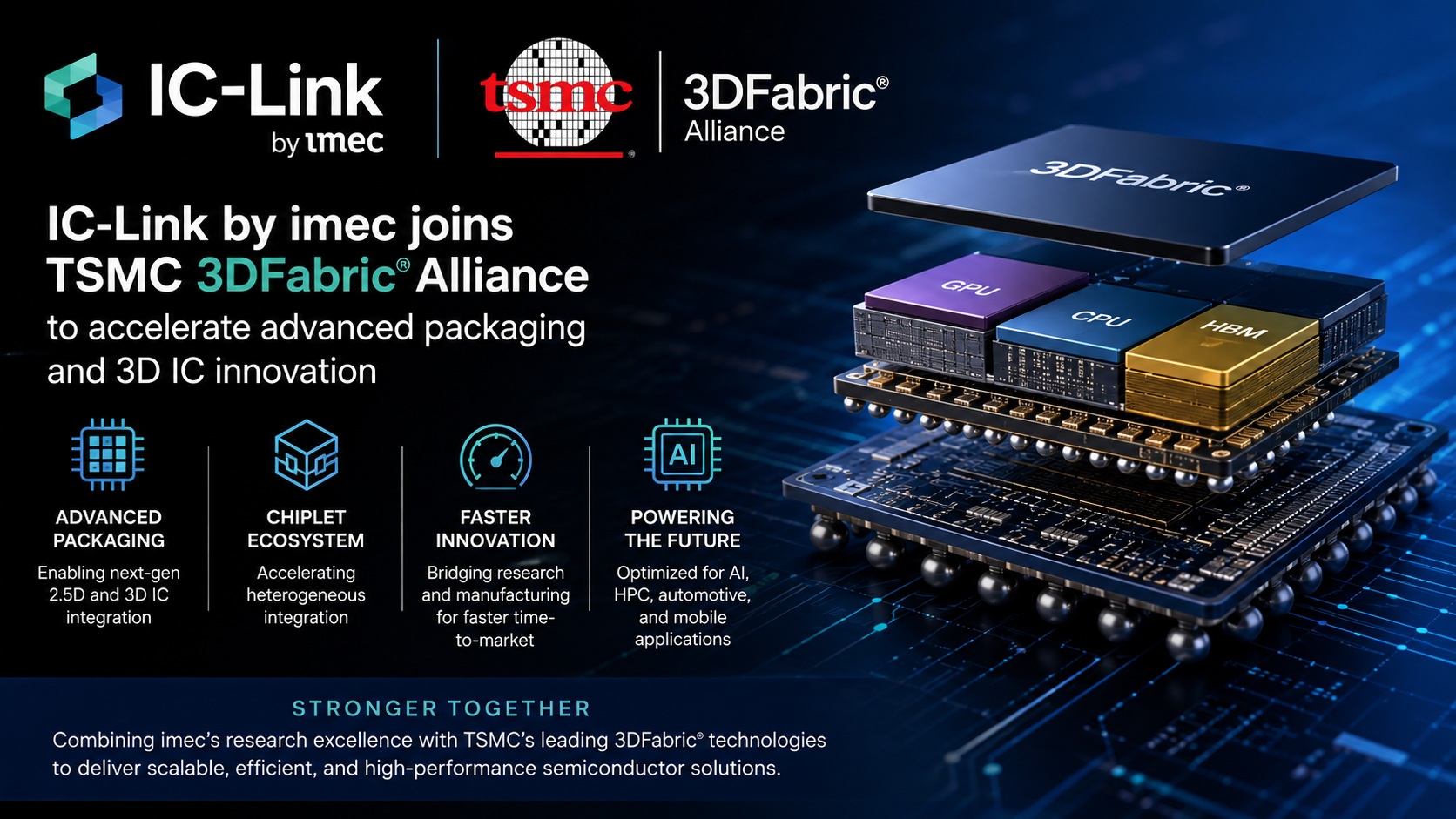

imec announced that IC-Link by imec has joined the TSMC 3DFabric Alliance, a strategically important move that reflects the semiconductor industry’s transition from traditional monolithic scaling toward heterogeneous integration, chiplet architectures, and advanced packaging-driven system optimization. The partnership is technically significant because it combines imec’s globally respected research expertise in advanced packaging and system scaling with TSMC’s production-leading 2.5D and 3D integration ecosystem, enabling faster commercialization of next-generation AI, HPC, automotive, and mobile semiconductor solutions.
For decades, semiconductor innovation was driven primarily by transistor scaling under Moore’s Law. Smaller transistors delivered higher performance, lower power, and lower cost per function. However, as process technologies approach physical and economic scaling limits below 3nm, system-level innovation has become equally important. Today, the bottleneck in many AI and HPC systems is no longer only compute density, but memory bandwidth, interconnect latency, thermal management, and power delivery. Advanced packaging technologies such as chiplets, 2.5D interposers, wafer-level integration, and 3D die stacking are increasingly becoming the primary mechanism for improving overall system performance.
TSMC’s 3DFabric platform addresses these challenges through a portfolio of advanced integration technologies that includes TSMC-SoIC®, CoWoS®, InFO, and TSMC-SoW™. These technologies enable heterogeneous integration, allowing logic, memory, analog, photonics, and specialized accelerators to be integrated into a unified package. Instead of building one extremely large monolithic die, designers can partition functionality across multiple optimized chiplets fabricated on different process nodes and interconnected with ultra-high bandwidth packaging technologies. This approach improves yield, reduces development cost, accelerates design reuse, and enables greater scalability for AI infrastructure.
The addition of IC-Link to the 3DFabric Alliance is important because IC-Link functions as a bridge between semiconductor research and industrial manufacturing. Imec already possesses deep expertise in heterogeneous integration, silicon photonics, advanced packaging, and ASIC development. Through IC-Link, these research capabilities can now be directly connected to TSMC’s production ecosystem. This reduces the traditional gap between R&D innovation and manufacturable commercial products.
One of the most critical technical implications is co-optimization between silicon design and packaging. In advanced AI systems, packaging is no longer treated as a backend assembly step. Instead, package architecture must be designed simultaneously with silicon architecture. Thermal dissipation, power delivery networks, interconnect topology, and memory placement all influence final system performance. The 3DFabric Alliance enables ecosystem participants to collaborate earlier in the design cycle, which improves design convergence and shortens time-to-market for complex multi-die systems.
This collaboration is particularly relevant for AI and HPC applications. Large language models and AI inference engines require enormous memory bandwidth and low-latency interconnects between compute and memory resources. Traditional package architectures cannot efficiently support these requirements. Technologies like CoWoS and SoIC enable high-density die-to-die interconnects and vertically stacked memory integration, significantly increasing bandwidth while reducing power consumption per bit transferred. This packaging-centric architecture is now central to competitive AI accelerator design.
Another major technical advantage is access to advanced manufacturing readiness. Through the alliance, IC-Link customers gain earlier access to TSMC’s advanced packaging flows and validated ecosystem infrastructure. This includes design enablement, IP integration, packaging qualification, substrate technologies, and manufacturing interoperability. For fabless semiconductor companies, especially startups and European innovators, this reduces development risk and accelerates the path from prototype to high-volume production.
The announcement also reflects the growing importance of Europe in advanced semiconductor development. Europe has historically been strong in semiconductor equipment, automotive electronics, and research, but less dominant in leading-edge manufacturing ecosystems. Imec has emerged as one of the world’s most influential semiconductor R&D organizations, and this partnership strengthens Europe’s role in advanced packaging innovation. By integrating with TSMC’s global ecosystem, imec can help European companies access state-of-the-art 3D IC technologies without building independent manufacturing infrastructure from scratch.
From a system architecture perspective, the industry is rapidly moving toward modular semiconductor design. Chiplet-based systems allow designers to independently optimize compute, I/O, memory, RF, and photonics functions using different process technologies. This modularity improves flexibility and lowers development cost while enabling rapid innovation cycles. However, chiplet integration introduces major complexity in interconnect density, signal integrity, thermal coupling, and package reliability. Ecosystem collaboration therefore becomes essential. The 3DFabric Alliance was specifically created to solve these integration challenges through cross-industry collaboration between foundries, packaging providers, EDA vendors, IP suppliers, and manufacturing partners.
The timing of the announcement is also important. Demand for advanced packaging capacity has surged because of AI infrastructure growth. Packaging technologies such as CoWoS have become strategic industry bottlenecks. Semiconductor companies increasingly compete not only on transistor technology, but on the ability to integrate large-scale AI systems efficiently. By joining the alliance now, IC-Link positions itself to support the next wave of AI accelerator development and heterogeneous system integration.
Bottom line: IC-Link joining the TSMC 3DFabric Alliance represents more than a business partnership. It signals a broader industry transformation in which advanced packaging and 3D integration are becoming primary drivers of semiconductor innovation. The collaboration combines imec’s research leadership with TSMC’s manufacturing scale to accelerate the development of complex multi-die systems optimized for AI, HPC, automotive, and next-generation communications. As semiconductor scaling becomes increasingly system-centric, alliances like this will define the future competitive landscape of the semiconductor industry.
Also Read:
Dr. L.C. Lu on TSMC Advanced Technology Design Solutions
Dr. Y.J. Mii on TSMC Technology Leadership in 2026
Enabling Next-Generation AI Through Advanced Packaging and 3D Fabric Integration
Share this post via:




Comments
There are no comments yet.
You must register or log in to view/post comments.