





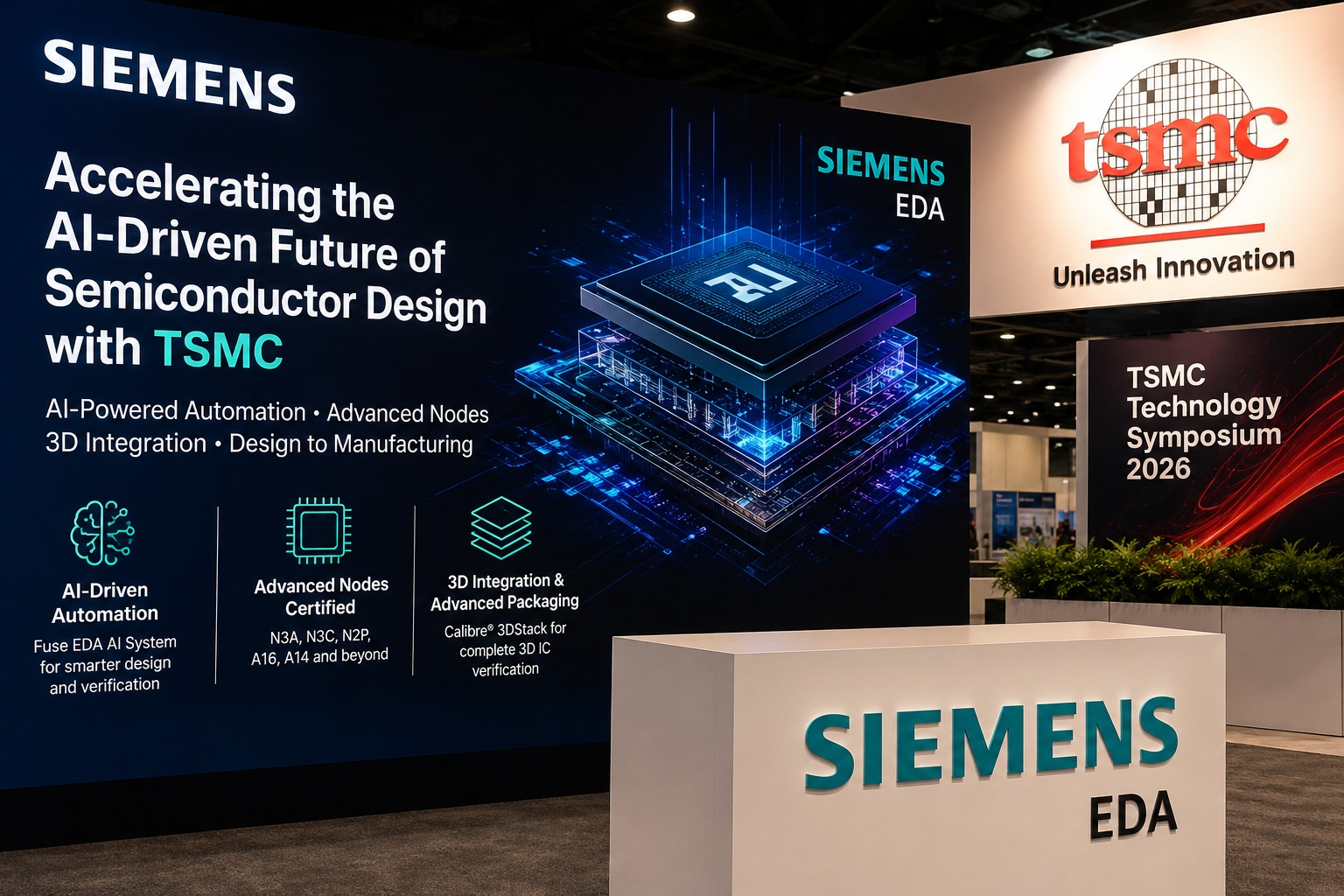
At the recent TSMC Technology Symposium 2026, Siemens EDA reinforced its position as one of the key ecosystem partners supporting TSMC in the race toward AI-driven semiconductor design, advanced packaging, and next-generation process technologies. The annual forum has become one of the semiconductor industry’s most important gatherings, bringing together foundry customers, EDA suppliers, IP vendors, and packaging innovators to align around future technology nodes and design methodologies.
A major theme throughout the event was the growing impact of artificial intelligence on chip development. Siemens EDA used the symposium to highlight expanded collaboration with TSMC focused on AI-powered automation across the semiconductor workflow. The companies announced joint work involving automated Design Rule Check fixing, AI-assisted physical verification, and intelligent design optimization using Siemens’ recently introduced Fuse EDA AI System.
The partnership reflects a broader industry shift. Semiconductor complexity is increasing dramatically as AI accelerators, high-performance computing devices, automotive processors, and chiplet-based architectures push beyond the limits of traditional design methods. Designers are now managing multi-die systems, advanced 3D packaging, massive data throughput requirements, and power delivery challenges simultaneously. As a result, AI-enabled EDA tools are becoming critical to reducing development cycles and improving productivity.
Siemens emphasized that its AI technologies are being integrated directly into production-proven tools such as Calibre and Aprisa. According to the company, TSMC is collaborating with Siemens to improve multi-step automation for DRC-centric physical verification while also helping engineers gain faster access to design insights and guided recommendations during implementation.
One of the most significant aspects of the announcement involved support for TSMC’s latest process technologies. Siemens reported certifications for its EDA tools on multiple advanced nodes including N3A, N3C, N2P, A16, and A14 technologies. These certifications are essential because semiconductor companies require validated design flows before committing billions of dollars to advanced-node tape-outs. By securing early enablement and certification, Siemens ensures that mutual customers can begin development with confidence on TSMC’s newest manufacturing platforms.
Another important focus at the forum was advanced packaging and 3D integration. TSMC continues expanding its 3DFabric and CoWoS packaging ecosystems to support increasingly complex AI systems. Siemens highlighted capabilities within its Calibre 3DStack platform that address interface checking, connectivity verification, inter-chiplet DRC validation, antenna analysis, and current density analysis for 3D systems. These capabilities are particularly important as AI processors move toward heterogeneous integration involving logic, memory, photonics, and specialized accelerators inside a single package.
Industry analysts noted that the symposium showcased an increasingly competitive environment among the three leading EDA vendors: Siemens, Synopsys, and Cadence. While all three announced expanded TSMC collaborations, Siemens differentiated itself through its emphasis on agentic AI orchestration and design-to-manufacturing integration. The company’s strategy appears centered on automating complex workflows that traditionally require extensive engineering intervention.
The timing of these announcements is significant. TSMC’s roadmap now includes multiple sub-2nm technologies, backside power delivery, advanced automotive nodes, and co-packaged optics initiatives. Each of these innovations introduces new design and verification challenges. Semiconductor companies are under intense pressure to reduce design turnaround time while maintaining power, performance, and reliability targets. AI-assisted automation is increasingly viewed as the only viable way to sustain productivity improvements at advanced nodes.
At the symposium, TSMC also reinforced the importance of its Open Innovation Platform (OIP) ecosystem, where Siemens remains a key partner. The OIP model enables close collaboration between foundry technologies and EDA tool providers, ensuring early process enablement and optimized design flows. Siemens’ long-standing participation in this ecosystem has allowed it to remain deeply integrated into TSMC’s technology roadmap.
The broader semiconductor industry context also shaped discussions at the event. According to industry commentary surrounding the symposium, AI demand is driving unprecedented semiconductor growth, especially in high-performance computing infrastructure. Advanced packaging capacity, power delivery innovation, and chiplet architectures are becoming central to competitive differentiation. As these challenges intensify, EDA vendors are evolving from traditional software providers into strategic enablers of AI-era semiconductor development.
For Siemens EDA, the TSMC Technical Forum served as more than a technology showcase. It was a strategic statement about the future direction of chip design. The company is positioning itself at the intersection of AI automation, advanced manufacturing enablement, and heterogeneous system integration. By strengthening collaboration with TSMC, Siemens aims to help semiconductor companies accelerate innovation while managing the escalating complexity of next-generation designs.
Bottom line: As AI continues reshaping the semiconductor industry, partnerships like Siemens and TSMC will likely become even more important. Future chip development will depend not only on transistor scaling, but also on intelligent automation, advanced packaging methodologies, and tightly integrated ecosystem collaboration. The announcements made at the TSMC Technical Forum suggest that Siemens EDA intends to play a central role in enabling that future.
Also Read:
A Different Angle on Co-Simulation for Systems
Siemens U2U 3D IC Design and Verification Panel
Solving the EDA tool fragmentation crisis
Share this post via:



Comments
There are no comments yet.
You must register or log in to view/post comments.