





I was born in the UK (then still a part of Europe), so always eager to see them succeed. But I must admit that past behavior has reinforced the view that the EU’s only active “contribution” to progress is regulation. However this seems to be changing in multiple interesting ways. On a grand scale, the Nordic economic model is taking off, exemplified by Sweden. That country, known for a heavy emphasis on socialism and very high taxes, is now moving to a blend of capitalism and socialism (as reported recently in the Wall Street Journal) – lower taxes, scaling back all-embracing social safety nets, and becoming more pro innovation. Closer to our domain, the EU is getting more aggressive in encouraging innovation in ASIC startups, my guess in part to accelerate growth and in part to reduce dependency on the US. There are signs that the policy makers already recognize they need to be part of that movement if they want to stay relevant.
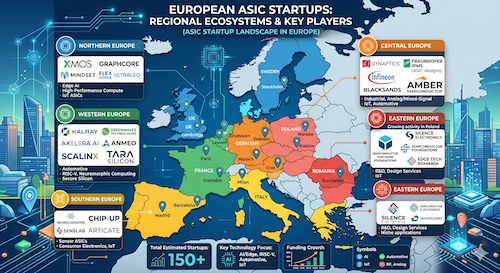
European ASIC activity
The big players are still NXP, Infineon and ST. They too are growing beyond their comfort zones, for example with NXP now offering hardware and software to support agentic systems at the edge for industry and automotive applications. My focus here is on the nascent ASIC startup ecosystem in Europe, very much on the leading edge of innovation.
A quick personal perspective on why this is happening now. Clearly Europe has been losing out in economic growth through tech. This has been a reality for many years however a clear catalyst to move them from the status quo to action is a view that Europe can no longer depend on the US for defense or trade and that therefore they should become much more self-reliant.
For example: companies like Fractile (UK) have a $220M raise to build a new class of inference engines, Axelera has raised $250M, Arago in France aims to accelerate inference in datacenters and Vertical Compute in France has plans to reduce memory load in AI systems.
Quintaris in German, a collaboration between Bosch, Infineon, NXP, Nordic Semi and Qualcomm, is targeting application processors for automotive, later for IoT and datacenters and Semidynamics in Spain already have a strong reputation for developing ultra-customizable Risc-V systems coupled with AI accelerators.
There are several ventures promoting leading edge systems based on photonic or neuromorphic tech and new approaches to natural language processing, including Optalysys in the UK, Inmotive/Innatera in the Netherlands, and Cortical.io in Austria.
The European Chips Act (adopted late 2023) is further stimulating this activity through sovereign guarantees and funds to match VC investment. They are shooting for EU global market share in chips to be 20% by 2030, a suitably aggressive goal.
Of course we could argue that European policy makers will get in their own way and kill this initiative in the cradle. As I mentioned earlier there are promising signs that they will not be given that opportunity. The Nordic economic model and Germany’s plans for defense spending supporting home-grown tech are high profile examples. Defense particularly is a compelling priority likely to override bureaucratic resistance.
Another Initiative: European Chips Design Platform
Policy makers love their organizations, committees and acronyms. The European Chips Act created a legislative framework called the Chips Joint Undertaking (Chips JU) as a vehicle to sponsor public-private partnership to execute the Act’s goals. The Chips JU European Chips Design Platform (EuroCDP) provides access tools and technologies at predefined pricing levels, making it easier for startups, small companies and academic institutions to exploit the same tech used by large ASIC enterprises.
This is not the only such plan for EDA tool access but as the Chip JU scope expands I can see enhanced access further helping accelerate European innovation. Unsurprising then that Siemens as a big player in Europe is supporting this effort by providing access to their EDA tools through this program.
You can read the Siemens press release HERE and learn more about the EuroCDP initiative HERE.
Share this post via:



Comments
2 Replies to “Europe is Getting Serious About ASIC Innovation”
You must register or log in to view/post comments.