You are currently viewing SemiWiki as a guest which gives you limited access to the site. To view blog comments and experience other SemiWiki features you must be a registered member. Registration is fast, simple, and absolutely free so please,
join our community today!
            WP_Term Object
(
    [term_id] => 18
    [name] => Intel Foundry
    [slug] => intel
    [term_group] => 0
    [term_taxonomy_id] => 18
    [taxonomy] => category
    [description] =>
    [parent] => 158
    [count] => 484
    [filter] => raw
    [cat_ID] => 18
    [category_count] => 484
    [category_description] =>
    [cat_name] => Intel Foundry
    [category_nicename] => intel
    [category_parent] => 158
    [is_post] =>
)

WP_Term Object
(
    [term_id] => 18
    [name] => Intel Foundry
    [slug] => intel
    [term_group] => 0
    [term_taxonomy_id] => 18
    [taxonomy] => category
    [description] =>
    [parent] => 158
    [count] => 484
    [filter] => raw
    [cat_ID] => 18
    [category_count] => 484
    [category_description] =>
    [cat_name] => Intel Foundry
    [category_nicename] => intel
    [category_parent] => 158
    [is_post] =>
)
Intel Foundry and ASML say high-numerical-aperture extreme-ultraviolet lithography has crossed an important boundary: it is no longer only a development tool, but a production technology. At the SPIE Photomask Technology and Extreme Ultraviolet Lithography conference, the companies reported that Intel has processed … Read More
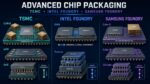
Advanced semiconductor packaging has become essential to improving computing performance as conventional transistor scaling grows more difficult and expensive. Instead of manufacturing an entire processor as one large monolithic die, chipmakers can divide it into smaller chiplets and combine logic, memory, input/output… Read More
Intel Foundry has a blog on LinkedIn that is worth a look. The blogs are by trusted Intel Foundry technical experts and are filled with content. I will cherry pick write a bit about them but be sure and subscribe to this, absolutely.
Intel 18A-P is not a new process node in the conventional sense. It is a performance-enhanced derivative… Read More
Intel’s next-generation 14A manufacturing process is showing unusually strong early progress, with defect density falling faster than the company expected. The improvement gives Intel a technical boost as it attempts to restore confidence in its manufacturing operation, win foundry customers and demonstrate that years… Read More
Intel’s Crescent Island is a discrete data-center GPU designed for agentic AI inference, where performance is constrained by more than matrix arithmetic. Multi-step agents impose latency through repeated model calls and tool interactions, consume large memory capacity for weights and long-context key-value caches, and… Read More
Akhilesh Kumar & Krishnakanth Sistla, Intel
Diamond Rapids is Intel’s next-generation Xeon processor, designed around the proposition that hyperscale performance increasingly depends on moving, processing, and protecting data as efficiently as executing instructions. The architecture replaces the conventional… Read More
Lance Hacking, Intel
Intel Core Series 3, code-named Wildcat Lake, is a mainstream client system-on-chip derived from the Panther Lake-based Core Ultra Series 3 architecture. Its design objective is not maximum feature density, but broad deployment of current-generation CPU, graphics, AI, memory, security, and connectivity… Read More
Intel is considering a return to memory technology decades after abandoning mainstream DRAM and, more recently, selling its NAND business. Chief executive Lip-Bu Tan has argued that memory should no longer be viewed simply as a low-margin commodity. Artificial intelligence is turning bandwidth, latency and data movement … Read More
By Nikhil Shah
Capital spending is often treated as if it becomes semiconductor capacity about twelve months later. That can be a useful rule for equipment installed in an existing fab. It is a poor description of a new fab built from the ground up.
I tested the distinction using five advanced-node projects in the United States where… Read More
Intel EMIB and Intel Foveros are advanced semiconductor-packaging technologies designed to combine multiple silicon dies, or chiplets, within one processor package. Both support heterogeneous integration: manufacturers can build different functions using the process technology best suited to each one, then connect … Read More