You are currently viewing SemiWiki as a guest which gives you limited access to the site. To view blog comments and experience other SemiWiki features you must be a registered member. Registration is fast, simple, and absolutely free so please,
join our community today!
            WP_Term Object
(
    [term_id] => 18
    [name] => Intel Foundry
    [slug] => intel
    [term_group] => 0
    [term_taxonomy_id] => 18
    [taxonomy] => category
    [description] =>
    [parent] => 158
    [count] => 495
    [filter] => raw
    [cat_ID] => 18
    [category_count] => 495
    [category_description] =>
    [cat_name] => Intel Foundry
    [category_nicename] => intel
    [category_parent] => 158
    [is_post] =>
)

WP_Term Object
(
    [term_id] => 18
    [name] => Intel Foundry
    [slug] => intel
    [term_group] => 0
    [term_taxonomy_id] => 18
    [taxonomy] => category
    [description] =>
    [parent] => 158
    [count] => 495
    [filter] => raw
    [cat_ID] => 18
    [category_count] => 495
    [category_description] =>
    [cat_name] => Intel Foundry
    [category_nicename] => intel
    [category_parent] => 158
    [is_post] =>
)
Akhilesh Kumar & Krishnakanth Sistla, Intel
Diamond Rapids is Intel’s next-generation Xeon processor, designed around the proposition that hyperscale performance increasingly depends on moving, processing, and protecting data as efficiently as executing instructions. The architecture replaces the conventional… Read More
Lance Hacking, Intel
Intel Core Series 3, code-named Wildcat Lake, is a mainstream client system-on-chip derived from the Panther Lake-based Core Ultra Series 3 architecture. Its design objective is not maximum feature density, but broad deployment of current-generation CPU, graphics, AI, memory, security, and connectivity… Read More
Intel is considering a return to memory technology decades after abandoning mainstream DRAM and, more recently, selling its NAND business. Chief executive Lip-Bu Tan has argued that memory should no longer be viewed simply as a low-margin commodity. Artificial intelligence is turning bandwidth, latency and data movement … Read More
By Nikhil Shah
Capital spending is often treated as if it becomes semiconductor capacity about twelve months later. That can be a useful rule for equipment installed in an existing fab. It is a poor description of a new fab built from the ground up.
I tested the distinction using five advanced-node projects in the United States where… Read More
Intel EMIB and Intel Foveros are advanced semiconductor-packaging technologies designed to combine multiple silicon dies, or chiplets, within one processor package. Both support heterogeneous integration: manufacturers can build different functions using the process technology best suited to each one, then connect … Read More
The Design Automation Conference in Long Beach was a pleasant surprise. It drew strong attendance from leading companies across the semiconductor ecosystem, along with an impressive number of newcomers. AI-focused EDA companies came out in force—and delivered.
Intel Foundry also made its presence felt, reminding everyone… Read More
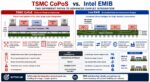
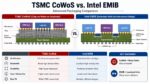
TSMC’s CoPoS, generally described as Chip-on-Panel-on-Substrate, and Intel’s EMIB, or Embedded Multi-die Interconnect Bridge, address the same strategic problem: integrating increasingly large, heterogeneous chiplet systems. However, they attack different physical constraints. CoPoS is an emerging panel-level … Read More
There has been talk at the latest conferences about TSMC customers taking wafers to Intel for packaging. The question is why? Is it competitive pricing? Capacity? Supply chain diversity? CC Wei was asked about this during the last investor call and his perfect response was:
Jeff Su: I guess very simply put, EMIB-T, in his view, is… Read More
Synopsys Foundation IP for Intel 18A is a portfolio of semiconductor building blocks designed to help system-on-chip developers build advanced chips with better power, performance, and area, often called PPA. The offering includes embedded memory compilers, standard-cell logic libraries, and input/output libraries for… Read More
Intel’s 18A process technology has become one of the most scrutinized semiconductor manufacturing nodes in the industry. It represents Intel’s introduction of two major innovations: RibbonFET gate-all-around (GAA) transistors and PowerVia backside power delivery (BSPD). These technologies are intended to improve transistor… Read More