





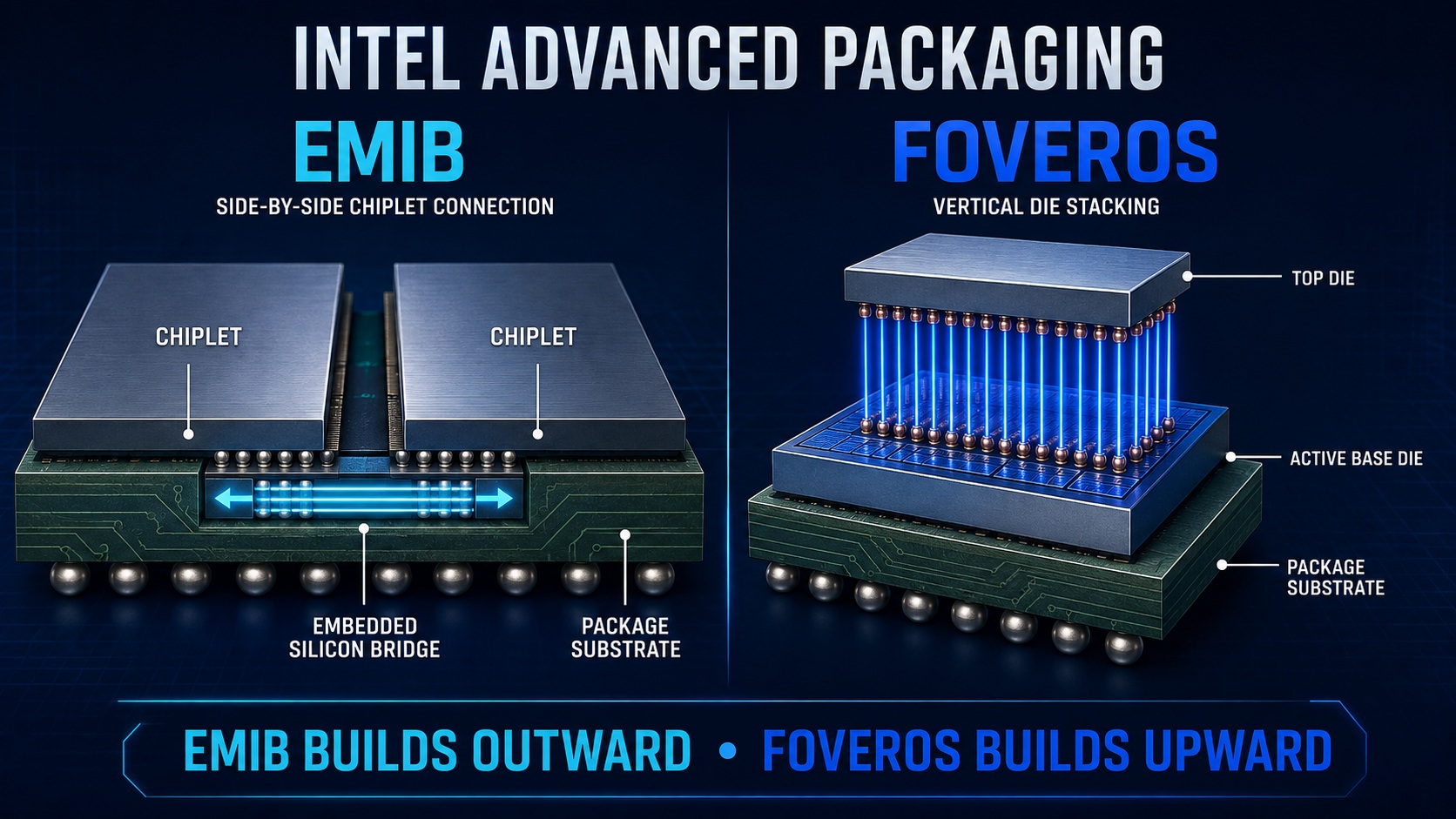
Intel EMIB and Intel Foveros are advanced semiconductor-packaging technologies designed to combine multiple silicon dies, or chiplets, within one processor package. Both support heterogeneous integration: manufacturers can build different functions using the process technology best suited to each one, then connect them as a unified system. Their principal difference is geometric. EMIB primarily connects dies positioned side by side, while Foveros enables dies to be stacked vertically.
EMIB stands for Embedded Multi-die Interconnect Bridge. Instead of placing chiplets on a large silicon interposer, Intel embeds small silicon bridges directly into the package substrate. The edges of neighboring dies sit above these bridges and communicate through dense microscopic connections. Because silicon bridges appear only where high-bandwidth links are required, EMIB can avoid the cost and manufacturing complexity of a full-size interposer while still providing much denser communication than an ordinary circuit-board connection.
This side-by-side arrangement makes EMIB particularly useful for connecting large logic dies, accelerator tiles, input/output chiplets and high-bandwidth memory. Each component has direct access to the package surface, which helps with power delivery and cooling. The architecture can also accommodate dies of different dimensions and process nodes. Its main spatial disadvantage is that adding chiplets expands the package horizontally, potentially increasing its overall area and the distance between some components.
Foveros approaches integration vertically. In a typical Foveros design, one or more compute dies are mounted above a base die. Fine-pitch connections carry data and power between the layers, allowing the stacked dies to function as a tightly integrated system. The base die can be active silicon containing communication, input/output or power-management circuitry rather than merely a passive mounting surface. This creates something closer to a three-dimensional system on a package.
Vertical stacking provides several benefits. It shortens connections between functional blocks, increases interconnect density and places more computing capability within a smaller footprint. Designers can separate processor functions that would previously have occupied one monolithic die. For example, high-performance CPU or graphics tiles can be fabricated on an advanced process, while less performance-sensitive input/output functions use a more economical process. Smaller dies may also produce better manufacturing yields than one enormous piece of silicon.
Foveros introduces challenges that are less severe in a side-by-side EMIB design. Heat generated by a lower die must pass through the material above it, while an upper die may obstruct cooling of the base layer. Supplying power through a stack and testing the individual components also require careful engineering. Manufacturing tolerances become demanding as connection pitches shrink. Foveros Direct addresses interconnect performance by using copper-to-copper hybrid bonding, producing dense, low-resistance links without relying on conventional solder bumps.
The two technologies therefore suit different design requirements. EMIB is attractive when several substantial dies or memory stacks need high-bandwidth lateral connections, straightforward cooling and a cost-effective alternative to a large interposer. Foveros is attractive when package area is constrained or when extremely dense links are needed between logically related layers. EMIB tends to build outward; Foveros builds upward. Neither method is universally superior because bandwidth, power, cooling, yield, package size and manufacturing cost must be balanced for each product.
Most importantly, EMIB and Foveros are complementary rather than mutually exclusive. Intel can combine them in what it describes as 3.5D packaging. Foveros may create individual vertical stacks, while EMIB bridges connect those stacks to other compute tiles or high-bandwidth memory positioned beside them. This permits designers to construct complex processors from specialized building blocks instead of forcing every function onto a single die.
Bottom line: EMIB connects neighboring chiplets through localized silicon bridges embedded in the package, whereas Foveros stacks dies and connects them vertically. EMIB emphasizes flexible lateral integration, accessible cooling and efficient connections between large components. Foveros emphasizes compactness, short communication paths and three-dimensional integration. Together, they demonstrate how advanced packaging is becoming as important as transistor scaling: future performance gains increasingly depend not only on making transistors smaller, but also on arranging specialized silicon components and moving data efficiently among them.
Also Read:
Intel Foundry and the DAC2026 Ecosystem
TSMC CoPoS Versus Intel EMIB Semiconductor Packaging
TSMC CoWoS versus Intel EMIB Semiconductor Packaging
Share this post via:



Comments
There are no comments yet.
You must register or log in to view/post comments.