You are currently viewing SemiWiki as a guest which gives you limited access to the site. To view blog comments and experience other SemiWiki features you must be a registered member. Registration is fast, simple, and absolutely free so please,
join our community today!
Daniel is joined by Nir Sever, an industry veteran with over 30 years of technological and managerial experience in advanced VLSI engineering. Before joining proteanTecs, Nir served for 10 years as the COO of Tehuti Networks, a pioneer in the area of high-speed networking Semiconductors. Prior to that, he served for 9 years as … Read More
Artificial intelligence is becoming part of the infrastructure that powers healthcare, transportation, finance, manufacturing, and everyday digital services. As these systems grow more capable, they also process more sensitive information and depend on increasingly complex hardware. The Synopsys white paper, “Securing… Read More
Intel Foundry published a two article series on chip power delivery that are worth reading. Here is a quick summary:
Artificial intelligence is changing the requirements for semiconductor innovation. Faster transistors and denser packaging remain essential, but their benefits increasingly depend on another engineering… Read More
For decades, chipmakers improved computing performance largely by putting more capable circuitry on a piece of silicon. That remains important, but AI is exposing its limits. Large models demand enormous amounts of data movement, sustained power and effective cooling. A fast processor cannot deliver its full benefit if memory… Read More
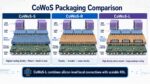
Chip-on-Wafer-on-Substrate, commonly called CoWoS, is an advanced packaging platform developed by TSMC. It allows processors, chiplets, and high-bandwidth memory stacks to be integrated within a single package. CoWoS has become especially important for artificial-intelligence accelerators and high-performance computing… Read More
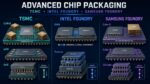
Advanced semiconductor packaging has become essential to improving computing performance as conventional transistor scaling grows more difficult and expensive. Instead of manufacturing an entire processor as one large monolithic die, chipmakers can divide it into smaller chiplets and combine logic, memory, input/output… Read More
SEMICON West 2026 arrives at a pivotal moment for the global chip industry. Scheduled for October 13–15 at San Francisco’s Moscone Center, the event returns to the Bay Area after its 2025 edition in Phoenix. Organized by SEMI under the theme “Transform Tomorrow,” it will bring together semiconductor manufacturers, equipment… Read More
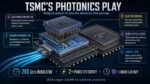
TSMC’s photonics strategy is centered on integrating optical input-output with advanced logic, rather than selling conventional optical transceivers as standalone products. The company is developing a silicon-photonics foundry platform and a packaging architecture called TSMC-COUPE, or Compact Universal Photonic … Read More
Intel is considering a return to memory technology decades after abandoning mainstream DRAM and, more recently, selling its NAND business. Chief executive Lip-Bu Tan has argued that memory should no longer be viewed simply as a low-margin commodity. Artificial intelligence is turning bandwidth, latency and data movement … Read More
Hot Chips 2026, formally the thirty-eighth Symposium on High Performance Chips, arrives at Stanford’s Memorial Auditorium from August 23 through 25 with a program that captures a decisive shift in computer architecture. Peak arithmetic throughput remains important, but the conference is increasingly about system balance:… Read More