







By Nikhil Shah
Capital spending is often treated as if it becomes semiconductor capacity about twelve months later. That can be a useful rule for equipment installed in an existing fab. It is a poor description of a new fab built from the ground up.
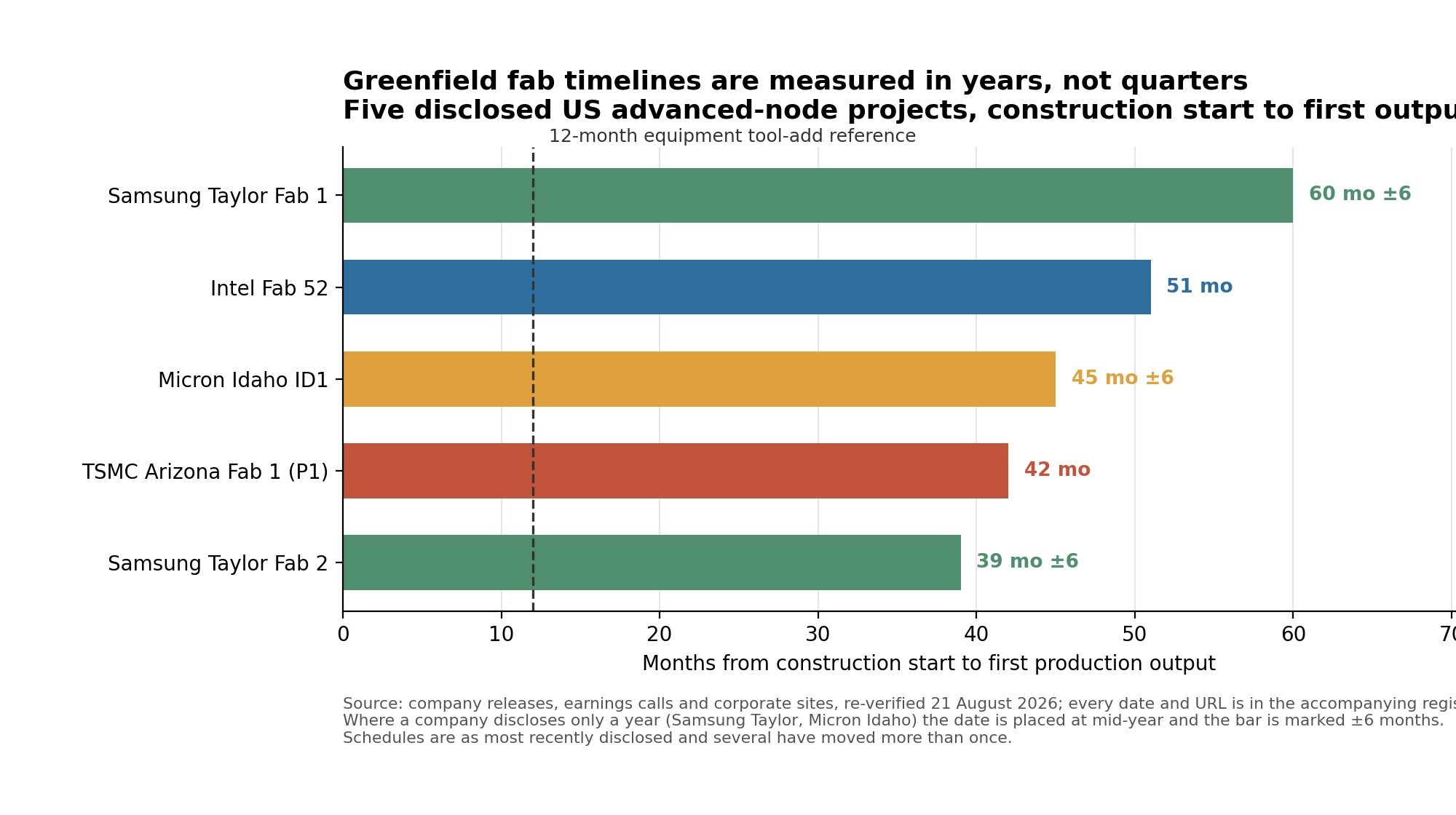
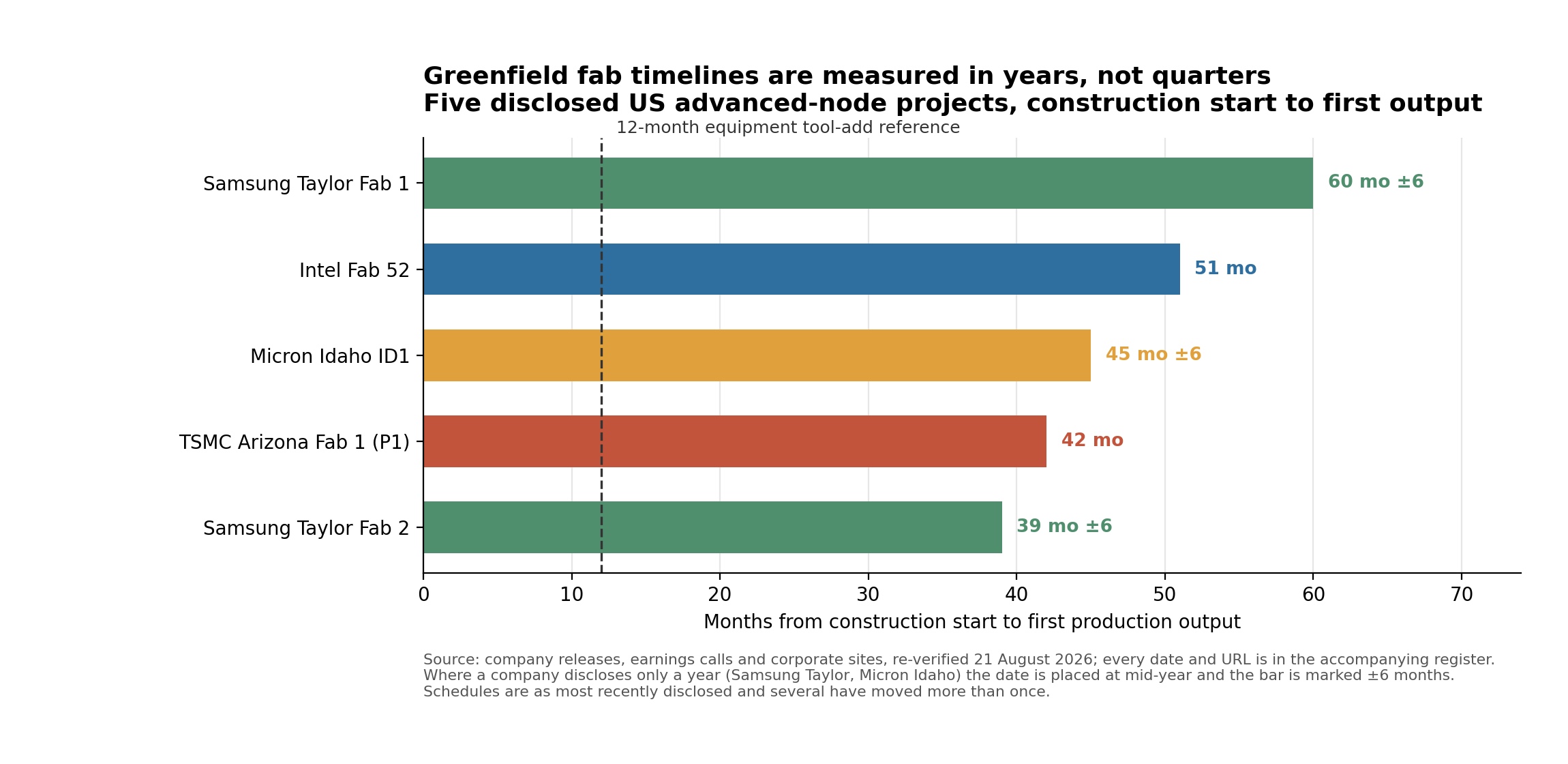
I tested the distinction using five advanced-node projects in the United States where I could source both a construction start and a first-production date. The set covers TSMC, Intel, Samsung and Micron. Measured from the start of construction to first production, the disclosed schedules have a median lag of 45 months and a range of 39 to 60 months.
That is not a new industry rule. Five projects are too few, several dates are only precise to a year, and three of the production dates were still targets as of August 2026. It does show why a twelve-month capex lag and a four-year fab schedule can both be true.
Two different clocks
The shorter clock starts after the shell, cleanroom, utilities and much of the workforce are already in place. In that setting, the marginal dollar buys tools and the relevant delay is procurement, installation and qualification.
The longer clock starts when a company begins a greenfield site. Construction, utility connections, cleanroom systems, equipment installation, process qualification and hiring all sit between the announcement and commercial output. A tool lead time captures only part of that sequence.
TSMC’s Arizona site makes the distinction visible. Its first fab began construction in June 2021 and started high-volume N4 production in the fourth quarter of 2024. TSMC says the structure of its second Arizona fab was completed in 2025, while N3 volume production is targeted for the second half of 2027. Finishing the building is not the same as finishing the capacity.
Intel’s Fab 52 tells a similar story. Intel broke ground on its two-fab Arizona expansion in September 2021. Fab 52 was fully operational in October 2025 and was preparing to reach high-volume Intel 18A production by year-end. The elapsed time was about four years.
Samsung and Micron provide the forward-looking observations. Samsung dates the groundbreaking for its first Taylor fab to 2022. On its first-quarter 2026 earnings call, Samsung said the fab would start operations in 2026 and commence mass production in 2027. I use the 2027 production milestone so the comparison stays consistent. Its second Taylor fab is expected to begin construction by the end of 2026 and target mass production in 2030. Micron formally announced the start of construction on its Boise memory fab in October 2023 and schedules initial DRAM output for 2027.
Why the dates need caution
These milestones are not standardized. A groundbreaking ceremony, the start of continuous construction, structure completion, equipment move-in and volume production are different events, but companies do not always report each one.
Micron is the clearest example. It held a Boise groundbreaking in 2022, then issued an October 2023 release titled “Micron Initiates Construction on Leading-Edge Memory Manufacturing Fab.” I used the later date because it is the company’s explicit construction milestone. Using the ceremony instead would lengthen the same project’s lag by about a year.
Samsung reports some milestones only by year. I placed those dates at the middle or stated boundary of the year and marked the resulting interval with a six-month tolerance. That is better than inventing a quarter, but it is still an estimate.
The sample also mixes two completed projects with three company schedules. Future delays would lengthen the latter observations. For that reason, 45 months should be read as a description of this small disclosed sample, not a forecast with false precision.
The capex-to-capacity ratio is harder to calculate
The same exercise exposed a second problem. To compare capital intensity, a project needs one budget and one planned wafer-start figure on the same basis. Only one row in the register meets that standard cleanly.
TSMC’s May 2020 Arizona announcement paired approximately $12 billion of spending with 20,000 wafers per month. That equals $600,000 of announced investment per monthly wafer start. The arithmetic is simple because both numbers describe the same fab in the same announcement.
More recent disclosures usually do not. Intel’s original $20 billion Arizona figure covered Fab 52 and Fab 62 together without a published wafer-start target for either. Micron’s roughly $15 billion Boise figure spans spending through the end of the decade. TSMC’s Arizona commitment now covers six logic fabs, two advanced-packaging facilities and an R&D center. None of those figures can be divided by a single fab’s capacity without adding assumptions that the companies did not disclose.
That limitation matters. A site-level investment number is useful for measuring the scale of a program. It is not automatically a measure of incremental wafer capacity.
What forecasters can take from the register
The practical lesson is modest. A capex announcement needs two labels before it can be used as a supply signal: whether the spending is greenfield or brownfield, and whether the disclosed dollars can be tied to a specific capacity figure.
For existing fabs, a roughly twelve-month equipment lag may still be a useful working assumption. For the five greenfield projects in this register, the company timelines are closer to four years from construction start to first output. Combining the two in one aggregate lag hides the difference.
The register is small, US-only and dependent on company disclosures. Its value is not a universal 45-month rule. Its value is showing which clock a forecast is actually using.
Nikhil Shah is a finance student at UT Austin’s McCombs School of Business. The underlying project register records the source, date precision and calculation for every observation.
Also Read:
How TSMC Is Wiring the AI Era With Light
The Fab Is Not the Finish Line
Share this post via:



SEMICON West’s Autonomous Fab Vision Needs a Decision-Escalation Design