




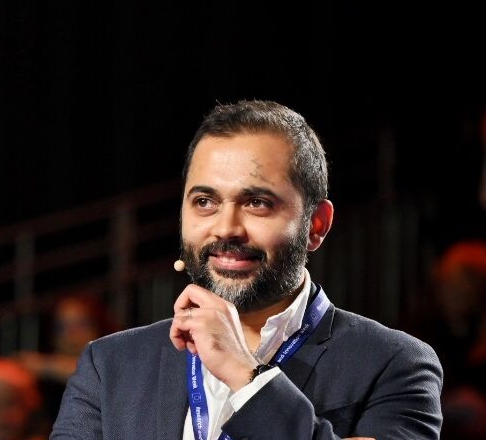




Dr. Sumeet Kumar is CEO of Innatera, the pioneering Dutch neuromorphic processor company. Dr. Kumar was previously with Intel and Indrion Technologies, and has spent his career in microprocessor development. He co-founded Innatera in 2018 as a spin off from the Delft University of Technology.
Tell us about your company?
When we founded Innatera in 2018, sensors were becoming far more capable. Products were beginning to incorporate microphones, radar, IMUs, image sensors, and other rich sources of physical data, but the compute sitting alongside those sensors hadn’t evolved at the same pace. Most architectures were optimized for general-purpose processing and only later adapted for AI. We felt there was an opportunity to rethink that model by bringing brain-like intelligence directly to the sensor.
That thinking aligned with more than a decade of research our founding team had been conducting at Delft University of Technology in neuromorphic computing. We believed the next generation of intelligent devices would require a different kind of processing architecture – one purpose-built to continuously interpret the physical world while operating within the power, latency, and size constraints of embedded systems.
Today, that work is embodied in Pulsar, the world’s first commercially available neuromorphic microcontroller. It combines analog and digital spiking neural network processing alongside CNN acceleration, an FFT engine, and a RISC-V CPU in a single heterogeneous architecture. Together with Talamo, our software development kit, it gives developers a tangible way to build neuromorphic applications through familiar machine learning workflows.
Physical AI has become one of the defining themes in technology, but its success hinges on devices being able to perceive, interpret, and respond to the physical world locally and efficiently. That’s what we’ve been focused on from the beginning, and it’s where we believe neuromorphic computing has an important role to play.
What problems are you solving?
The edge AI market has a power problem and a latency problem, and they’re closely related.
Start with power. Battery-constrained devices – from wearables and industrial sensors to consumer electronics and hearing devices – now incorporate rich always-on functionalities. For example, your smartwatch measures your heart rate and activity throughout the day. Conventional processors weren’t designed for those always-on workloads, and consume far more energy in delivering the levels of performance required for such processing. Within the tight energy budgets of devices like your smart watch, developers often have to compromise by simplifying models, duty-cycling hardware, or worse, sending data off-device to be processed without energy limitations. Each approach comes with tradeoffs in capability, responsiveness, or privacy.
Latency is the other side of the equation. Applications like fall detection, speech recognition, and industrial monitoring need to respond in real time, while users expect sensitive data to remain on the device rather than being sent to the cloud.
We believe the root cause to be architectural. Conventional processors perform computation continuously regardless of whether meaningful events are occurring or not. Neuromorphic computing takes a different approach by processing information only when relevant events occur. That dramatically reduces unnecessary computation while enabling much faster response times. With Pulsar, that translates to up to 500× lower energy consumption and up to 100× faster execution than conventional AI processors for the workloads it was designed to address.
What application areas are your strongest?
We tend to answer that question by sensing challenge rather than market category, because that’s where our architecture creates the most leverage. Wherever products need to continuously interpret sensor data within tight power, latency, and size constraints, neuromorphic computing delivers the greatest value. That’s why we’re seeing momentum across consumer electronics, smart home devices, wearables, robotics, industrial monitoring, and intelligent sensing systems.
Audio is a great example. Through our collaboration with Joya Design, Pulsar powers the EdgeCore AI module for contextual audio intelligence, giving OEMs a straightforward way to add always-on audio understanding to products like baby monitors. Because the AI runs locally, it delivers fast response times, preserves privacy, and minimizes power consumption.
The same principle extends even further. With 42 Technology, we’re applying neuromorphic processing to vibration analysis and condition monitoring, enabling equipment to detect subtle changes that can indicate wear before failures occur. Through our collaboration with CYRAN AI, we’re also exploring wearable and embedded AI applications that combine EMG, audio, and other sensing modalities within extremely tight power budgets.
The underlying sensing challenge is often more important than the end market. Whether the input is radar, IMU, vibration, or a combination of sensors, the need is the same: continuously extract meaningful information from the physical world while consuming a tiny amount of power. That’s exactly what our architecture was designed to do.
What does the competitive landscape look like and how do you differentiate?
The conversation around edge AI has become much more nuanced over the last few years. Early on, success was measured by benchmark performance in TOPS. But this rigid figure of merit assumes that models need to be massive and emphasizes the magnitude of compute. The novel capabilities of neuromorphic compute enable more powerful application functionalities. We observe that a majority of developers are now asking broader, system-level questions: How do I hit this application spec within a 3mW power budget with the lowest BOM complexity? This reflects a mature market, and AI/ML is an intrinsic part of the solution architecture.
The AI accelerator is only one part of a bigger picture, and often, their advantage vanishes when their performance and efficiency are viewed at system level. This is why our approach was centered on delivering the complete microcontroller platform, not just the accelerator. Pulsar brings together multiple efficient compute engines within a single architecture, providing developers with a powerful heterogeneous computing solution that delivers performant compute at the industry’s lowest power levels. This enables developers to construct powerful application pipelines that leverage the unique advantages of each computing fabric within Pulsar.
We’ve taken the same philosophy with software. Talamo integrates directly with PyTorch because we wanted neuromorphic computing to fit naturally into existing machine learning workflows. We think the long-term success of this technology depends not only on advances in silicon, but on making it straightforward for developers to evaluate, build, and deploy real products.
What new features/technology are you working on?
Our roadmap is largely shaped by what customers are building – and what they’re building is becoming more sophisticated. Intelligence in products goes beyond simply finding patterns. Future products will incorporate features that rely on accurate interpretation of the world around them, with impeccable accuracy and long battery life. Adaptivity and personalization will play an important role. As will autonomy, especially looking at the growing maturity of the robotics market. This is an exciting time for the industry, and neuromorphic computing in particular, and Pulsar is only the tip of the proverbial iceberg. We have a lot more in store.
Software is just as important as silicon. Developers need tools to train, validate, and deploy neuromorphic models efficiently, and the quality of that toolchain directly affects how quickly products get to market. We’re continuing to invest in Talamo, our SDK, and we recently introduced Synfire – an open platform for sharing and validating neuromorphic models and processing pipelines to make that ecosystem more accessible and collaborative.
Importantly, our focus right now is on our customers. As more customers move into production with our chips, we’re learning where frictions occur in developer workflows, how teams tune applications, and other novel constraints that emerge when we’re used in fundamentally new contexts. We’ve come a long way, and it is fantastic to see the outcomes that customers are able to achieve using our technology.
How do customers normally engage with your company?
We’re fortunate to have top-tier customers across the US, Europe and Asia as our customers, spanning the consumer electronics, industrial, IoT, and automotive segments of the market. We receive tremendous interest in our reference designs – our solution for energy-efficient presence sensing with mmWave Radars for instance enables robust detection of human targets in security monitoring and smart lighting use-cases. Vendors can implement advanced presence detection features in video doorbells, security cameras, and automatic lighting systems by integrating our design, with a shorter time to market. We also work with top-tier customers that come with specific application asks, and we work closely with these customers in developing solutions.
Increasingly, our network of solutions partners play a role too. Partners such as 42Technology and CyranAI develop applications solutions for customers based on Innatera’s products, in addition to having a portfolio of application solutions of their own.
The increasing maturity of the neuromorphic ecosystem is also evident in our growing customer base, with a greater number of customers carrying out leading-edge neuromorphic application developments internally using our software and hardware. We’re happy to support customers in the process of developments, helping them figure out how to best use the capabilities of our silicon and our tools. This is perhaps also a sign that the ecosystem support for neuromorphic is paying off – integration with standard frameworks like PyTorch – enabling more users to leverage the advantages of neuromorphic compute, within the time-to-market constraints of today’s world.
Also Read:
CEO Interview with Leon Lauritsen of Aras
CEO Interview with Jerry Chen of Upbeat Technology
CEO Interview with Brendan Emery of iQ Sense
CEO Interview with David Reeder from Entegris
Share this post via:



SEMICON West’s Autonomous Fab Vision Needs a Decision-Escalation Design