


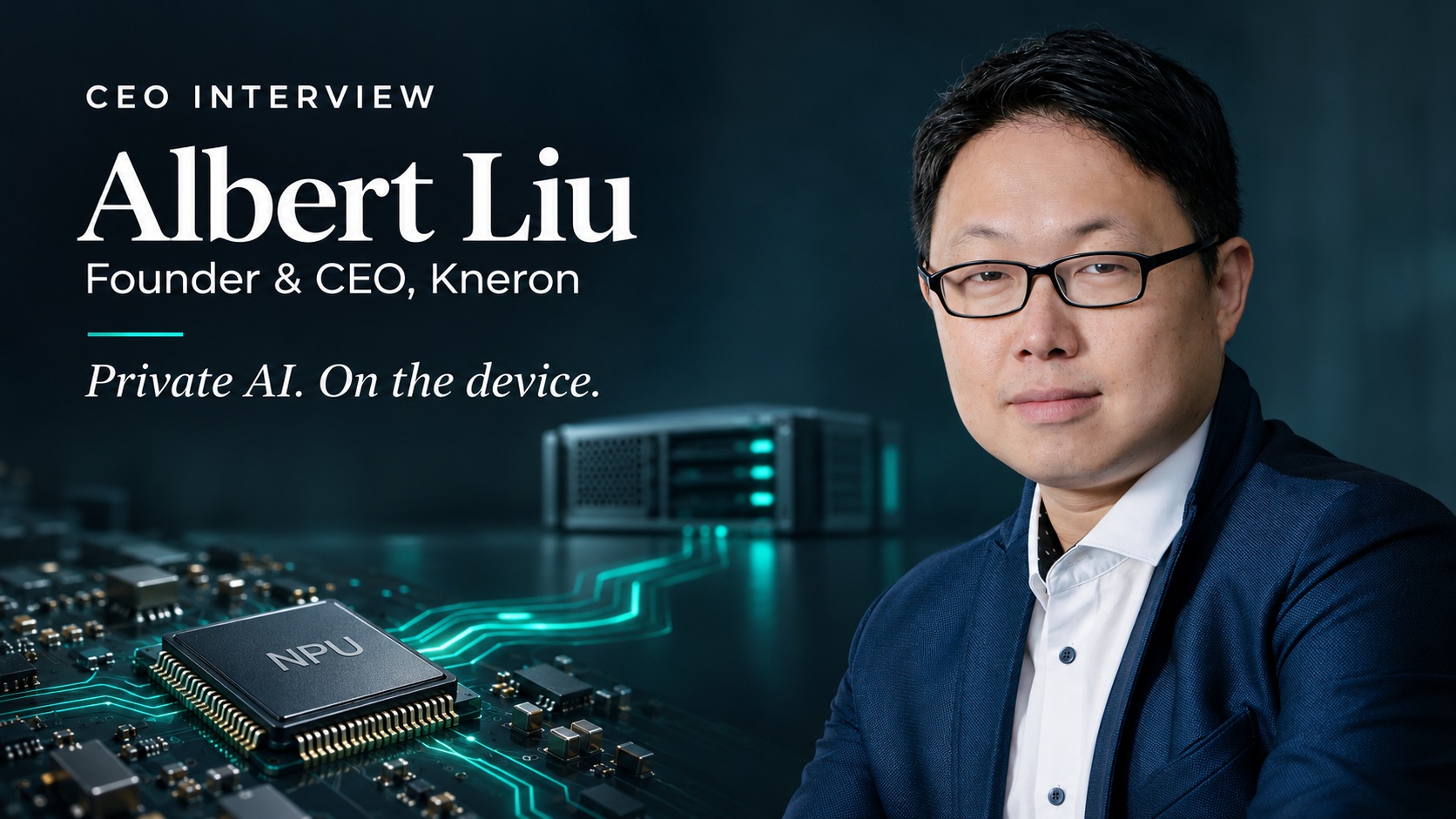



Albert Liu founded Kneron in 2015 with a mission to bring on-device Edge AI and machine learning to mass-market devices and usher in the age of AI everywhere. His vision for Kneron is to realize the Edge AI Net, democratizing AI by moving inferencing away from the centralized cloud “brain” and onto devices everywhere.
Liu previously held R&D and management positions at Qualcomm, where he led a team that developed nine patents and won the Qualcomm ImpaQt Research & Development award. He has also worked in the Samsung Electronics R&D center and for MStar and Wireless Information as a researcher.
An experienced Chairman of the Board and CEO, Liu has a long track record in the computer software industry. His skills span hardware architecture, management, sales, strategic planning and application-specific integrated circuits (ASIC).
Tell us about your company?
Kneron is the leading manufacturer of the private AI stack, from NPU chips to secure operating software and inference tools that run AI on the device or on premises. The company was founded in San Diego in 2015 by myself and my friend and co-founder, Dr. M.C. Frank Chang, a UCLA distinguished professor and member of the National Academy of Engineering.
Kneron licensed its first NPU IP for endpoint devices in 2016 and brought its first NPU into mass production in 2017. The KL520 followed in 2019, and the KL720, adopted by Hanwha for surveillance cameras, in 2020. In 2021 the KL530 brought transformer support to an edge NPU. The KL830 brought generative AI to edge devices in 2024, and the KL1140 brought large language models to the device in 2025. Today the company has more than 200 employees and over $200M in funding.
What problems are you solving?
NPUs provide a level of efficiency and privacy that isn’t possible with other chips that rely on the cloud. Kneron’s Kneo Rack uses 60% less power than an H100 GPU server at equivalent throughput, and its KL1140 delivers LLM inference at up to one-tenth the hardware cost of cloud solutions. Inference is where AI’s operating costs compound, and Kneron’s customers pay for less power, less cooling and no per-query cloud fees. Kneron’s systems also process data locally, with encrypted models, secure boot, and secure over-the-air updates, for companies that can’t afford the risks associated with the cloud.
What application areas are your strongest?
Kneron’s products excel wherever AI needs to run quickly, privately and without connection to the cloud. This includes security cameras, smart appliances and private enterprise AI servers for financial firms, educational institutions and manufacturers where they cannot send data to a third-party cloud provider.
Our NPUs aren’t just used by enterprises, but also in everyday consumer electronics such as smart home devices, surveillance cameras, appliances and wearables to name a few.
What keeps your customers up at night?
Our customers always want to be on the cutting edge of technology, and that’s why we’ve constantly been innovating over the last decade, long before demand spiked in the last few years. We knew from an early stage that efficiency and privacy would become more and more important as AI integrated itself into workflows across industries, and we’re motivated to continue being the first movers ahead of the market.
What does the competitive landscape look like and how do you differentiate?
We really don’t compete with GPU providers. We’re focused on producing the best possible NPUs, designed for AI workloads rather than adapted from graphics hardware which means lower power consumption, lower costs and full privacy with no dependence on the cloud. We were also early to developing transformer support at the edge, launching our first transformer-capable chip in 2021.
What new features/technology are you working on?
This year has been busy, all building on the K1140 chip we launched at the end of last year, enabling practical, high-performance models at the edge. At CES, we announced the KneoEdge, a full-stack AI lineup that runs the Kneo 330 box to the Kneo 350 server and the air-cooled Kneo Rack cluster. They’re all built to keep data on-site and cut the power and cooling required for GPU setups.
We also recently announced our partnership with Sinar Mas, one of Indonesia’s largest and most diversified business groups with a 90-year history and operations across financial services, telecommunications and technology, energy and infrastructure, agribusiness and food, healthcare and education.
We believe there’s a broader shift toward accessible, energy-efficient, and commercially scalable AI infrastructure beyond centralized GPU computing, and we’re on the forefront of it.
How do customers normally engage with your company?
Enterprises and institutions usually come in through our KNEO private GPT servers, often via channel partners. Developers get started with our KNEO Pi platform and boards, which has more than 28,000 developers worldwide. We also work with manufacturing and strategic partners like Foxconn and Taiwan Spark Technology to build and scale deployments.


The $725 Million Chip Development: Why Execution Risk, Not IP Cost, Now Dictates Advanced-Node Survival