



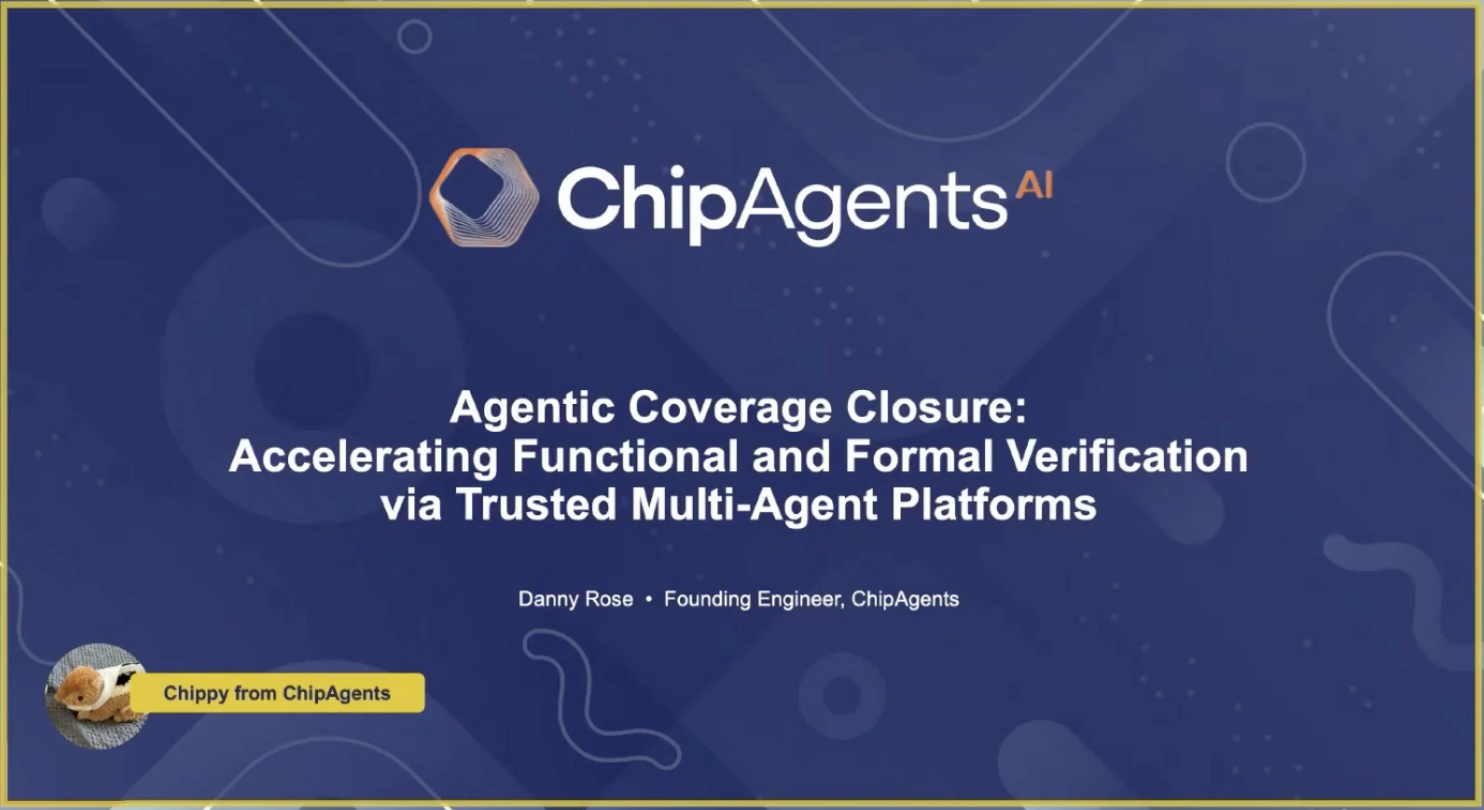
We all know that functional verification consumes most of the front-end design effort. Most teams face hours of planning, days of simulation and debugging, and weeks of iteration. It becomes clear that as designs grow more complex, AI systems are required. Systems that can accelerate the verification cycle while improving quality of results.
An important webinar is coming up on Tuesday, December 8 that addresses these challenges with substantial detail and clear explanations. This content is based on ChipAgents’ 2026 Best Paper Award from DVCon Japan. You will see real-world lessons from deploying multi-agent workflows across simulation-based and formal verification on diverse customer environments. A link to register for this event is coming. But first, let’s look at some details of the ChipAgents Webinar to see how a multi-agent platform accelerates functional and formal verification.
The Webinar Presenter

The webinar is presented by Danny Rose, Founding AI Engineer at ChipAgents, where he has been developing an AI environment to revolutionize chip design and verification for over two years. Danny comes from UC Santa Barbara, where he worked at the renowned UCSB Natural Language Processing Group creating state-of-the-art research advancements in Neuro Linguistic Programming, Machine Learning, and Computer Vision.
Danny has developed an inference time method called visual chain of thought to augment large language models with visual imagination to create synthetic text-image pairs that bridge the logical gaps present in sequential data. Additionally, he has motivated and curated an inference-time challenge dataset as a resource for multi-step video understanding. Danny has a deep understanding of what ChipAgents is doing, and he has a talent for explaining complex technology in an approachable, easy to understand way.
What Will be Discussed During the Webinar
Danny will highlight troubling industry statistics: approximately 75% of ASIC projects fall behind schedule, while only 14% achieve first-time silicon success. One of the greatest challenges is coverage closure. Initial verification progress can be rapid, but achieving the final few percentage points becomes progressively harder. Engineers must search through RTL, verification environments, coverage databases, and design specifications to identify elusive coverage gaps.
He will explain that ChipAgents believes specialized AI agents can dramatically reduce this burden. Danny will introduce ChipAgents’ approach to functional verification, built around a simple principle: run and review.
Rather than requiring engineers to manually create every test, modify constraints, and debug every issue, multiple specialized AI agents analyze coverage gaps and propose corrective actions. This workflow combines automated environment analysis, coverage prioritization, root-cause analysis, parallel simulation, and coverage-delta review. Agents can recommend new stimulus, modify constraints, correct scoreboard behavior, or propose justified coverage waivers.
Importantly, engineers remain responsible for approving changes and validating results. AI handles repetitive implementation tasks while humans focus on design intent and verification priorities.
Danny will present internal benchmarks using OpenTitan-based designs showing an average 30% coverage improvement, compared with approximately 19% using general-purpose Claude Code workflows. ChipAgents also reported completing these tasks in roughly 35 hours versus 80 hours for the comparison workflow.
In one customer example, coverage increased from approximately 55–60% to 95–97%, reaching the project’s sign-off target.
Bringing Agentic AI to Formal Verification
The webinar will then examine formal verification, which uses mathematical methods to establish whether a design satisfies specified properties. Unlike simulation, which exercises selected scenarios, formal verification can systematically explore possible behaviors and uncover corner cases that conventional testing misses.
However, formal verification introduces challenges involving state-space explosion, complex properties, ambiguous specifications, and difficult proof convergence. You will learn how ChipAgents addresses these problems through specialized workflows for formal test-plan generation, SystemVerilog assertion development, counterexample debugging, and proof-complexity reduction.
Examples will be shown, including internal benchmarks across 16 open-source designs. Here, ChipAgents reported detecting 33 of 35 faults, compared with 22 and 14 faults for two general-purpose AI approaches.
Learning from Every Verification Run
A particularly interesting theme is the relationship between verification and reinforcement learning. Danny will describe verification as an iterative process involving a current state, a proposed action, and a measurable result. For functional verification, that result might be improved coverage. For formal verification, it could be a successful proof or a newly discovered bug.
By combining these outcomes with human intent, execution costs, and historical results, AI systems could learn which verification strategies are most effective. This creates opportunities to predict simulation outcomes, reuse successful verification patterns, and reduce unnecessary computation.
The Roadmap: Functional and Formal Working Together
Looking ahead, Danny will describe a unified verification environment based on a “mixture of verification experts.” Specialized functional and formal agents share information across specifications, RTL, waveforms, coverage databases, and proof results. Intelligent routing directs problems toward the most appropriate verification methodology.
The longer-term vision includes shared learning across projects, improved agent orchestration, faster simulation and proof execution, and reusable engineering knowledge.
Danny will emphasize that progress depends on three ingredients familiar from large language model development: better architectures, more representative hardware data, and greater computational efficiency.
From Verification Engineers to Creative Verifiers
The webinar will conclude with a vision extending beyond individual AI copilots toward collaborative engineering platforms. Rather than spending time writing repetitive verification code or investigating routine failures, engineers can prioritize verification goals, review AI-generated evidence, approve corrective actions, and direct subsequent iterations.
The ultimate objective is not to eliminate verification engineers, but to amplify their expertise.
To Learn More
These are some of the things you learn at this webinar. There’s a lot more. If verification is a difficult bottleneck for you, this webinar is a must-see event. You can reserve your spot to attend this webinar on December 8 here. And that’s some details of the ChipAgents Webinar to see how a multi-agent platform accelerates functional and formal verification.
Share this post via:


Comments
There are no comments yet.
You must register or log in to view/post comments.