




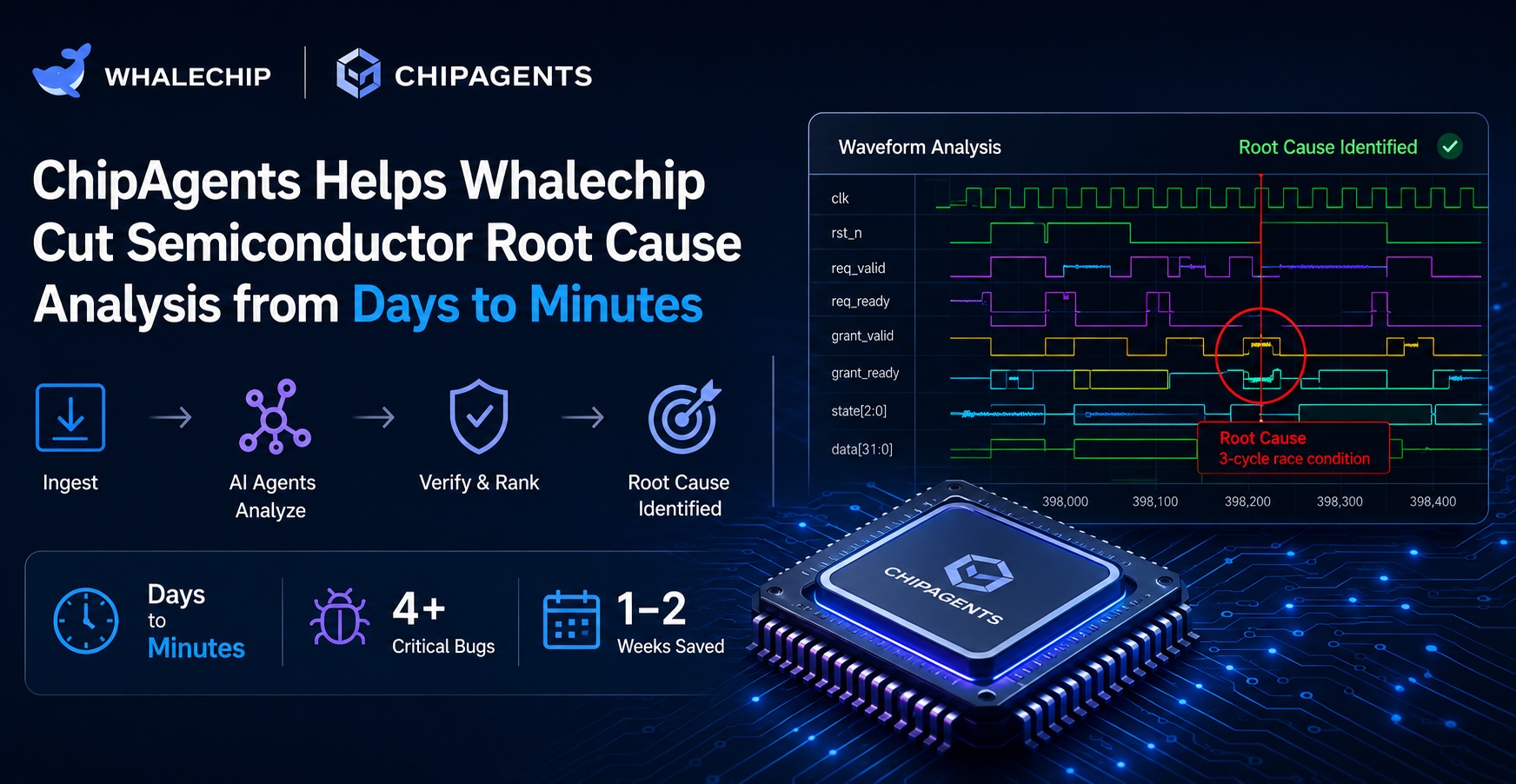

AI-powered platform identified four critical SoC bugs and helped prevent up to two weeks of potential development delays
Semiconductor verification is increasingly constrained not by simulation capacity, but by the engineering effort required to understand why a simulation failed. Modern ASIC and system-on-chip designs combine complex protocols, deep pipelines, multiple clock domains, reused intellectual-property blocks and massive waveform databases. When an assertion fires, engineers may spend hours or days correlating log messages, register-transfer-level code, testbench behavior and signal transitions before identifying the original defect.
Whalechip, a developer of advanced semiconductor and 3D-integrated-circuit solutions, applied the ChipAgents artificial-intelligence platform to accelerate this root cause analysis workflow. According to the companies’ reported results, the deployment reduced individual debugging cycles from multiple days to approximately 15–60 minutes. During one 60-hour critical debugging engagement involving a customer memory controller, the system reportedly identified three structural design pitfalls and four critical bugs, including a concealed three-cycle race condition. The intervention was estimated to have prevented one to two weeks of schedule delay.
The technical challenge is substantially different from ordinary software debugging. Hardware failures are temporal and highly concurrent. The visible error may occur thousands of cycles after the defect that caused it, while the relevant data may have crossed several modules, queues or clock boundaries. A failed transaction can therefore be the downstream symptom of incorrect backpressure, pipeline misalignment, control gating, protocol misuse or data corruption elsewhere in the design.
ChipAgents RCA addresses this problem through three primary components: a purpose-built waveform-understanding engine, a multi-agent prover–verifier architecture and a self-consistency ranking layer. The platform analyzes RTL designs, testbenches, simulator logs and waveform databases together rather than treating each artifact as an isolated source.
Its waveform engine places a structured index over compressed simulation data. Instead of loading every signal transition into a language model’s context window, an agent can issue targeted semantic queries such as locating where a signal first diverged, identifying a specific request-grant sequence or tracing a packet through pipeline stages. The engine returns compact symbolic results, allowing the reasoning system to navigate waveform databases that may contain hundreds of thousands of signals and millions of cycles. ChipAgents reports testing on compressed waveform files exceeding 1 GB, representing more than 100 GB of uncompressed signal activity.
Root cause hypotheses are explored through multiple prover–verifier agent pairs. A prover generates a candidate explanation, such as an incorrectly gated state transition or an off-by-one pipeline delay. A separate verifier tests that explanation against the available code, logs and waveform evidence. Multiple pairs can examine different causal paths concurrently, exchanging information and iterating until the system reaches a convergence threshold. This separation is intended to reduce the tendency of a single generative model to accept its first plausible answer without sufficient validation.
An aggregation layer then compares the independently generated traces and assigns confidence scores. High-agreement explanations are presented first, while lower-confidence findings remain available as partial diagnostic paths. This is important in semiconductor verification, where an incorrect recommendation can send an engineer into another lengthy debugging cycle.
The Whalechip deployment illustrates how agentic AI can change the economics of verification. Instead of manually inspecting waveforms signal by signal, engineers can initiate parallel investigations that autonomously search, test and rank failure hypotheses. The result is not merely faster log summarization, but a shift toward automated causal tracing across heterogeneous engineering data.
ChipAgents’ broader evaluations indicate that its RCA system can identify backpressure errors, handshake failures, data corruption, invalid protocol behavior and clock-domain-related defects in commercial-scale IP. The company also reports a PCIe 3.0 case in which the system isolated and patched a subtle AXI-related error in 10 minutes, compared with a human estimate of four to eight hours.
For Whalechip, reducing analysis from days to minutes translates directly into faster verification closure, lower schedule risk and more engineering capacity for architecture and implementation. More broadly, the case demonstrates how domain-specific AI agents may become an increasingly important layer within semiconductor EDA workflows.
Also Read:
See Autonomous Chip Design in Action with ChipAgents at DAC 2026
Agentic AI and the Future of Chip Design: From Productivity Tool to Engineering Partner
I Have Seen the Future with ChipAgents Autonomous Root Cause Analysis
Share this post via:



Comments
There are no comments yet.
You must register or log in to view/post comments.