




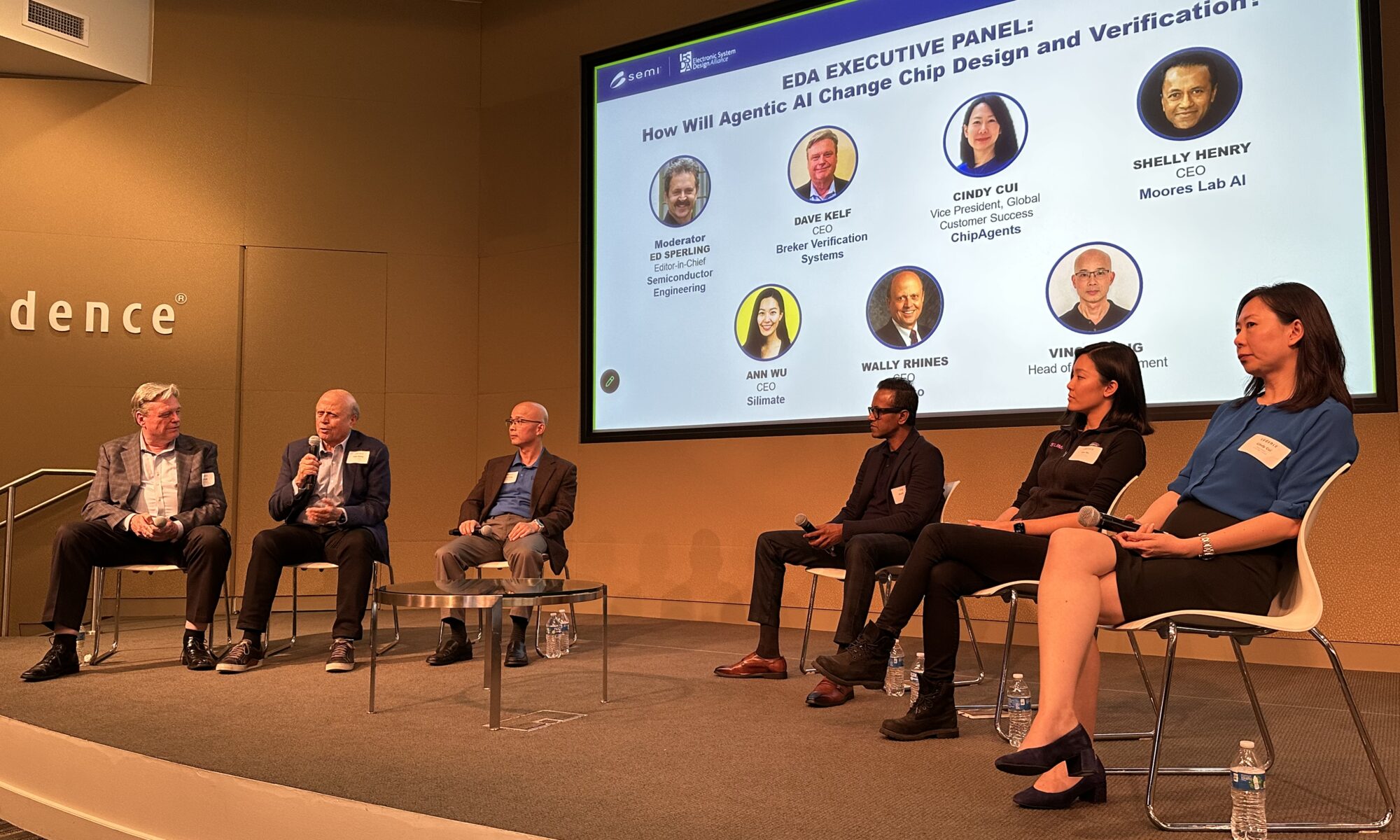

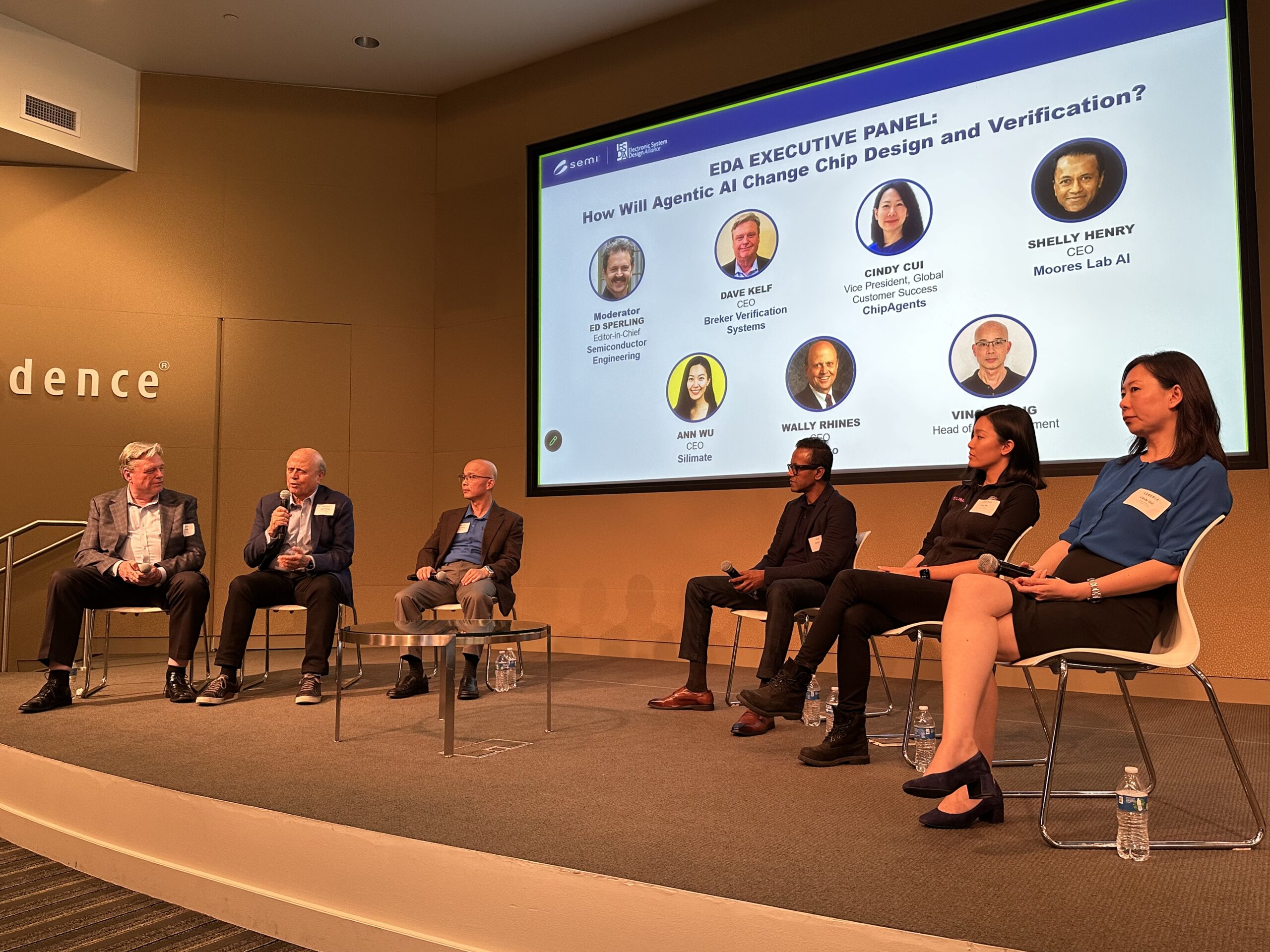
Highlights from a recent panel session moderated by Ed Sperling (Semiconductor Engineering) featuring Walden Rhines (Silvaco), Vincent Wong (Verific), Dave Kelf (Breker Verification Systems), Shelly Henry (MooresLab AI), Ann Wu (Silimate), and Cindy Cui (ChipAgents). The panel session was hosted by Electronic System Design Alliance (ESDA), a SEMI Technology Community.
The Question Is No Longer Whether AI Will Change Semiconductor Design
For decades, semiconductor engineers have faced the same challenge: growing design complexity combined with shrinking schedules. Every new process node, every new architecture, and every new application has increased the burden on design and verification teams.
At a recent industry panel on Agentic AI and semiconductor development, one message emerged clearly: artificial intelligence is no longer an experimental technology on the periphery of Electronic Design Automation (EDA). It is rapidly becoming a core component of the design and verification workflow.
What remains uncertain is not whether AI will be adopted, but how the industry will establish trust, accountability, and engineering discipline around its use.
From Copilot to Autonomous Engineering Systems
Today’s AI applications in semiconductor design largely function as assistants. They help generate RTL, create verification collateral, write testbenches, automate documentation, and accelerate debugging.
The next phase is agentic AI—systems capable of executing multi-step engineering tasks with minimal human intervention.
Several panelists described a future in which AI agents collaborate across the design flow, from specification and architecture through implementation, verification, physical design, and signoff.
The attraction is obvious. Chip development cycles measured in years could potentially be compressed into months. Engineering teams could explore far larger design spaces than would be practical using traditional methodologies.
But increased automation introduces a fundamental challenge: trust.
Productivity Is Easy. Correctness Is Hard.
One of the recurring themes throughout the discussion was that semiconductor design differs fundamentally from many other AI application domains.
A recommendation engine can occasionally be wrong without significant consequences. A chip cannot.
A single functional bug can result in months of schedule delay and millions of dollars in respin costs. As a result, the industry’s standards for correctness are exceptionally high.
The panel repeatedly returned to a central question:
How do engineers verify that AI-generated outputs are correct?
Generating RTL is relatively straightforward. Proving that RTL correctly implements the specification is much harder.
Generating a testbench is relatively straightforward. Demonstrating that the testbench adequately verifies the design is much harder.
As one panelist noted, speed without correctness is not progress.
The future of agentic AI in semiconductor design will therefore depend as much on validation technologies as on generation technologies.
Human-in-the-Loop Is Not Going Away
Despite excitement around autonomous agents, none of the panelists argued that fully autonomous chip tapeouts are imminent.
Today’s large language models still hallucinate. They can produce outputs that appear plausible while being fundamentally incorrect. This characteristic creates significant risk in engineering applications where subtle errors can remain hidden until late in the development cycle.
Consequently, most panelists advocated a “human-in-the-loop” approach.
Engineers will increasingly supervise AI systems rather than manually perform every task. Critical decisions will still require human review, signoff, and accountability.
The role of the engineer changes from creator to reviewer, architect, and orchestrator.
In that sense, AI does not eliminate engineering judgment—it increases its importance.
The Need for Industry Benchmarks
A particularly important topic was measurement.
How should the industry evaluate AI systems?
Traditional metrics such as code generation speed or productivity improvements are insufficient. Semiconductor companies need objective ways to assess quality, correctness, coverage, and reliability.
Several participants argued that the industry lacks common benchmarks capable of evaluating AI-generated designs and verification environments.
Without trusted benchmarks, organizations risk comparing tools based on marketing claims rather than measurable engineering outcomes.
The development of standardized benchmark suites may become one of the most important enablers of widespread AI adoption in EDA.
Design Space Exploration May Be AI’s Greatest Contribution
While much attention focuses on automation, another theme emerged repeatedly: exploration.
Historically, engineers have been constrained by time and computational resources. Only a limited number of architectural alternatives could be evaluated before schedules forced decisions.
Agentic AI changes that equation.
AI systems can evaluate dramatically larger solution spaces, explore more architectural options, and identify design tradeoffs that would be impractical to examine manually.
Several panelists compared this opportunity to earlier EDA revolutions such as synthesis and high-level synthesis. The true value may not be simple productivity gains but rather the ability to discover better solutions.
In this view, AI’s greatest contribution may be improving quality of results rather than merely reducing engineering effort.
Democratizing Chip Design
Another intriguing possibility is that AI could lower barriers to semiconductor development.
Historically, advanced chip design has required large engineering teams, substantial capital, and extensive infrastructure. As AI automates portions of the workflow, smaller organizations may gain the ability to build increasingly sophisticated devices.
This could create a broader and more diverse semiconductor ecosystem.
Rather than concentrating innovation among a handful of hyperscalers and semiconductor giants, agentic AI may enable startups and specialized companies to develop highly optimized solutions for specific applications.
The result could be an explosion of custom silicon.
What Happens to Engineers?
Perhaps the most important question from the audience concerned workforce impact.
Will AI replace engineers?
The panel’s consensus was nuanced.
Entry-level tasks involving documentation, repetitive coding, collateral generation, and routine verification activities are likely to become increasingly automated.
However, the need for experienced engineers is unlikely to disappear.
Future engineers will require a different skill set:
- Systems thinking
- Architectural reasoning
- Cross-domain understanding
- AI supervision and orchestration
- Verification and validation expertise
- Critical evaluation of AI-generated outputs
In short, engineers will spend less time producing artifacts and more time evaluating, directing, and integrating them.
The concern is not necessarily that engineering jobs disappear. The concern is ensuring that future engineers still develop sufficient expertise to become the architects and technical leaders of tomorrow.
The Road Ahead
The semiconductor industry has experienced several transformative shifts over the past four decades: logic synthesis, hardware description languages, formal verification, system-level design, and advanced process technologies.
Agentic AI may prove to be equally significant.
Yet unlike many previous automation technologies, AI introduces questions that extend beyond productivity. It forces the industry to confront issues of trust, explainability, accountability, workforce development, and engineering methodology.
The panel ultimately reached a broad consensus.
Agentic AI will become an essential component of semiconductor design and verification. The technology is already demonstrating value, and its capabilities continue to improve rapidly.
The challenge now is not building more powerful AI systems.
The challenge is building engineering processes that allow those systems to be trusted.
Also Read:
John Barr: The EDA Veteran and Award-Winning Needham Funds Portfolio Manager
SemiWiki Q&A with Julie Rogers, Executive Director, ESD Alliance
The Name Changes but the Vision Remains the Same – ESD Alliance Through the Years
Share this post via:



Comments
There are no comments yet.
You must register or log in to view/post comments.