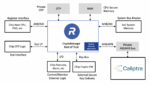
At the recent RISC-V Now event hosted by Andes, the discussion underscored the fact that RISC-V is no longer just about instruction set architecture advantages or customizable cores. The real focus has moved up the stack to system-level design. This is where connectivity, integration, and security define whether an innovation… Read More
Tag: Kalar Rajendiran
Enabling Next-Generation AI Through Advanced Packaging and 3D Fabric Integration
The rapid rise of artificial intelligence is fundamentally reshaping computing architectures. As AI models scale toward trillions of parameters, traditional approaches to performance improvement are no longer sufficient. Instead, the industry is entering a new era where system-level innovation, advanced packaging, … Read More
The Shift to System-Level AI Drives Next-Generation Silicon
At its 2026 Technology Symposium, TSMC delivered a clear message: the AI era has entered a new phase. The primary constraint is no longer model capability, but the systems required to run those models at scale. Addressing this shift will demand significant advances in semiconductor technology, spanning compute, memory, interconnects,… Read More
Two Paths for AI in Semiconductor Manufacturing: Platform Integration vs. Point Solutions
Semiconductor manufacturing has become one of the most data-intensive industrial environments in the world, and AI is rapidly becoming central to how fabs operate and optimize. Yet, rather than converging on a single model for AI adoption, the industry is evolving along two distinct paths. One centered on platform-scale… Read More
RISC-V Has Momentum. The Real Question Is Who Can Deliver
RISC-V has momentum. The industry knows it. The harder question is: who can actually deliver when and where it matters?
A Shift That Changes the Stakes
On March 24, 2026, Arm made something explicit: it is now a silicon company. After decades as a neutral IP provider, Arm is moving up the stack. It’s building chips and complete solutions,… Read More
Synopsys Advances Hardware Assisted Verification for the AI Era
At the 2026 Synopsys Converge Event, Synopsys announced a broad set of new products and platform upgrades, with its hardware-assisted verification (HAV) announcement emerging as a key highlight within that lineup. A key aspect of this announcement was moving beyond a hardware centric model to a more scalable, programmable … Read More
Scaling Multi-Die Connectivity: Automated Routing for High-Speed Interfaces
This article concludes the three-part series examining key methodologies required for successful multi-die design. The first article Reducing Risk Early: Multi-Die Design Feasibility Exploration focused on feasibility exploration and early architectural validation, while the second article Building the Interconnect… Read More
Accelerating Computational Lithography Using Massively Parallel GPU Rasterizer
As semiconductor manufacturing pushes deeper into the nanometer regime, computational lithography has evolved from a supporting step into a central pillar of advanced chip design. Mask synthesis, lithography simulation, and optical proximity correction (OPC) now demand unprecedented levels of accuracy and computational… Read More
Operationalizing Secure Semiconductor Collaboration: Safely, Globally, and at Scale
Semiconductor manufacturing is among the most complex industrial activities in existence. As device geometries shrink and systems become more interconnected, software has become as critical as process technology itself. Modern fabs depend on extensive automation, real-time analytics, and deep integration between tools,… Read More
Reducing Risk Early: Multi-Die Design Feasibility Exploration
The semiconductor industry is entering a new era in system design. As traditional monolithic scaling approaches its economic and physical limits, multi-die architectures are emerging as a primary pathway for delivering continued improvements in performance, power efficiency, and integration density. By distributing … Read More