




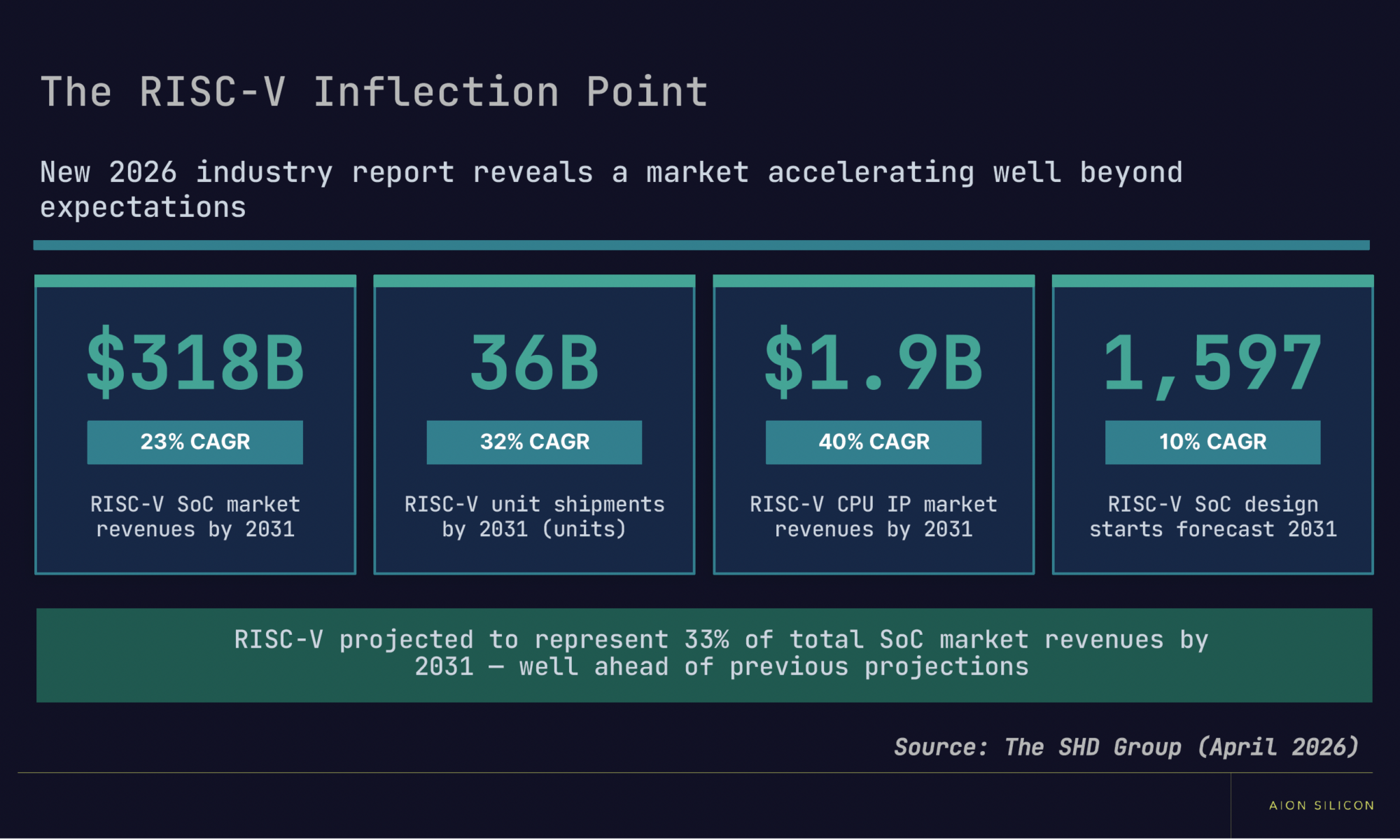

At the recent RISC-V Now by Andes conference, Aion Silicon’s presentation made one thing clear: RISC-V is no longer an emerging alternative but rather rapidly becoming foundational to modern silicon design. This conviction is not theoretical says Oliver Jones, CEO of Aion Silicon, who gave the talk. It is grounded in Aion Silicon’s direct experience delivering advanced-node-silicon spanning dozens of designs at 7nm and below and deep engagements across AI, networking, and automotive sectors. Across these engagements, a consistent pattern has emerged: RISC-V is increasingly selected where flexibility, control, and differentiation matter most.
The semiconductor industry is undergoing a structural shift, where the ability to tailor compute to specific workloads is becoming as critical as raw performance. RISC-V sits squarely at the center of this transformation.
The Real Driver: AI’s Insatiable Demand for Custom Compute
A central theme of the presentation is that artificial intelligence (AI) is not just another workload but a forcing function reshaping silicon design. AI workloads demand specialization, efficiency, and adaptability, all of which align naturally with RISC-V’s extensible instruction set architecture.
In practice, this is already visible in production silicon. RISC-V cores are increasingly embedded inside AI accelerators, including hyperscale deployments, where they handle control, orchestration and specialized processing tasks. Rather than displacing incumbent CPU architectures, RISC-V is occupying critical roles that benefit from tight optimization and domain-specific behavior. The alignment is powerful: AI creates demand for customization, and RISC-V provides the architectural mechanism to deliver it.
Customization as a First-Class Design Principle
One of the most compelling arguments presented is that customization is the defining advantage of RISC-V, not cost or openness alone. The ability to extend the ISA with domain-specific instructions allows silicon designers to tailor compute precisely to workloads, whether in AI, networking, or embedded systems.
This represents a meaningful shift in design philosophy. Instead of forcing software to adapt to fixed hardware constraints, organizations can now shape hardware around their most important workloads. The resulting gains in performance-per-watt and system efficiency are increasingly difficult to achieve with general-purpose architectures alone.
That said, this flexibility introduces complexity. Custom instructions ripple through compilers, verification flows, and system integration. The presentation emphasizes that successful adoption requires discipline with customization targeted, measured, and supported across the full stack.
The Rise of Heterogeneous SoCs
Another key insight is that RISC-V’s momentum is closely tied to the rise of heterogeneous system-on-chip architectures. Rather than replacing Arm or x86 CPUs, RISC-V is being deployed alongside them as a function-specific compute element.
This coexistence model reflects a broader industry evolution. Modern SoCs are no longer built around a single dominant processor; instead, they integrate multiple compute elements, each optimized for a specific role. Within this architecture, RISC-V frequently serves as the control and orchestration layer or as a targeted offload engine.
The implication is clear: RISC-V’s strength lies not in displacing existing architectures, but in complementing them—filling the growing need for specialized, adaptable compute within increasingly complex systems.
From Edge Volume to Datacenter Value
RISC-V’s adoption story began in microcontrollers and embedded systems, where its open and customizable nature provided immediate advantages. What is changing now is the direction and scale of growth. The architecture is expanding upward into edge AI, networking, and datacenter silicon.
This progression mirrors historical industry patterns. Volume at the edge drives ecosystem maturity, which in turn enables deployment in higher-value, performance-sensitive domains. As AI inference shifts from centralized cloud environments to distributed edge devices, the number of deployment opportunities grows exponentially.
The result is a virtuous cycle: broader adoption strengthens the ecosystem, which lowers barriers to entry and accelerates further adoption.
From Architecture to Silicon: The Importance of System-Level Thinking
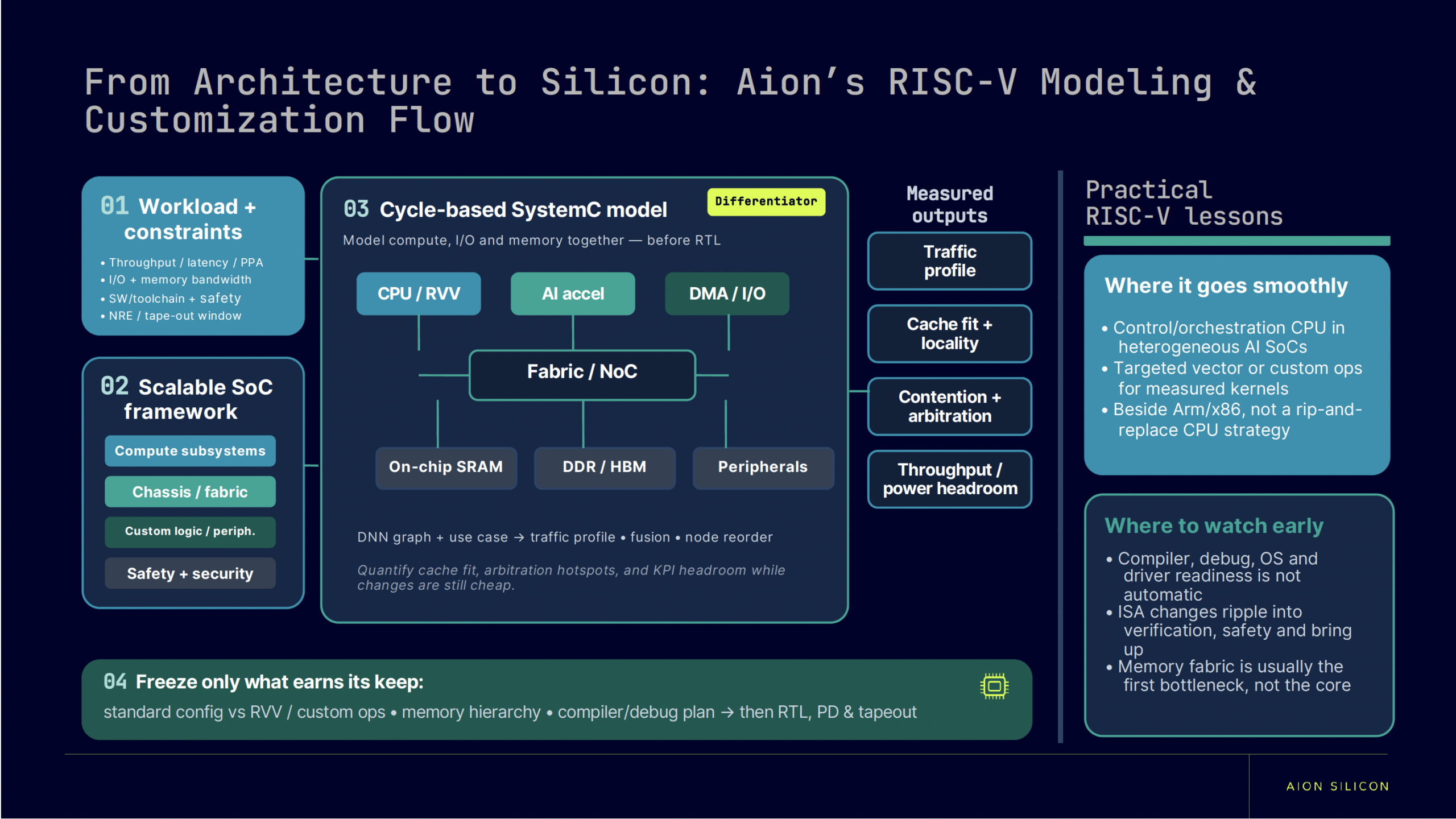
Beyond market trends, the presentation highlights how successful RISC-V designs are executed. Aion Silicon emphasizes system-level modeling, where compute, memory, and I/O interactions are analyzed early using cycle-accurate frameworks before committing to RTL.
This approach reflects a critical reality: in modern SoCs, performance bottlenecks are rarely confined to the CPU core. They emerge in memory hierarchies, interconnect fabrics, and data movement patterns. Early modeling enables teams to identify these constraints and optimize accordingly, while changes are still cost-effective.
The broader lesson is that architectural success depends on holistic system design, not just individual component optimization.
Where RISC-V Works and Where It Needs to Mature More
The presentation offers a pragmatic view of where RISC-V delivers immediate value and where challenges remain. It is particularly effective in control and orchestration roles within heterogeneous SoCs, and in scenarios where targeted vector or custom instructions can accelerate well-understood workloads.
At the same time, areas such as toolchain maturity, verification complexity, and system integration require careful management. These challenges are not unique to RISC-V, but they are amplified by its flexibility.
What emerges is a clear pattern: success with RISC-V is less about adopting the architecture itself and more about how thoughtfully it is integrated into the broader system.
Ecosystem and Collaboration: The Multiplier Effect
The role of ecosystem is another critical theme. The collaboration between Aion Silicon and Andes underscores how partnerships across IP providers, design services, and tooling vendors are essential to delivering production-ready solutions.
As the ecosystem expands, it reduces friction for adoption and increases confidence among customers. This network effect is a key driver of momentum, enabling RISC-V to scale beyond early adopters into mainstream deployment.
Summary
The overarching message is that RISC-V is evolving into the default architecture for control, customization, and specialization within heterogeneous systems. Its rise is driven by the convergence of AI workloads, the shift toward multi-architecture SoCs, and the growing importance of architectural flexibility.
For decision-makers, the implication is clear: RISC-V is becoming a strategic component of future silicon roadmaps. In that sense, RISC-V is doing more than spanning datacenter to edge. It is redefining how compute is designed, deployed, and optimized.
Learn more about Aion Silicon.
Also Read:
NoC Matters: Designing the Backbone of Next-Gen AI SoCs
The 10 Practical Steps to Model and Design a Complex SoC: Insights from Aion Silicon
Live Webinar: Considerations When Architecting Your Next SoC: NoC with Arteris and Aion Silicon
Share this post via:



Comments
There are no comments yet.
You must register or log in to view/post comments.