




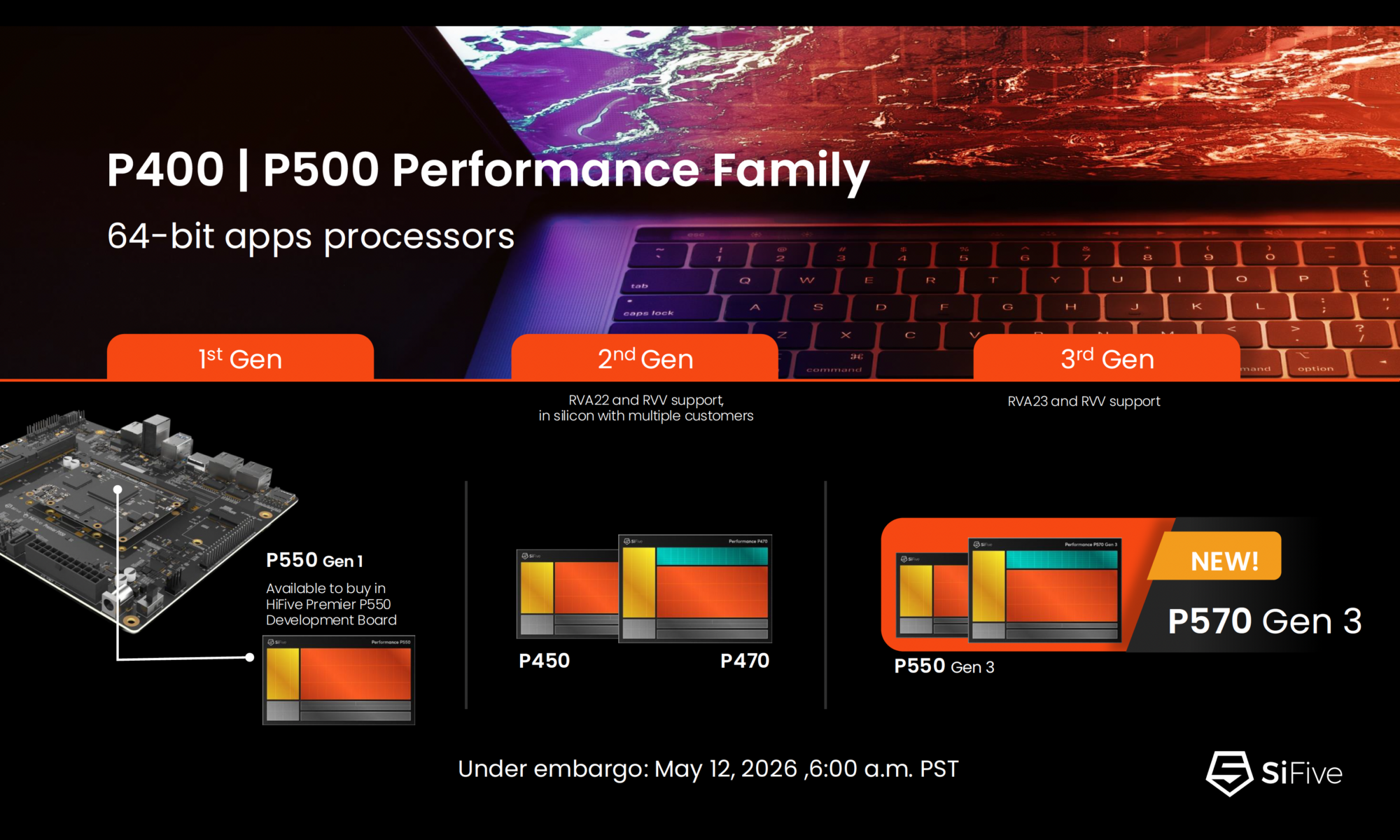

With the launch of its new P570 Gen 3 processor family, SiFive is making a broader statement about the future of edge computing and the growing role of RISC-V in mainstream application processors. Rather than simply unveiling another CPU core, the company is positioning the P570 as a balanced-performance processor built specifically for AI-era workloads.
The launch includes two processors: the P570 Gen 3 with vector support and the P550 Gen 3 without vector support. Both belong to SiFive’s “Performance” family and target Linux-class systems, Android-capable devices, edge AI platforms, consumer electronics, and embedded computing applications.
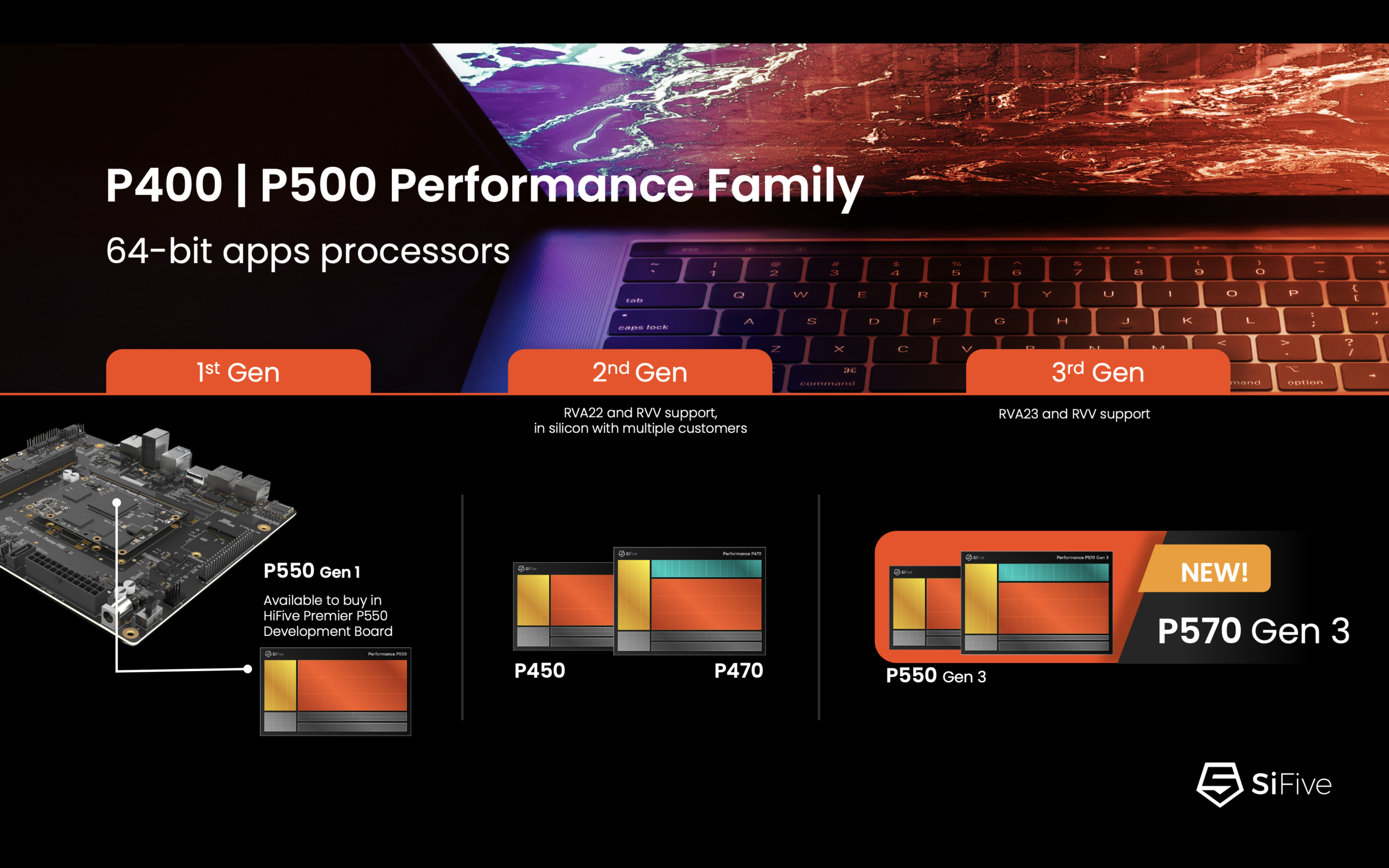
What makes the announcement significant is not just the performance uplift, but the architectural direction behind the design. SiFive is targeting a segment between low-power embedded processors and large server CPUs. This is a space where devices increasingly need AI acceleration, vector processing, and modern software support while still operating within tight power and silicon-area limits.
A New Kind of Edge Processor to Address a Market Gap
SiFive repeatedly described the P570 as a “balanced performance” processor, meaning it is optimized for performance-per-watt and performance-per-sqmm rather than peak benchmark scores alone.
That focus reflects how edge devices are evolving. Smart cameras, industrial systems, AI-enabled consumer electronics, and intelligent IoT devices increasingly run mixed workloads combining traditional CPU tasks with AI inference, media processing, and vectorized compute. These systems need far more capability than legacy embedded CPUs were designed to deliver, but they still cannot absorb the power and thermal costs of server-class processors.
SiFive argues that existing mid-range CPU architectures, particularly older Arm Cortex-A designs, have not evolved aggressively enough for these modern workloads. The P570 is intended to address that gap.
Fully Out-of-Order Scalar and Vector Execution
One of the most important aspects of the P570 is its execution architecture. According to SiFive, both the scalar and vector engines operate fully out-of-order.
That is unusual. Most processors execute scalar instructions out-of-order while vector operations remain in-order or only partially decoupled. Fully out-of-order vector execution is significantly more difficult to implement efficiently and is typically reserved for much larger server-class CPUs.
SiFive claims it has brought these capabilities into a smaller, more power-efficient design suitable for edge devices. The benefit is particularly important for modern heterogeneous workloads where scalar and vector operations are heavily interleaved. By allowing both execution engines to run out-of-order, the P570 can improve utilization and reduce bottlenecks in mixed AI-oriented workloads.
AI-Oriented Vector Enhancements
The P570 also introduces new vector dot-product extensions designed to accelerate AI and signal-processing workloads. Dot-product operations are fundamental to machine learning inference because neural networks rely heavily on multiply-accumulate operations.
By combining multiplication and accumulation into optimized vector instructions, the processor can improve throughput while lowering instruction overhead and power consumption. SiFive said some vectorized workloads achieved performance gains of up to 21× compared with earlier-generation designs.
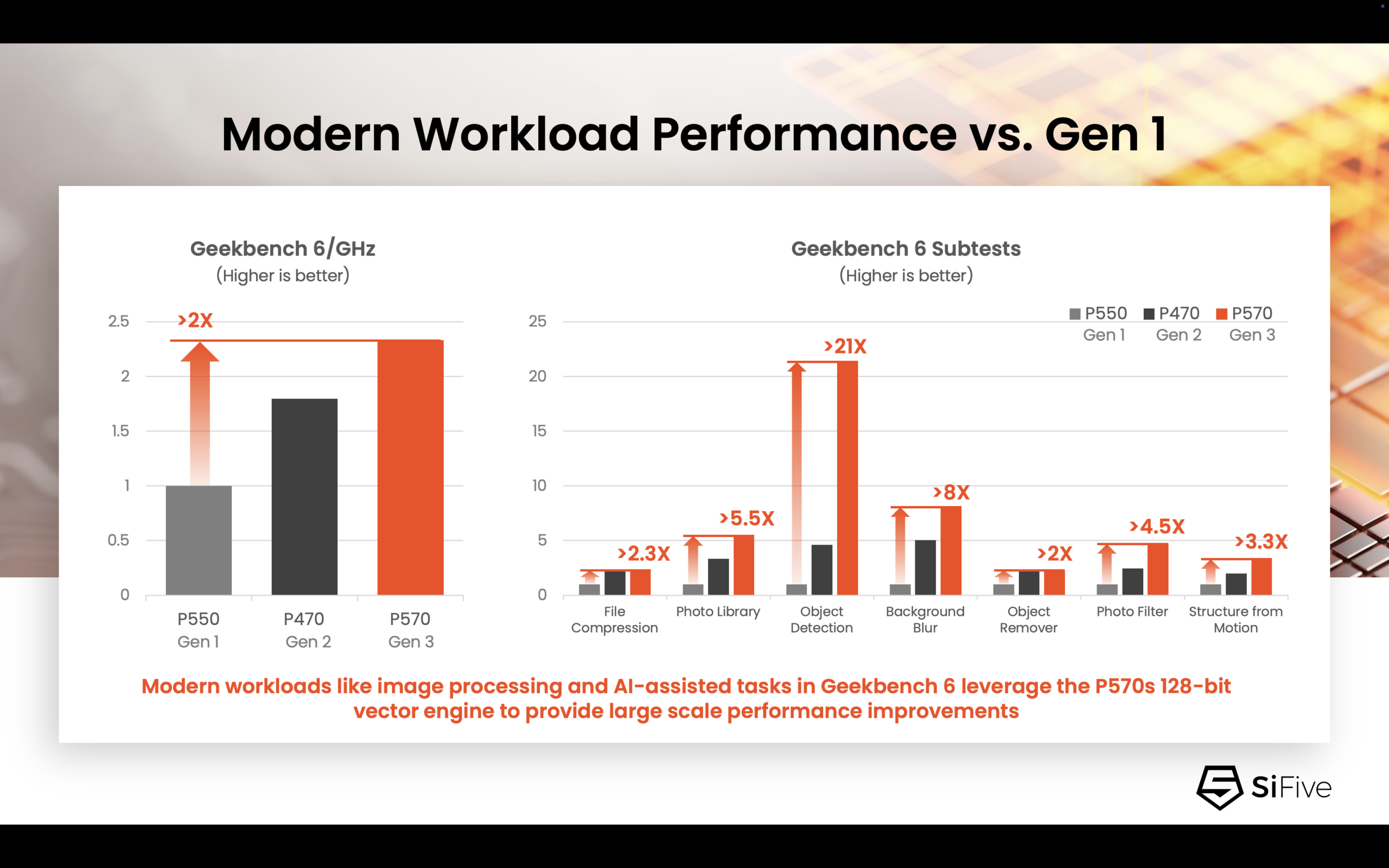
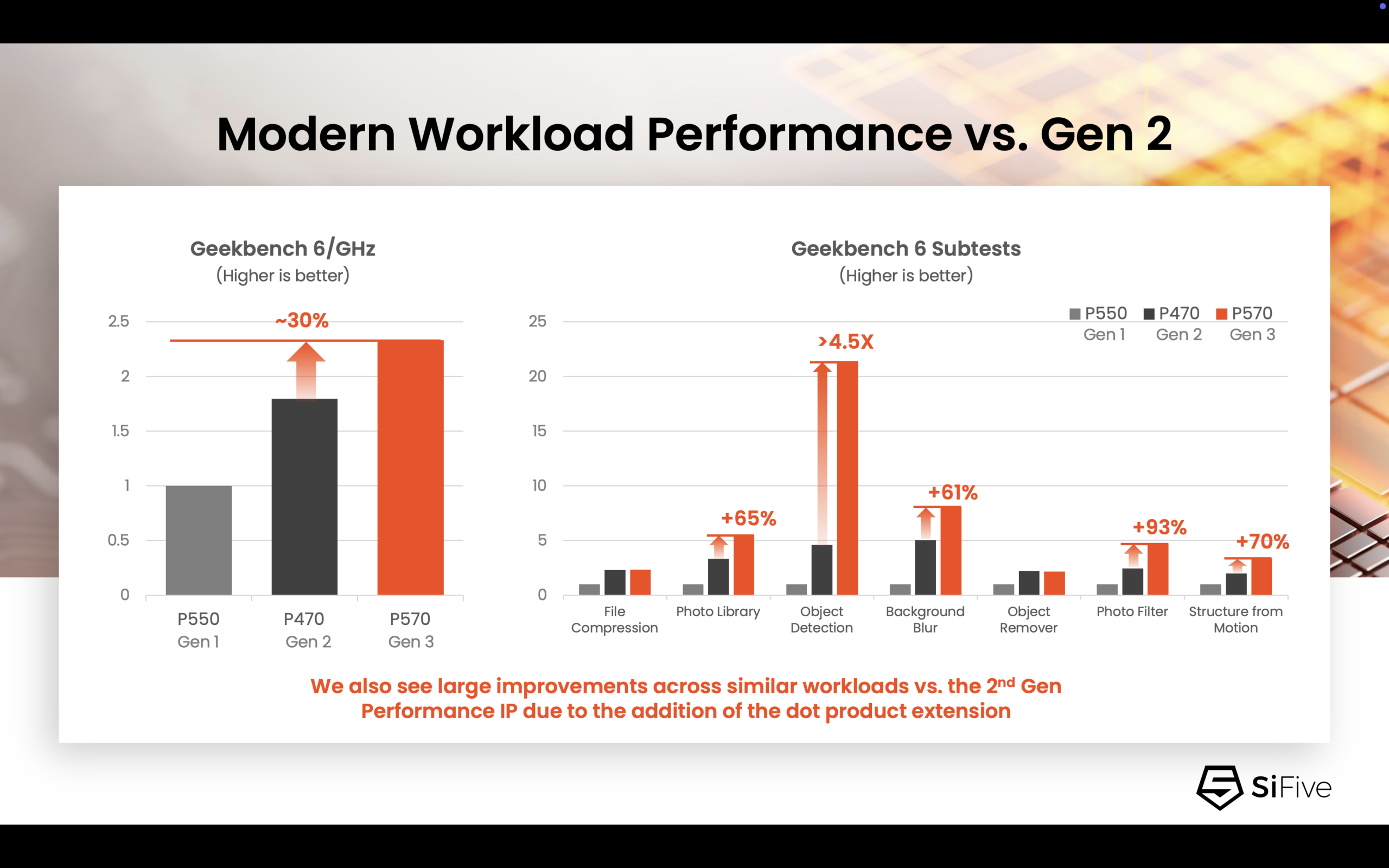
The company emphasized that these improvements come from architectural efficiency rather than brute-force scaling. Just as important, these dot-product extensions reportedly add very little silicon-area overhead.
RVA23 and Software Readiness
One of the most commercially important aspects of the launch is full support for the RVA23 application profile.
Historically, software fragmentation has been one of RISC-V’s biggest challenges, with vendors implementing different combinations of ISA extensions. RVA23 aims to establish a standardized baseline for modern application processors, including support for vectors, hypervisors, security features, and modern Linux requirements.
SiFive emphasized that Linux distributions and Android ecosystem efforts are increasingly aligning around RVA23. The P570 positions itself as a software-ready platform for mainstream operating systems by fully supporting the RVA23 profile, including several optional extensions.
The company also pointed to growing ecosystem momentum. Previous SiFive-based development platforms have reportedly been used by NVIDIA for CUDA-related RISC-V work, by Red Hat for enterprise Linux development, and by Samsung for Tizen demonstrations.
Part of a Broader AI Strategy
The P570 also fits into SiFive’s broader processor portfolio, which includes AI-focused Intelligence processors, embedded cores, and automotive products.
Importantly, SiFive does not position the P570 as a replacement for dedicated NPUs or AI accelerators. Instead, it is designed to work alongside them in heterogeneous AI systems. In many deployments, the P570 would run Linux or Android while dedicated AI engines handle inference workloads.
That approach reflects a larger industry trend toward heterogeneous SoC architectures where CPUs, vector engines, and accelerators work together rather than relying on a single monolithic processor.
Summary
The P570 Gen 3 is more than an incremental CPU refresh. It reflects a broader shift in edge computing itself. Modern edge devices increasingly require a combination of scalar compute, vector acceleration, AI processing, and software flexibility within strict power and area constraints.
By combining fully out-of-order scalar and vector execution, AI-oriented vector acceleration, RVA23 software compatibility, and efficient edge-focused design, SiFive believes the P570 represents one of the most advanced balanced-performance RISC-V processors introduced so far.
Whether the market embraces that vision at scale remains to be seen. But the launch makes one thing increasingly clear: RISC-V is moving well beyond its experimental roots and becoming a serious contender for mainstream application processing.
Learn more at SiFive.com
Also Read:
Architecting Intelligence: The Rise of RISC-V CPUs in Agentic AI Infrastructure
SiFive’s AI’s Next Chapter: RISC-V and Custom Silicon
SiFive to Power Next-Gen RISC-V AI Data Centers with NVIDIA NVLink Fusion
Share this post via:



Comments
There are no comments yet.
You must register or log in to view/post comments.