




May’s WSTS Report saw March’s total monthly semiconductor sales up 88.1 percent vs. March 2025, albeit down 8.5 percent from February 2026. This month-on-month decline needs to put in the context of February’s record-breaking 25.7 percent monthly growth.
This growth, however, was solely attributable to ICs, up 99.5 percent year-on-year, more specifically to Memory, up 269.1 percent, and Logic, up 38.9 percent, each in turn driven by the still white-hot AI-datacenter explosion.
In sharp contrast, IC growth excluding Memory was just 28.3 percent, Analog 13.8 percent, and Micro 8.8 percent, with Opto up 12.3 percent, and Discretes up just 10.1 percent.
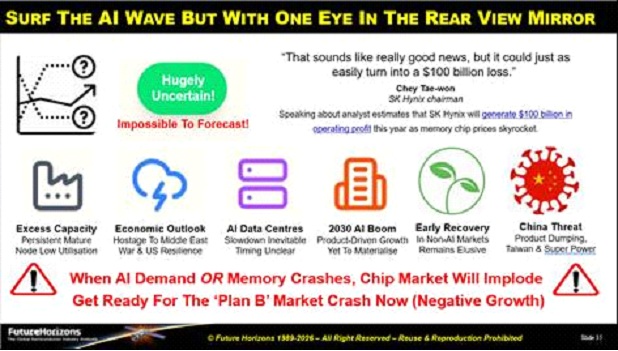
Annualised IC unit growth was relatively strong in March, up 20.3 percent vs. February’s 9.9 percent, but this does not detract from the fact the current stratospheric IC growth is being driven by ASPs, not real market demand. This, plus the fact it is severely AI Datacentre dependent, makes the current recovery untenable in the longer term. IC ASPs will drop like a rock when the datacentre boom slows, and the memory market will crash once new capacity comes on stream.
IC unit growth was also single digit, at just 9.9 percent, re-enforcing the fact the current stratospheric IC growth is being driven by ASPs, not real market demand. This, plus the fact it is severely AI Datacentre dependent, makes the current recovery untenable longer term.
ASPs will drop like a rock when the datacentre boom slows, and the memory market will crash once new capacity comes on stream.
At our recent IFS2026 industry webinar, we updated our outlook for the rest of this year. Given the current growth rates are wild, the numbers insane, with no clear baseline to underpin a consistent set of assumptions, we elected to provide a series of forecast guidance scenarios in lieu of our traditional forecast with bull and bear boundaries.
The likelihood of which scenario materialised depending on three factors, namely, the global economy, the AI boom and memory ASPs.
These in turn depend on how long the Middle East war hostilities and associated disruptions continue; if (when?) investor and AI market data centre exuberance wanes; and how soon new DRAM capacity comes onstream.
The net result was a potential market growth of anywhere from 13 to 101 percent.
The key difference between our view on the market and the overwhelming industry consensus is the impact of AI.
We do not accept that today’s AI boom represents a brave new world of AI-driven semiconductor reality, given AI chips account for between 25-50 percent of the total revenue, depending on how you count it, but significantly less than 1 percent of the total unit shipments.
The current boon may well be the second longest on record, with dollar growth rates to die for, but unit growth is abysmal and the non-AI markets struggling.
Whilst we absolutely believe AI will eventually transform the world as we currently know it, just as the car, air and rail travel, telecommunications, radio, TV, calculators, computers, the Internet and numerous other breathtaking inventions changed the way we live, work and play, we believe these all take time to materialise and the durable path of the associated technological evolution has yet to emerge.
We are the only analyst currently forecasting an industry downturn “maybe this year, if not, next” but we believe the risks are clear given the current market anomalies.
Unit growth is below the industry trend-line and market growth is being driven by ASPs not unit demand, which is unusual. It’s usually the other way round.
The industry’s recent dollar growth is alarmingly unprecedented with Q1-2026, normally the weakest quarter of the year, seeing quarter-on-quarter sales grow 25 percent. That is not only the strongest growth for Q1 over Q4 growth in the 70 plus year industry history, the first quarter growth average is minus 3 percent, it is the highest quarterly growth rate ever.
If datacenter investment weakens, AI chip sales will inevitably follow.
The more optimistic chip forecast current grabbing the headlines would see the chip market increase its share of the US$126 trillion world GDP market from 0.6 percent to 1.5 percent by 2035, growing three times as fast as the historical GDP growth rate, twice as fast as the pre-AI industry average, and with no slowdown in growth.
With all due respects, this is not going to happen. There will be a correction. Either AI demand will tank, or the infrastructure will not be able to keep pace with the demand.
Enjoy the current party but proceed with extreme caution. Do not be misled by current headline dollar growth numbers, they reflect ASP expansion, not underlying demand.
Malcolm Penn
Future Horizons
May 2026
Also Read:
Future Horizons Industry Update Webinar IFS 2025
Semiconductor Industry Update: Fair Winds and Following Seas!
The Recovery has Started and it’s off to a Great Start!
Share this post via:



Comments
6 Replies to “The Semiconductor Growth Numbers are Insane but the Real World Doesn’t Tally!”
You must register or log in to view/post comments.