







John Barr, Portfolio Manager of the top-ranked Needham Aggressive Growth Fund, has built a career with skills honed not just on Wall Street, but in the trenches of the early EDA industry.
Before becoming a respected sell-side analyst and later a buy-side portfolio manager, Barr spent 15 years in the EDA industry, working through marketing, sales and corporate development. It’s a foundation he credits for nearly everything that followed.
His entry into EDA was almost accidental. Fresh from Harvard Business School, Barr joined Communications Satellite Corporation’s corporate development group and worked on projects in various industries, including EDA. He then joined the new Comsat division, which had been launched just before Daisy Systems, Mentor Graphics and Valid Logic.
Comsat had acquired companies with the leading microwave, circuit and logic simulation products. What it lacked in ease of use and integration, it made up with powerful simulators. A few years later, the division was sold to GE Calma, which had the leading IC layout system, sending him through a labyrinth of corporate actions and long-ago EDA companies including HHB Systems, Cadnetix, Daisy, Racal-Redac and Interconnectix. It also meant moves from Washington, D.C. to Austin, to New Jersey, to Japan, and back to New Jersey
It sounds chaotic. Barr frames it differently. It gave him a unique understanding of technology and business.
“I learned so much,” he says without hesitation. “Founder vision is important, and engineer-led companies are good. Important customer backing goes a long way. Good things take time. Every quarter-end is a miracle. Third-party marketing deals are rarely a big deal. Layoffs are hard on an organization and its people. Mergers and acquisitions are really hard.”
He lived all of it. He was part of HHB’s IPO, which occurred just days before the Black Monday stock market crash of October 19, 1987. Within a few months, Cadnetix and HHB agreed to a friendly merger, which was designed to fend off a hostile takeover by Daisy — only to become the poison pill that left an over-leveraged Daisy heading toward collapse and Chapter 11. What followed was a friendly acquisition by U.K. firm Racal-Redac, and six years later, to a company breakup, layoffs, and the dispersal of assets: the front-end tools went to Viewlogic. The PCB CAD tools went to Zuken, which survives to this day. Barr was let go.
“All of that,” he reflects, “provides a complete history of everything you might want to go through if you want to be an investor.”
From Layoff to Needham
The layoff forced him to reconsider his path. He had always been interested in stocks and investing. He took six months and immersed himself in finding a Wall Street position. He wrote a report on the EDA industry and networked with analysts, investment bankers, traders and investors.
Alas, while he got close on a couple of positions, there were no job offers. He gave up on the idea and was fortunate to join a great, venture-backed EDA startup called Interconnectix, which had a very clever signal integrity-based PCB routing technology.
After a year, he learned that Needham & Company had an opening for a sell-side analyst. It turned out to be a natural fit. “A small firm like Needham was willing to take a chance,” he says. “They prided themselves on people with unconventional backgrounds — and I was it.”
Barr joined Needham’s sell-side in 1995. This timing put him at the center of one of the most extraordinary IPO windows in history. He was the analyst when Meta-Software, Analogy, OrCAD, and Summit Design went public.
In July 2001, he was recruited to Robertson Stephens, which he describes plainly as “the epicenter of the tech bubble.” In March of 2000, the tech market had started its crash, but there were a number of great, small, EDA companies poised to go public. Virage Logic and Synplicity went out in 2000 and were in the top 10 IPO performers of the year. 2001 was a terrible year for the markets and IPOs.
EDA companies defied the tide: four of the top ten performing IPOs of 2001 were EDA companies. Verisity was number one; Magma was second; NASSDA was fourth; and PDF Solutions was eighth. Simplex, he notes, had the best opening-day performance of 2001— up 77%.
What were the highlights? What was the greatest memory? “Taking those great EDA companies public in 2000 and 2001. Introducing them to small-cap institutional investors in the public markets — it really was something the whole EDA industry should be proud of. My greatest memory on the sell-side was helping those great companies and their leaders go public and be introduced to investors,” Barr says.
The Long View
Barr returned to Needham in 2009 and moved to the buy side, co-managing the firm’s mutual funds — a role he holds today. His EDA years give him an interpretive lens few investors possess: he’s seen these companies not just as ticker symbols, but from the inside.
It’s worth noting that of all the companies from the 2000 and 2001 vintages, PDF Solutions is the only one still publicly traded — and it remains in Barr’s current portfolio. Its CEO, co-founder and Director John Kibarian also serves as Co-Chair of the ESD Alliance’s Governing Council.
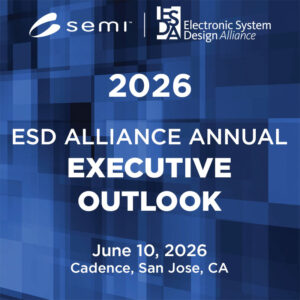
Now, as venture-backed agentic AI startups begin reshaping EDA, Barr watches with informed curiosity. Whether this moment echoes 2000–2001 remains to be seen. For those wanting early insight, the ESD Alliance’s Executive Outlook June 10 features a panel on “How Will Agentic AI Change Chip Design and Verification?”
Event Details:
Date: Wednesday, June 10
Location: Cadence Design Systems, 2655 Seely Avenue, San Jose, Calif.
Schedule: Networking, dinner and beverages at 5:30 p.m.; panel begins at 6:30 p.m.
Panelists: Three agentic AI entrepreneurs, plus EDA executives including Wally Rhines (longtime CEO of Mentor Graphics, now CEO of Silvaco)
Tickets: Registration is open and free for SEMI/ESDA members. SemiWiki readers should use the SEMIWIKI50 promo code for 50% off the non-member $40 per person rate.
Members of the EDA ecosystem, the semiconductor industry, startups and emerging companies are also invited to attend “Navigating Export Controls in EDA,” a free webinar Thursday, June 11, on why and how governments implement trade controls. Presented by members of SEMI’s Public Policy and Advocacy team and Cadence representatives The webinar is free to attend, but registration is required.
Julie Rogers
Executive Director
ESD Alliance, a SEMI Technology Community
Also Read:
SemiWiki Q&A with Julie Rogers, Executive Director, ESD Alliance
Podcast EP340: A Review of the Q4 2025 Electronic Design Market Data Report with Wally Rhines
Share this post via:



Comments
There are no comments yet.
You must register or log in to view/post comments.