





The TSMC OIP Ecosystem Forum highlighted many accomplishments across TSMC’s vast ecosystem. Specific achievements with TSMC as well as collaborative work across several companies were all on display.
And there was an exhibit area where you could meet the companies behind many of these stories and learn more about them.
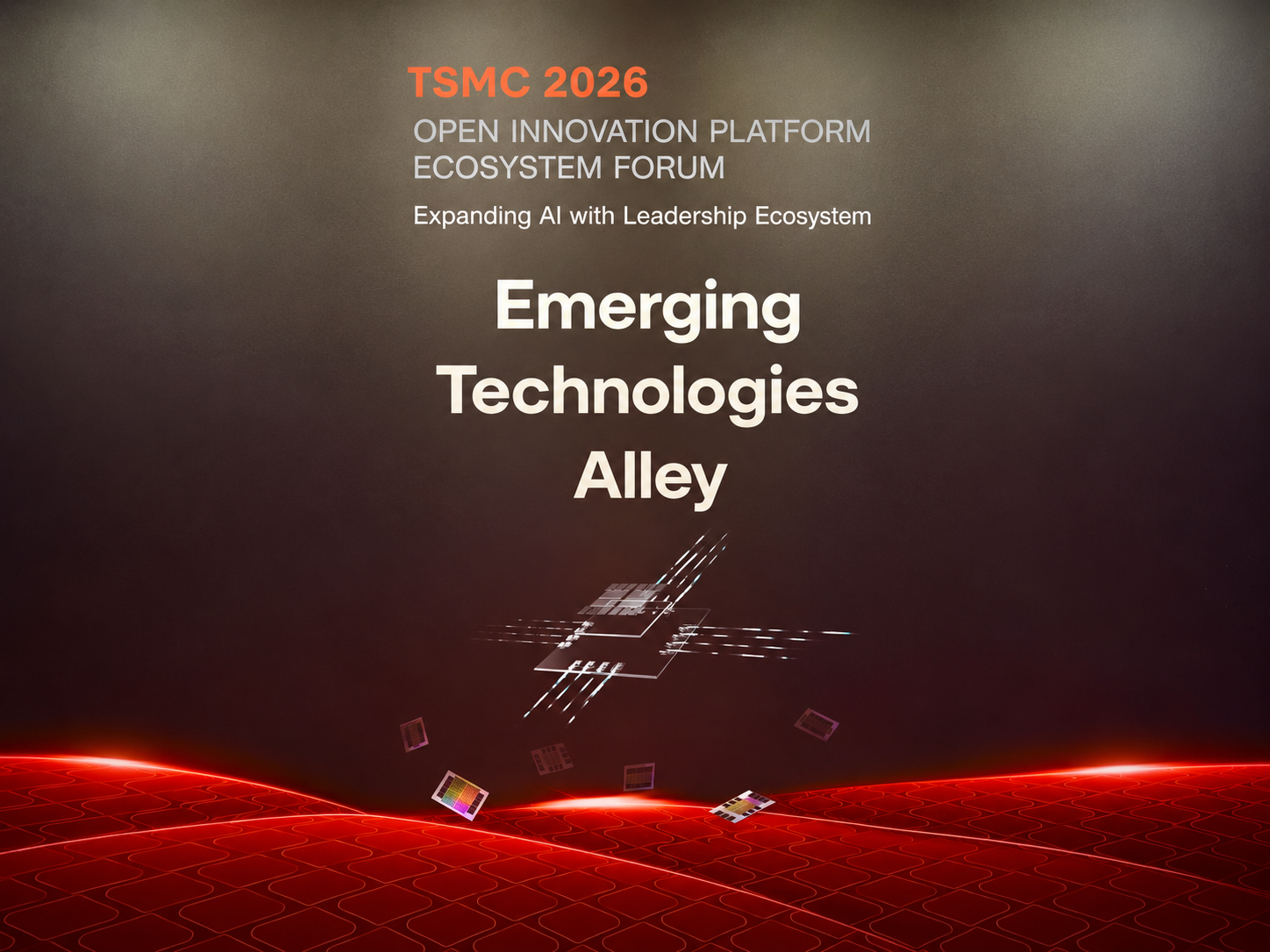
This year, there was a new area on the exhibit floor. TSMC invited six emerging companies to showcase their accomplishments. Called Emerging Technologies Alley, this new area on the show floor highlighted what these companies were doing to advance the state of design.
I had an opportunity to speak with all six. What follows is a short version of their story. There were five design technology companies and one IP company. Listed alphabetically, here is what I learned at the TSMC OIP Ecosystem Forum 2026 as the spotlight was focused on emerging technologies.
Agentrys
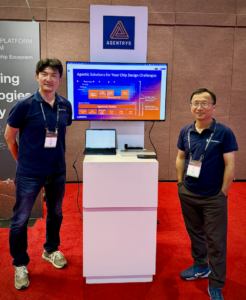 I spoke with Mark Ren (on the right) and Duo Ding (on the left). Agentrys is a tool builder vs. a tool provider. The company provides its customers with the ability to develop multi-agent frameworks that target their specific requirements.
Agentrys also provides “out of the box” solutions that can be used directly to address challenges such as design verification, root cause analysis, and RTL generation.
Agentrys didn’t just talk about these capabilities. They also ran several live demos to showcase out-of-the-box solutions as well as demos to show how to build your own multi-agent framework. Particularly difficult problems around SerDes integration were also addressed.
Overall, there was a lot going on at the Agentrys kiosk. Agentic design flows are on the rise. There are many offerings that harness this technology. What is unique about Agentrys is the company’s ability to provide out-of-the-box solutions as well as a development platform to allow customers to build their own custom agentic flows that continue to learn and get better with every design.
ChipAgents
I spoke with William Wang. William explained that ChipAgents is working with TSMC customers to jointly define the next generation of the spec to GDS agentic flow. He told me that ChipAgents is currently working with over 200 customers, so the company has a broad view of what is needed.
As a side comment, the growth of ChipAgent’s customer base is nothing short of spectacular. William pointed to the importance of working with TSMC to harness the power of its technology and vast ecosystem.
The knowledge that ChipAgents has gained from its extensive work with customers positions the company to work in a collaborative way with TSMC to more clearly define and deploy the next generation flow.
It will be interesting to watch the interactions between ChipAgents and the rest of the ecosystem including TSMC, as agentic design becomes more prevalent. ChipAgents has the qualities to lead the way.
INPSY
 Inspy was the lone IP provider at Emerging Technologies Alley. This was also the first time the company exhibited at this show. Inspy focuses on IP to facilitate high-speed communication.
The company is a leader in ONFI (Open NAND Flash Interface) IP solutions. The Inspy ONFI PHY is a silicon-proven, high-performance physical layer IP solution that is purpose-built for the most demanding NAND Flash memory applications.
Inspy also provides broad support for high-speed die-to-die communications with libraries of both PHY and Controllers for UCIe 3.0.
UCIe-S delivers balanced performance and power efficiency for MCM packages. UCIe-A delivers leading bandwidth density for advanced packages, such as CoWoS, InFO, and EMIB. And UCIe-3D provides the ultimate density for next-generation 3D stacking. F2F, F2B, B2B, and multi-stack configurations are all supported.
Inspy is about seven years old. The broad support for applications including AI, HPC, data center, edge, automotive, and chiplet designs are good examples of why they were part of Emerging Technologies Alley.
Ricursive Intelligence
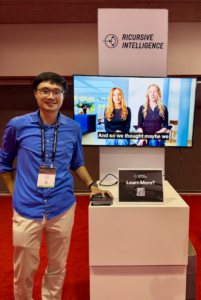 I spoke with Yi-Chen Lu. Ricursive Intelligence (spelled with “Ri” on purpose) offers an end-to-end, AI native chip design service. The company serves those customers that have a product vision that includes a custom chip, but doesn’t have the required team to get the job done.
Ricursive Intelligence provides performance architects to work with customer to design and deliver the critical custom chip. Capabilities include formal verification, and a very fast implementation flow. The company can go from RTL to GDS in minutes.
This flow includes many innovative, fast and accurate tools that Ricursive built from the ground up. Large customers have used some of these tools and found that they deliver superior results. The flow is AI native, so there has been significant training from the start in semiconductor design. The customer’s design data is also added to these models to make them specific to a particular customer’s needs.
The only customer that can be mentioned at present is Nvidia. Nvidia has an advanced hardware design team, but they use Ricursive Intelligence technology to extent their productivity. That is quite an endorsement for the Ricursive Intelligence flow. If you need an advanced chip designed, this organization is one to contact.
Silimate
 I spoke with Ann Wu. Silimate has a large footprint for agentic chip design. At the TSMC OIP event the company focused on optimizing PPA using TSMC technology – helping digital design teams tape out PPA optimized chips faster.
From a bigger picture point of view, Silimate offers a complete system solution that ingests customer collateral and improves results autonomously. The tools blend with the customer’s existing flows and models to deliver superior results very fast.
Many of Silimate’s customers stopped by the kiosk during the event. The company seems to be building strong momentum across many applications and markets.
The offer to “converge to your PPA targets and fix functional bugs in days instead of months” is quite compelling. Silimate is a company to watch. I understand why TSMC chose to offer this organization a spot in the Emerging Technologies Alley.
Vinci
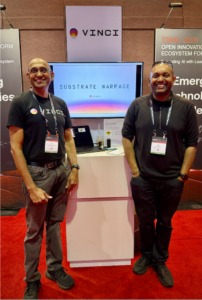 I spoke with Satish Radhakrishnan (on the left) and Hardik Kabaria (on the right). Vinci delivers a physics AI foundation model that natively understands the governing laws of physical systems. It combines AI acceleration with FEA solver accuracy to deliver full manufacturing-resolution simulations — without approximations.
It was pointed out that physics problems and the manifestation of thermal and thermal-mechanical problems are linked to performance, manufacturing, and advanced packaging. Growing design complexity is demanding that all these related issues must be addressed holistically, and problems must be detected early.
This is the only way to avoid the nightmare of discovering something like package warpage weeks before product introduction. This is the domain of Vinci, and a close relationship with TSMC will help to ensure manufacturing and advanced packaging dynamics are well understood.
One way to think about the impact of Vinci is to realize that one can now take multiphysics analysis and “shift left” to find problems much earlier, when they are easier to fix. After my conversation at the Vinci kiosk, I realized something else. Call it “the art of the possible.” By shifting accurate multiphysics analysis earlier in the design flow, it is now possible to not just optimize the current approach, but to also find a better approach. And that has significant implications.
To Learn More
I have just scratched the surface on what these six companies offer. If you want to dig deeper, the company website is great place to start. Many of these companies are also covered on SemiWiki, so I’ve included those links as well.
Ricursive Intelligence website
And that’s how the TSMC OIP Ecosystem Forum 2026 provided a spotlight on emerging technologies.
Also Read:
TSMC’s AI Design Kit: Bringing Agentic AI Into Chip Design
TSMC OIP Ecosystem Forum 2026: Broadcom’s View of ASICs and Ecosystems
Why Advanced Chip Packaging Is Becoming a Design Problem
Share this post via:




Comments
There are no comments yet.
You must register or log in to view/post comments.