





Agentic AI is beginning to move semiconductor engineering beyond copilots and isolated task automation.
From Agentrys’ public material and recent discussion, its architecture points toward a broader engineering flow:
Specification → RTL → verification → synthesis / physical design → PPA optimization → physical verification → sign-off-clean GDS
The platform combines hierarchical agents, bounded iteration loops, objective functions, provenance, and a knowledge base intended to feed engineering experience back into subsequent decisions. Its broader model—Onboard → Evolve → Scale—suggests a progression from automating established engineering workflows toward reusable and increasingly capable agents.
That direction is important, but as agentic systems move deeper into semiconductor development, the engineering question changes. The issue is no longer simply whether an autonomous system can produce a valid GDS. The more consequential question is whether it can repeatedly produce a trustworthy design that an engineering organization is willing to tape out—and what evidence supports that confidence.
That distinction may define the next phase of agentic semiconductor design.
Repeatable Convergence
One of the most important questions is repeatability.
Agentrys has demonstrated its approach across multiple RISC-V specifications, providing useful evidence that the architecture can operate across different design inputs. A different experiment would reveal something equally important: behavioral consistency under controlled conditions.
Take exactly the same specification, PDK/library, EDA tools, constraints, and objective function, then launch multiple independent agentic runs. Compare the resulting distributions of:
frequency
power
area
floorplan and physical architecture
sign-off results
time to convergence
number of iterations to closure
Do the runs converge into a reasonably narrow solution region while meeting the required performance and execution-speed targets? Or do they produce materially different physical implementations, PPA outcomes, and convergence times while still satisfying the formal constraints?
Neither result necessarily means the system is good or bad. Semiconductor design contains large solution spaces, and different valid implementations can exist. What matters is whether the system can repeatedly reach acceptable engineering outcomes within the required performance, quality, and time boundaries.
For an autonomous engineering system, repeatability does not have to mean identical layouts. It means understanding the range of outcomes the system produces under controlled conditions. That gives an engineering organization something more useful than a single successful run: a measure of behavioral consistency.
Valid GDS Versus Trustworthy GDS
Producing sign-off-clean GDS is an important milestone. Agentrys has publicly reported an AgentCore CPU implementation using open-source tools and the ASAP7 predictive library, including reported frequency, area, and clean physical-verification results. That demonstrates capability.
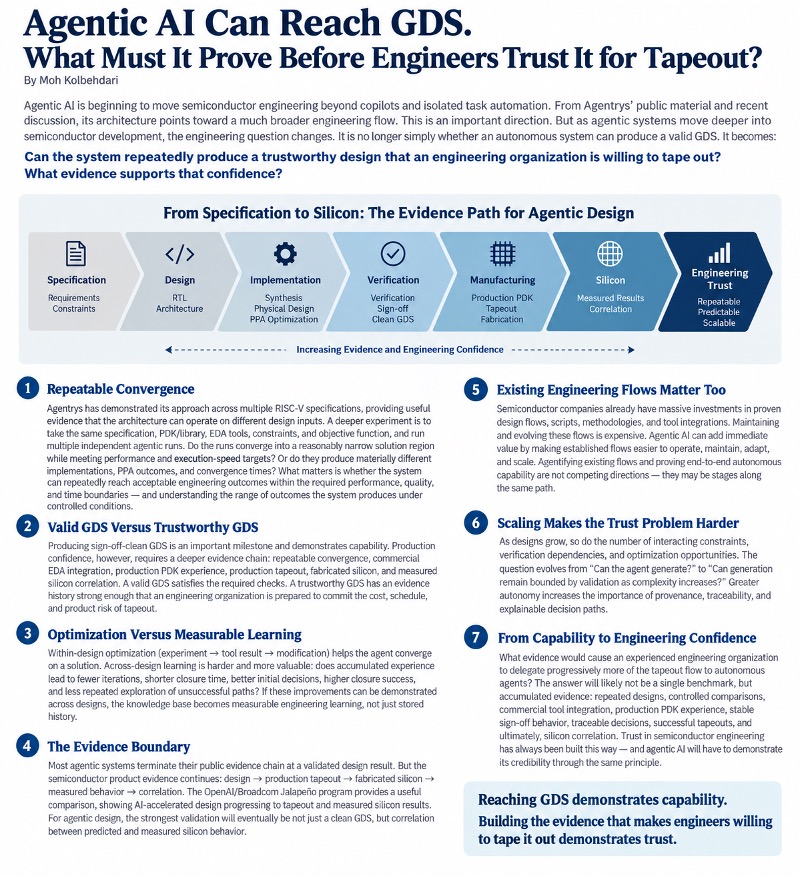
Production confidence, however, requires a deeper evidence chain:
repeatable convergence
↓
commercial EDA integration
↓
production PDK / advanced-node environment
↓
production tapeout
↓
fabricated silicon
↓
measured silicon correlation
Each step answers a different engineering question: can the agents operate the tools, close the design, do so repeatedly, work within production-qualified environments, and ultimately produce silicon that behaves as predicted?
This is why I distinguish between a valid GDS and a trustworthy GDS. A valid GDS satisfies the required checks within the demonstrated environment. A trustworthy GDS has an evidence history strong enough that an engineering organization is prepared to commit the cost, schedule, and product risk of tapeout.
The practical question eventually becomes: what is the probability that this system repeatedly produces a design I am willing to tape out, and what evidence supports that confidence?
Optimization Versus Measurable Learning
Agentrys’ Evolve concept raises another important issue. The company describes a continuously curated knowledge base containing design recipes, tool behavior, PPA-closure heuristics, and sign-off lessons, with completed engineering work feeding subsequent decisions.
That creates the possibility of something more significant than workflow automation. But there is an important distinction between two loops.
Within-design optimization
experiment → tool result → modification → next experiment
The agent improves its next action within a particular design trajectory.
Across-design learning
validated experience from one design → improved decisions on subsequent designs
The second loop is much harder—and potentially much more valuable. A system can accumulate enormous amounts of history without demonstrating that the history improves future engineering outcomes.
Transferable learning should therefore become measurable. Does accumulated experience produce:
fewer iterations?
shorter closure time?
better initial decisions?
higher closure success?
narrower outcome distributions?
less repeated exploration of previously unsuccessful paths?
If those improvements can be demonstrated across designs, the knowledge base becomes more than stored history. It becomes measurable engineering learning.
The Evidence Boundary
Most EDA-oriented agentic systems naturally terminate their public evidence chain at a validated design result. That is a legitimate boundary: EDA produces the information required to manufacture the device; it does not manufacture the silicon itself.
But semiconductor product evidence continues beyond GDS. The deeper loop is:
model-assisted design → production tapeout → fabricated silicon → measured behavior → correlation
Closing that loop matters because models, libraries, tools, constraints, and agent decisions ultimately represent predictions about a physical product.
A useful comparison is the OpenAI/Broadcom Jalapeño program. The comparison needs to be made carefully: OpenAI has not publicly claimed that Jalapeño was produced by a completely autonomous RTL-to-GDS agent. Its public description instead indicates that AI accelerated portions of the design and optimization process.
But the program provides another kind of evidence: it progressed from design into manufacturing tapeout and subsequently into measured fabricated-silicon results. That creates a deeper evidence loop.
For agentic semiconductor engineering, reaching that point will be significant. The strongest validation of an autonomous design system will eventually be not simply that its GDS passes design checks, but that its predictions correlate with the behavior of manufactured silicon.
Existing Engineering Flows Matter Too
Duo Ding raised an important point in the discussion around the original version of this article. Semiconductor companies already possess enormous investments in legacy design flows, scripts, methodologies, tool integrations, and engineering knowledge. Those flows work, but maintaining and evolving them is expensive.
That means the near-term opportunity for agentic AI is not limited to replacing an existing semiconductor development process with an entirely autonomous one. There is substantial value in making established flows easier to operate, maintain, adapt, and scale.
This may be one of the most practical paths toward greater autonomy. An agent operating inside an existing engineering flow inherits boundaries that experienced engineers have already established. Its performance can be compared with known results, and engineers can observe where it succeeds, where intervention remains necessary, and which tasks can safely be delegated.
That creates evidence gradually. In that sense, agentifying existing flows and proving autonomous end-to-end capability are not competing directions. They may be stages along the same path.
Scaling Makes the Trust Problem Harder
Agentrys’ Onboard → Evolve → Scale direction is logical. But scaling an autonomous semiconductor engineering system is not only an agent-scaling problem.
As designs grow, so do the number of interacting constraints, possible implementation paths, verification dependencies, optimization opportunities, local optima, physical-design interactions, and the consequences of decisions made earlier in the flow.
The question therefore evolves from whether the agent can generate to whether generation can remain bounded by validation as complexity increases—and whether validated outcomes can become reusable engineering learning without losing traceability and engineering confidence.
This is where provenance becomes particularly important. If an autonomous system changes a constraint, modifies RTL, selects a physical-design strategy, reacts to a tool result, or chooses among competing PPA alternatives, engineers eventually need to understand not only the final result but the evidence trail that produced it.
Greater autonomy increases the importance of that evidence.
From Capability to Engineering Confidence
This leads to what I think is the central question for the next phase of agentic semiconductor engineering: what evidence would cause an experienced engineering organization to delegate progressively more of the tapeout flow to autonomous agents?
The answer will probably not be one benchmark. It will be accumulated evidence:
repeated designs
controlled comparisons
commercial tool integration
production PDK experience
stable sign-off behavior
traceable decisions
successful tapeouts
eventually, silicon correlation
Trust in semiconductor engineering has always been built this way. Design rules are trusted because they are validated. Models are trusted because they are correlated. Processes are trusted because they demonstrate repeatability. Sign-off flows are trusted because their relationship to manufacturing outcomes has been established over time.
Agentic AI will likely have to build its engineering credibility through the same principle.
The webinar convinced me that agentic chip design is moving beyond isolated copilots toward long-running engineering workflows. The next major milestone should therefore not be viewed simply as another demonstration that AI can reach GDS.
It will be evidence that autonomous engineering can converge repeatably, learn measurably, operate within trusted production flows, preserve traceability, and ultimately correlate design decisions with fabricated silicon.
Reaching GDS demonstrates capability.
Building the evidence that makes engineers willing to tape it out demonstrates trust.
Also Read:
Podcast EP365: How Agentrys is Revolutionizing Chip Design with Mark Ren
Follow the Money – Agentrys Raises $24.5 Million to Build Agentic Design Automation
Agentrys Shows You How to Build a Multi-Agent System in 30 Minutes
Share this post via:



Comments
There are no comments yet.
You must register or log in to view/post comments.