






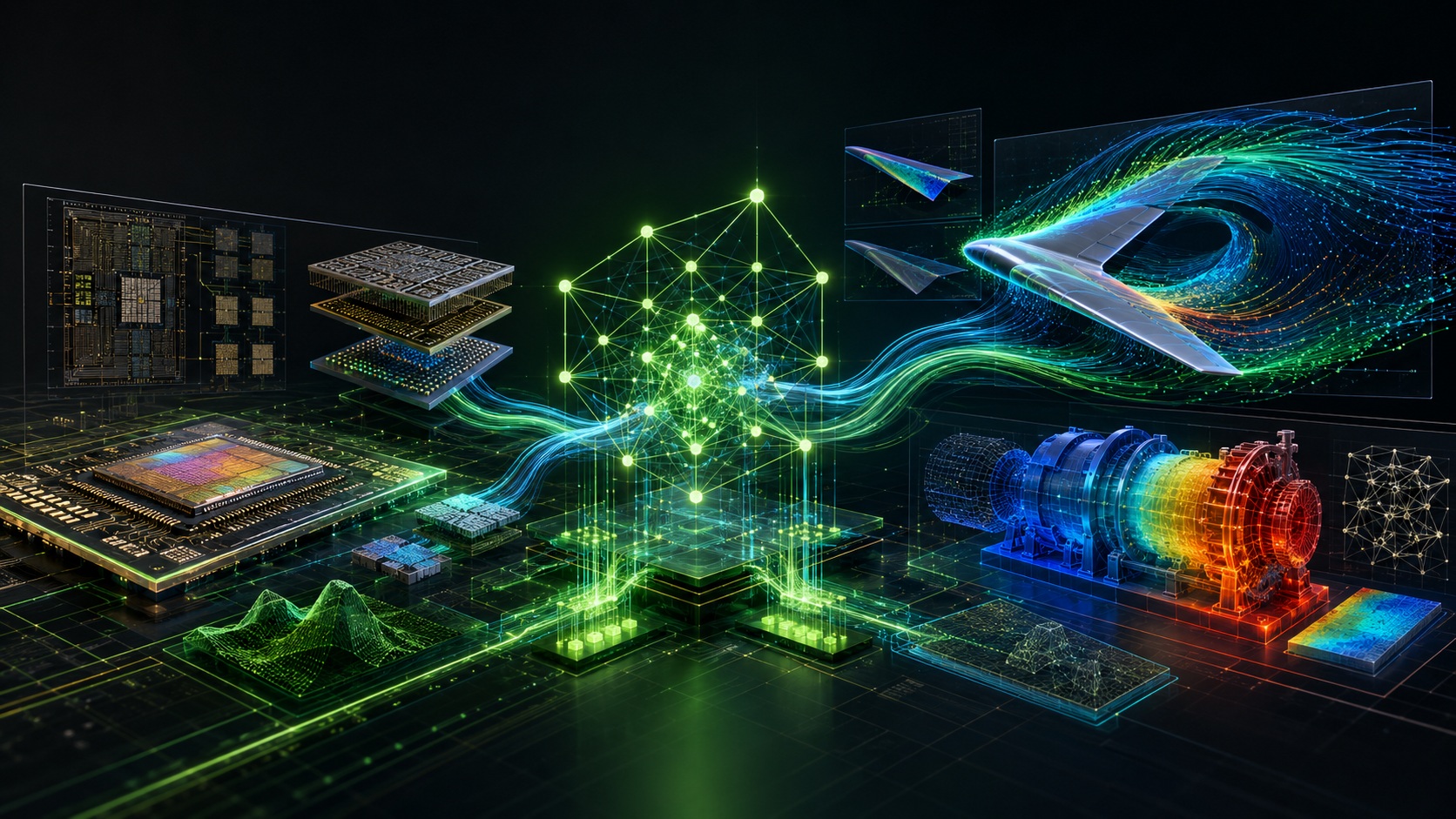
NVIDIA’s expansion of the NVIDIA Agent Toolkit with PhysicsNeMo and CUDA-X libraries marks a shift from general-purpose AI assistants toward autonomous engineering systems. Instead of limiting agents to document retrieval, code generation, or workflow automation, the expanded toolkit lets developers connect reasoning models directly to physics models, numerical solvers, simulation environments, and electronic-design tools. The objective is an “agentic engineer” that can formulate a technical plan, invoke specialized software, evaluate results, and iterate toward a validated design.
PhysicsNeMo supplies the physics-AI layer. The open-source framework supports building, training, fine-tuning, and deploying scientific machine-learning models that combine simulation data with physical constraints. Its architectures include neural operators, graph neural networks, point-cloud models, physics-informed neural networks, and generative models. These methods can serve as surrogate models for computationally expensive simulations in computational fluid dynamics, structural mechanics, thermal analysis, electromagnetics, and semiconductor manufacturing. Within an agent workflow, a trained surrogate becomes a callable tool: the agent can rapidly estimate a design’s behavior, identify promising candidates, and reserve high-fidelity solvers for final verification.
CUDA-X contributes the accelerated numerical foundation. NVIDIA’s new cuISS library provides composable iterative sparse solvers and preconditioners for large systems arising from discretized partial differential equations. cuDSS supplies direct sparse solvers designed for numerically robust device, circuit, system, and scientific simulation, with multi-GPU and multi-node scalability. cuEST extends the stack into electronic-structure calculations, including density functional theory and post-DFT methods. Together, these libraries enable an agent to do more than recommend parameters: it can launch GPU-accelerated calculations whose outputs are grounded in established numerical methods.
The resulting architecture separates reasoning from computation. A language or reasoning model interprets engineering goals, maintains workflow state, and chooses tools. PhysicsNeMo models provide fast learned approximations. CUDA-X solvers produce higher-fidelity numerical results, while domain software applies constraints and signoff rules. An agent can therefore move through a loop of hypothesis, simulation, measurement, optimization, and verification. For example, a thermal-design agent might generate cooling geometries, use a surrogate to rank them, run detailed simulations on finalists, inspect hotspots and pressure losses, then revise the geometry automatically.
NVIDIA is also targeting semiconductor design. Nemotron 3 Ultra, paired with NVIDIA Research’s ACE-RTL agent, is positioned for agentic register-transfer-level coding. NVIDIA says the model leads open models on a comprehensive Verilog design benchmark and can be post-trained on proprietary data for local or on-premises deployment. That combination matters because chip-development agents must handle sensitive intellectual property while generating RTL, debugging failures, operating verification tools, and preserving traceability.
Major engineering-software vendors are integrating parts of the stack. NVIDIA reports that Cadence is applying accelerated computing and agentic systems to packaging and PCB design; Synopsys is developing autonomous thermal-optimization and verification workflows; and Siemens is orchestrating multiple tools and agents across semiconductor, 3D-IC, PCB, and system design. Reported examples include more than tenfold faster library characterization at Siemens, up to twentyfold multiphysics acceleration at Cadence, and large gains in computational lithography, electromagnetic simulation, and quantum chemistry. ChipAgents is using NVIDIA Agent Toolkit to build domain-specific AI agents for chip design and verification. The team is fine-tuning NVIDIA Nemotron models for complex end-to-end semiconductor design and verification workflows including debug, formal verification, coverage and more.
The practical result could be shorter iteration cycles, broader exploration of alternatives, and better utilization of expensive simulation infrastructure across distributed engineering organizations worldwide.
The technical value, however, depends on governance. Engineering agents must expose assumptions, preserve inputs and solver versions, quantify uncertainty, enforce operating limits, and require independent verification before manufacturing decisions. A surrogate’s speed is useful only within its validated domain, while an agent’s fluent explanation cannot substitute for convergence testing, physical signoff, or expert review.
Bottom line: NVIDIA’s strategy is therefore broader than adding another AI interface. It is converting accelerated-computing libraries and physics models into standardized agent skills. If those skills remain interoperable, auditable, and tightly coupled to validated solvers, agents could compress design-space exploration from a manually coordinated sequence into a continuous computational process. That would change how teams engineer products: humans would define objectives, constraints, and acceptance criteria, while autonomous systems execute and refine much of the simulation and optimization loop.
Also Read:
Rethinking Formal Verification in the AI Era
Whalechip Uses ChipAgents to Compress Root Cause Analysis into Minutes
Share this post via:



Rethinking Phase Jitter: An Algorithmic Approach to Signal Integrity