



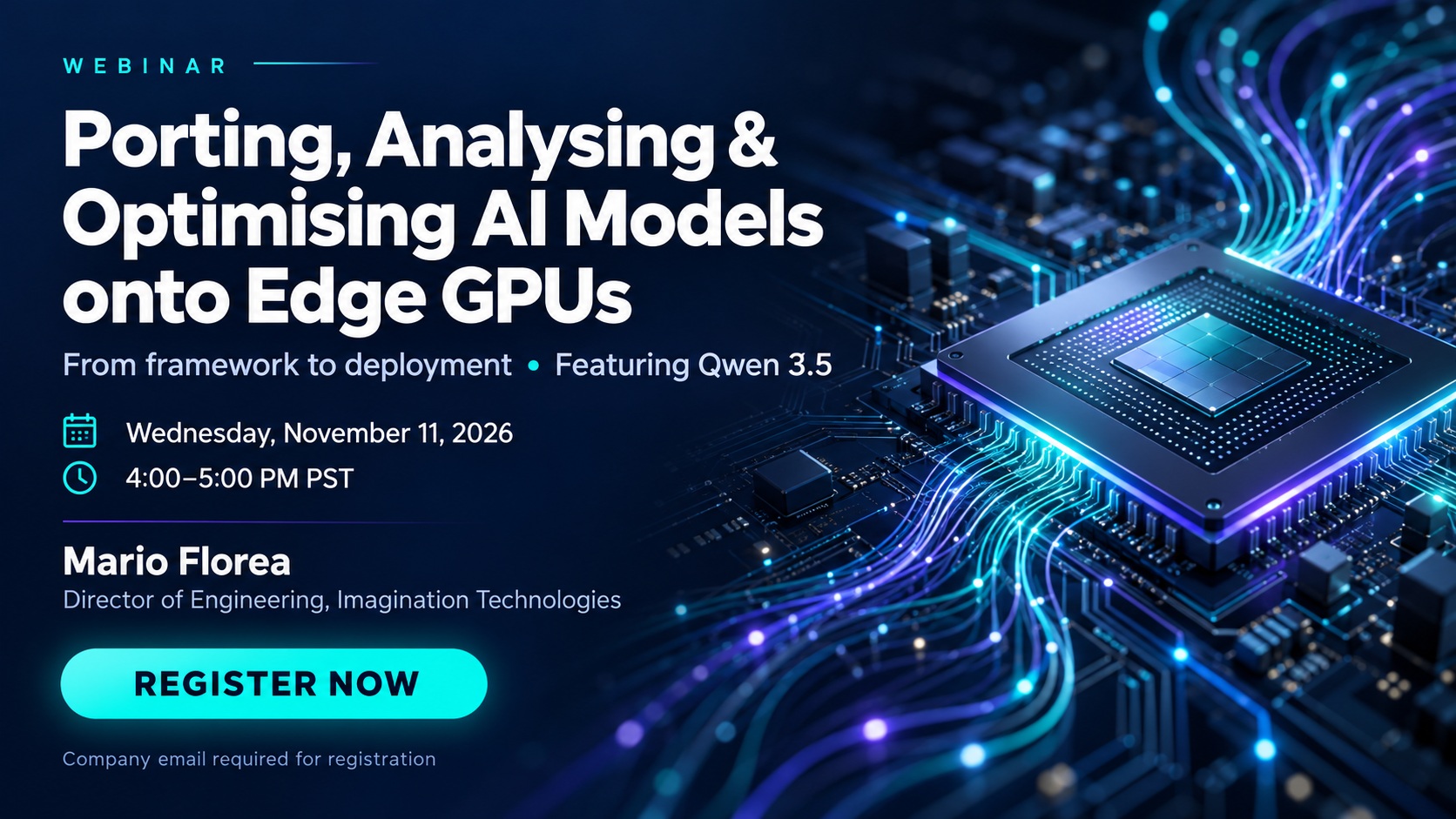
Modern AI models are opening up new possibilities at the edge. Turning those possibilities into responsive, efficient applications, however, requires more than choosing hardware with an impressive TOPS figure. Developers need to understand how models behave on their target devices, where performance is lost, and which optimisations will make a meaningful difference.
Join Imagination Technologies for Porting, Analysing & Optimising AI Models onto Edge GPUs, a practical webinar exploring the journey from AI framework to deployment. Using Qwen 3.5 as a working example, the session will examine how to bring modern AI models onto edge GPUs and improve their performance within the constraints of edge devices.
Whether you are preparing to deploy a model, investigating disappointing inference performance, or evaluating your approach to GPU acceleration, this session will help you connect model requirements with the realities of implementation.
Follow the complete deployment journey
Getting a model running is an important milestone, but it is only part of the process. Understanding what happens between the original framework and the deployed application is essential to making informed engineering decisions.
This webinar will walk through the end-to-end workflow of porting, analysing and optimising AI models for edge GPUs. You will explore how the stages fit together, why performance analysis matters throughout the process, and how a structured approach can guide optimisation work.
With Qwen 3.5 providing a practical reference point, the session will connect the discussion to a modern model rather than leaving the workflow at the level of abstract principles.
Find the bottlenecks that matter
Where should you focus when a model runs, but does not deliver the throughput or responsiveness your application needs?
The session will explore how profiling tools help developers identify performance bottlenecks and understand where optimisation effort can have the greatest impact. By examining model execution more closely, developers can move from assumptions about performance to decisions grounded in observed behaviour.
You will also learn about leveraging optimised kernel libraries as part of the deployment workflow, and how these resources support efforts to maximise throughput, responsiveness and efficiency on edge devices.
For teams balancing multiple performance goals, this perspective can help frame the right questions: what is limiting execution, which changes deserve attention, and how should improvements be assessed against the needs of the application?
Prepare for evolving AI workloads
AI development continues to move quickly. Models change, operators evolve, and application requirements expand. An approach that supports today’s workload must also give developers room to adapt.
The webinar will explore how a programmable GPU architecture helps developers respond as AI workloads evolve. This discussion will connect architectural flexibility with the practical challenge of bringing emerging AI capabilities to resource-constrained devices.
Learn from an engineering leader
Your speaker, Mario Florea, Director of Engineering at Imagination Technologies, leads engineering efforts focused on AI software for GPU-accelerated edge inference.
His work centres on enabling efficient, high-performance AI workloads on resource-constrained devices, bridging modern AI models and highly optimised GPU hardware. Bringing a background in engineering and technology leadership, Mario works at the intersection of AI software and GPU architecture to help translate emerging capabilities into practical edge solutions.
Make your next edge AI deployment more informed
If your work involves AI software, GPU acceleration, model deployment or edge inference, join this session for a clearer view of the workflow, tools and architectural considerations behind efficient execution.
Build your understanding of how to take a model from framework to deployment, investigate its performance, and identify opportunities for improvement.
Also Read:
Share this post via:


Comments
There are no comments yet.
You must register or log in to view/post comments.