



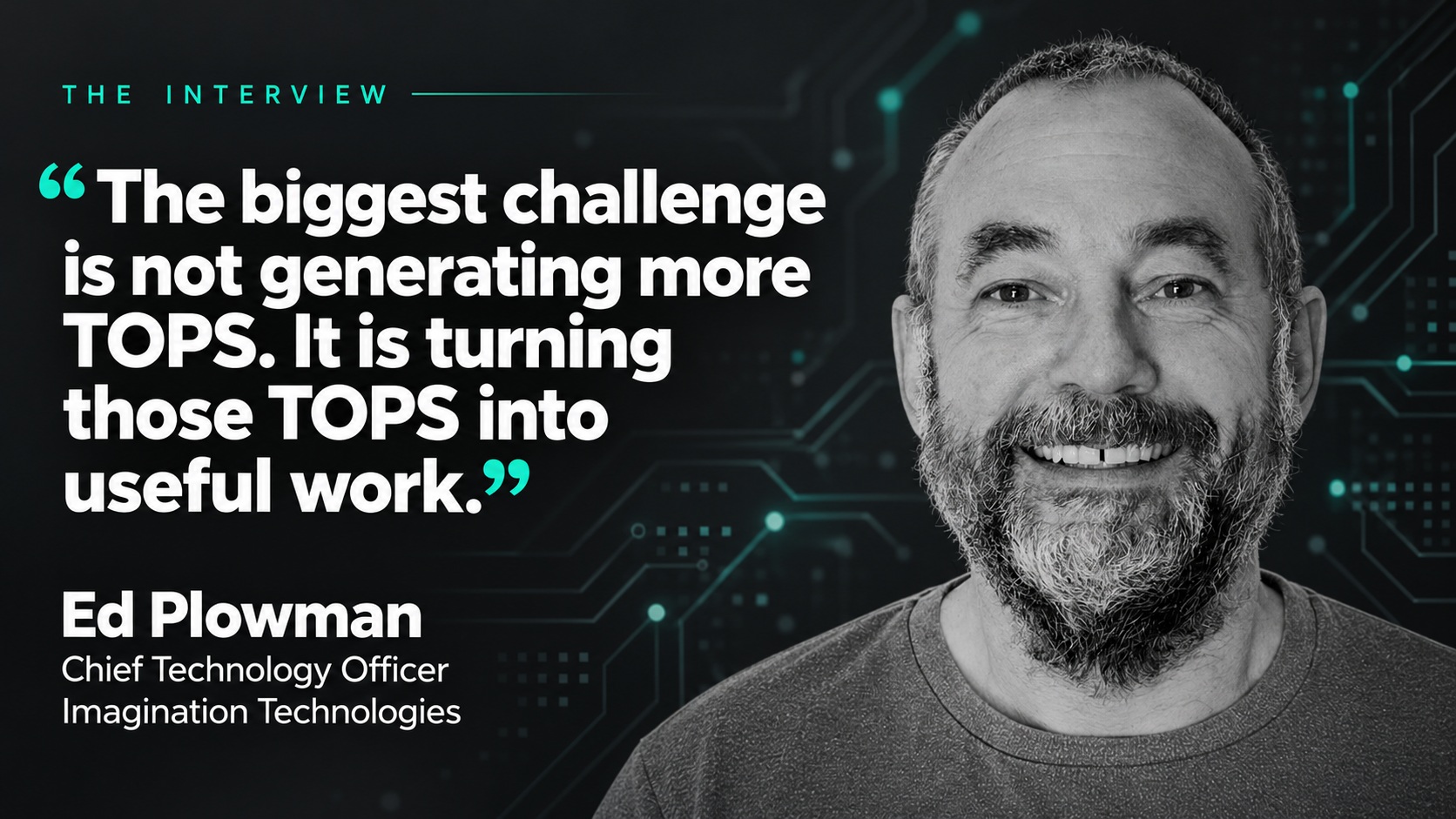
Ed Plowman is Chief Technology Officer at Imagination Technologies, where he leads technology strategy, advanced architecture research and long-term innovation initiatives. He focuses on the convergence of graphics, compute and artificial intelligence, helping shape the next generation of efficient and adaptable computing platforms for automotive, edge and intelligent systems markets.
What brought you to Imagination Technologies?
My connection with Imagination Technologies goes back a long way. Early in my career I worked alongside teams putting Imagination graphics technology into real products, so I saw first-hand what a well-designed, efficient architecture could enable.
What always appealed to me was the willingness to challenge conventional thinking and take on genuinely difficult engineering problems. When the opportunity came to join Imagination and help shape where the technology goes next, it felt less like joining somewhere new and more like picking up a thread that had run through much of my career.
That is particularly interesting now. AI and increasingly complex workloads are changing what customers need from computing platforms, and efficiency and adaptability matter at least as much as headline performance.
What is the biggest challenge your customer is facing?
The biggest challenge is not generating more TOPS. It is turning those TOPS into useful work.
Customers are trying to run graphics, computer vision, AI inference, sensor processing and conventional software at the same time, usually inside fixed power, thermal and cost envelopes. Everything is competing for the same resources.
The industry likes peak performance numbers, but customers don’t ship benchmarks. They ship products. Memory bandwidth, data movement, utilisation, latency and software overhead can matter as much as the theoretical capability of the compute. If you cannot get at the performance efficiently, the number on the datasheet is largely academic.
So the real problem is useful, predictable performance in the system, not simply making the TOPS number bigger.
Why is your approach to solving this problem unique?
Our bias is towards adaptable, programmable compute rather than hardening everything around today’s workload. AI is moving extraordinarily quickly. Model architectures, data formats and optimisation techniques can change in months, while semiconductor development cycles are measured in years.
That makes flexibility important. We optimise for delivered performance, not benchmark performance. Customers cannot ship theoretical TOPS; they have to ship a product that does useful work within real power, thermal, memory and cost constraints.
That also means looking at the whole problem. There is little point scaling the compute engine if memory movement, orchestration or software stops you using it. Efficient parallel processing matters, but so do the compiler, tools, workload mapping and the software ecosystem around it.
The aim is fairly simple: keep the architecture open and adaptable enough that customers can optimise for what they actually need, including workloads we cannot predict perfectly today.
What other approaches are being used to solve this problem?
There are perfectly valid alternatives. One is a tightly integrated hardware and software ecosystem, where the whole stack is controlled and optimised together. That has produced some very impressive results, particularly in cloud AI.
Another is dedicated neural processing hardware. If the workload matches the assumptions made when the hardware was designed, that can be extremely efficient.
The question is how long those assumptions remain true. Fixed-function hardware absolutely has a place, but the more specialised you become, the more certain you need to be about the workload. AI is not especially good at giving us that certainty at the moment.
So it is really a question of where you draw the line between specialisation, programmability and efficiency and how expensive it is to move that line later.
What challenges will your customers face in the near future?
Uncertainty is probably the biggest one. We make technology decisions years before products reach the market, while an important AI technique can move from a research paper to deployment in months.
Automotive makes that particularly stark. Validation and safety requirements are substantial, product development takes years and vehicles can remain in the market for well over a decade. You are effectively making architectural bets today against workloads that may not properly exist yet.
That is why I keep coming back to flexibility. Raw performance still matters, obviously, but customers also need platforms that remain useful when the workload changes underneath them. Over-specialise too early and today’s optimisation can become tomorrow’s constraint.
How has AI changed your business strategy?
We increasingly don’t think of AI as a separate market. It is becoming part of almost every market we serve and, increasingly, part of graphics itself. That reinforces the case for efficient parallel compute, scalable software and architectures that can support a broad mix of workloads.
It has also changed how I think about the balance between hardware and software. There are important things we can and should do in hardware, but the bigger opportunity is often in software: compilers, tooling, workload mapping and using AI itself to optimise applications for the architecture. You cannot bridge every software gap simply by throwing more engineers at it.
The same applies internally. AI can take repetitive analysis and optimisation work away from engineers and give them more time for the difficult problems where engineering judgement actually matters.
For me the strategic lesson is straightforward: AI is moving too quickly to pretend we know exactly what the dominant workload will look like several years from now. Build efficient, malleable hardware, invest heavily in the software that makes it useful, and keep enough flexibility to move when the market moves.
Also Read:
WEBINAR: Porting, Analysing & Optimising AI Models onto Edge GPUs
WEBINAR: The Convergence of Edge Accelerators
Significant Performance Gains Reinforce Imagination’s GPU-First Strategy
Share this post via:


Comments
There are no comments yet.
You must register or log in to view/post comments.