





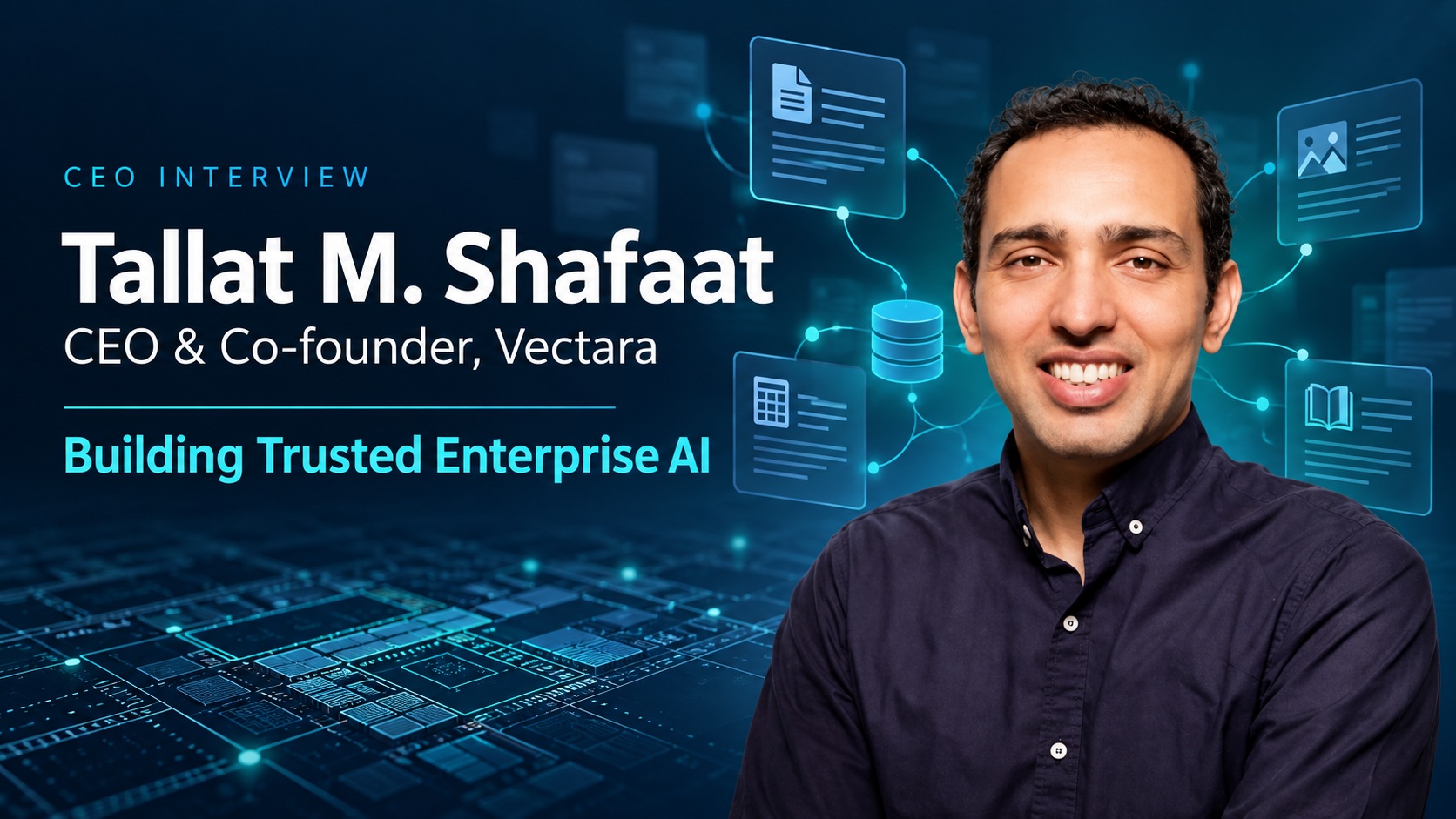
Tallat M. Shafaat is CEO and co-founder of Vectara, an enterprise AI company that helps organizations build AI applications capable of retrieving information and generating reliable, grounded responses. Prior to founding Vectara, he worked at Google, contributing to its Search and Ads infrastructure, including the Knowledge Graph indexing team.
Tallat brings extensive expertise in distributed systems, cloud computing, search infrastructure, and scalable data platforms. His work sits at the intersection of information retrieval and generative AI, with a focus on making AI applications more dependable, scalable, and practical for real-world enterprise use. He is particularly focused on addressing the technical challenges involved in connecting large language models with trusted enterprise data to deliver responses that are relevant, transparent, and grounded in source material. Tallat holds a Ph.D. in large-scale distributed systems from KTH Royal Institute of Technology in Sweden.
Tell us about your company?
Vectara provides a unified enterprise AI agent platform designed for mission-critical applications, combining accurate, grounded information retrieval with the tools organizations need to build, deploy, and govern trustworthy AI agents at scale. The platform brings together multimodal data ingestion and parsing, hybrid search and reranking, hallucination detection and evaluation, and agent orchestration capabilities.
By consolidating these capabilities into a single, secure, and observable platform, Vectara enables engineering, support, and operations teams to develop reliable AI applications on a shared foundation of enterprise knowledge and context, eliminating the need to build and maintain fragmented infrastructure for each agent. Vectara is available as a fully managed SaaS offering, within a customer’s virtual private cloud, or on-premises, including in air-gapped environments.
Founded in 2020 and headquartered in Silicon Valley, Vectara is SOC 2 Type II certified and HIPAA compliant, providing enterprises with a foundation for deploying AI in security-sensitive and regulated environments. Gartner has recognized Vectara as a Representative Vendor in Enterprise AI Search.
What problems are you solving?
Enterprise data is complex. Answers live across multimodal sources such as documents, images, tables, tickets, logs, and operational systems, each with its own access rules. Most teams cope by building a separate pipeline for every agent, which is how fragmentation and agent sprawl begin. We address this complexity by providing seamless intelligence across these sources, respecting each source’s access controls, on one platform for every agentic use case, whether you run on-premises, in a private cloud, or in a public cloud.
Getting every source into one place is only the start. Context is what makes that data useful to an agent. We unify your data into actionable context for the agent harness and automatically enrich metadata for access control, reranking, and context. The result is one data layer serving every agent, making it quick and inexpensive to add each new one. Without that context, agents give answers based on partial evidence, leading to inaccurate or misleading responses.
That is what builds confidence. Every answer comes with full observability and one-click, verifiable traceability from answer to source. You get higher accuracy, fewer hallucinations, and measurable results. You also get one set of guardrails and a full audit trail, instead of agents running wild.
What application areas are your strongest?
Vectara serves leading semiconductor companies, including Altera, Broadcom, and SanDisk, helping them deploy reliable AI across mission-critical engineering, manufacturing, and customer support workflows. Broadcom reports 85% support containment using Vectara to power customer support environments built on a single index of more than 4 million documents serving over 2 million users. The platform also supports approximately 40,000 Broadcom employees through its internal helpdesk. With three deployments in place, Broadcom has standardized on Vectara as its enterprise agentic AI platform.
Vectara is also delivering measurable gains in failure analysis where a leading memory manufacturer increased retrieval accuracy from 40% to 90%. The solution has also transformed the engineering workflow: a single engineer can now perform work that previously required a five-person AI team. In yield acceleration, AI helps teams correlate wafer, process, and test data across fab sites, enabling faster investigation and resolution of manufacturing issues. In design acceleration, AI agents access and leverage specifications, netlists, and verification history within active design workflows, helping engineers find critical information faster and make more informed decisions.
What keeps your target customers up at night?
The first risk is an agent delivering a confidently wrong answer. When an agent sees only part of the evidence, it can give a wrong answer that an engineer acts on. In failure analysis, the difference between a retest and identifying the root cause can depend on which sources the agent can access. Teams worry that they cannot demonstrate accuracy, making it difficult to put agents into production. A large memory manufacturer improved retrieval accuracy from 40% to 90%, and we evaluate responses for hallucinations and score performance.
The second challenge is protecting intellectual property. Design data, process records, test programs, and customer or partner information cannot leave the building, and an agent exposing information a user is not authorized to access can cause a serious incident. Customers need agents to enforce each user’s permissions at query time, maintain a complete audit trail, and operate on a platform that never trains on their data. We support SaaS, VPC, on-premises, and fully air-gapped deployments.
The third concern is the burden of maintaining agents at scale. One agent is manageable. By the fifth, someone must maintain the connectors and evaluation framework, and explain to auditors which documents each agent accessed. Teams also worry about being locked into a single LLM. For example, one of the top 10 global semiconductor companies runs more than a dozen use cases on one platform without LLM lock-in.
What does the competitive landscape look like and how do you differentiate?
The competitive landscape includes frontier model providers, turnkey AI platforms, open-source frameworks, hyperscaler retrieval services, and specialized tools for process control, visual inspection, and product lifecycle management. Each addresses a specific part of the problem, but enterprises often must integrate multiple components, manage complex infrastructure, and build their own governance.
Semiconductor failure analysis illustrates our competitive advantage. Most customers run these workflows on-premises because their sensitive data and intellectual property cannot leave their environments. Their alternative is often an internal quality or failure analysis team building its own AI solution. The challenge is achieving the accuracy needed to identify root causes reliably; inaccurate results can delay investigations and leave failures unresolved. Vectara complements existing failure analysis tools with AI software that retrieves and correlates critical evidence to help engineers isolate and diagnose failures faster. Rather than replacing established tools, we help teams improve diagnostic accuracy, accelerate resolution, and reduce the engineering effort required.
What new features/technology are you working on?
We’re currently focussing on the following four areas, all aimed at running agents in production with confidence: first, an evaluation framework for agents that measures performance before launch, then monitors continuously so you catch degradation before users do; second, self-improving agents that get better over time without manual retuning; third, a business suite that collects and visualizes the business metrics your agents generate, so you can see what they deliver and fourth, financial governance which helps you understand token consumption and reduce it across your applications.
We’re also expanding our managed agents for failure analysis, engineering knowledge search, and support automation. These help teams bring their first workload into production faster while allowing every subsequent use case to build on the same shared data layer.
How do customers normally engage with your company?
Most engagements start with one workload and a working session on the customer’s own data: 30 minutes, understanding their failure modes and application requirements, no slideware. Entry usually comes through one of two doors. Engineering teams start with failure analysis or product design assistance, and corporate IT and support teams start with deflection or the helpdesk. We then scope a first phase. Altera went from POC to production in three months across three use cases, in four phases from ingestion to analytics and handoff. The first use case builds the data and context layer, and every subsequent one reuses it.
Share this post via:


The $725 Million Chip Development: Why Execution Risk, Not IP Cost, Now Dictates Advanced-Node Survival