


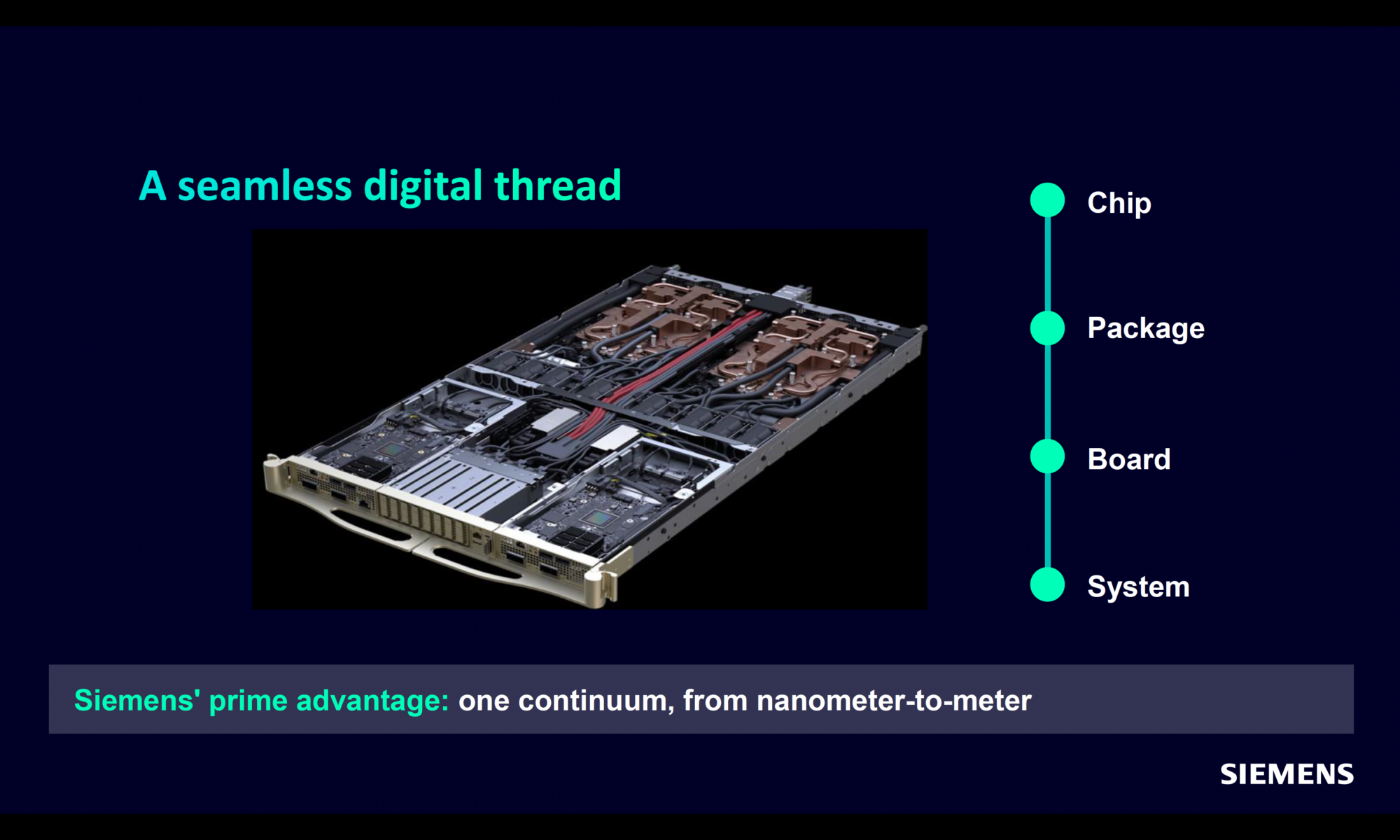

As data rates climb into 112 Gbps and 224 Gbps regimes, high-speed electronic systems design is running into a wall. Printed circuit boards are no longer passive interconnections; they have become complex three-dimensional environments where trace geometry, dielectric loss, and layer stackups dictate whether a system operates or fails. Yet, while board complexity accelerates, the global pool of signal integrity (SI) and power integrity (PI) specialists qualified to verify these systems is steadily shrinking.
To break this bottleneck, Siemens EDA introduced the HyperLynx Agentic Toolkit. Rather than asking engineers to rely on generative AI models that estimate outcomes probabilistically, Siemens is coupling natural language orchestration directly with its physics-based simulation solvers. The result is a shift from manual, specialist-heavy verification sweeps to autonomous, physics-validated engineering workflows.
The Economics of the Specialist Bottleneck
In most electronics organizations, a small group of SI and PI experts supports dozens of layout designers. Because post-layout verification requires deep domain expertise in both electromagnetic behavior and complex tool configuration, these specialists quickly become the narrowest bottleneck in product development schedules.
To prevent late-stage design flaws, specialists often over-constrain layout rules upfront. This over-constraining demands wider trace clearances, extra shielding layers, or expensive chipsets. However, modern, tightly packed mechanical enclosures rarely offer the space required for such conservative margins. Layout teams are forced to negotiate trade-offs, dragging specialists back into manual reviews. When deadline pressures mount, compressed verification windows increase the risk of undetected signal flaws slipping into production, triggering costly board re-spins.
This operational drag is confirmed by industry survey data commissioned by Siemens and conducted by analyst firm Lifecycle Insights. Across electronics engineering teams:
- 80 percent identified analysis and verification as their top priority for AI adoption.
- 75 percent sought cycle-time reduction as their primary goal.
- 60 percent cited output reliability and result trust as the main barrier to using AI.
- 58 percent flagged data security and cloud IP leakage as critical risks.
“Electronics teams are pushing AI hardest where the pain is greatest,” noted Chad Jackson, Chief Executive Officer and Chief Analyst at Lifecycle Insights. “In verification, AI is only valuable if engineers can trust what it tells them.” Jackson also highlighted a hidden productivity drag: 75 percent of surveyed engineers spend at least four hours every week simply configuring or prompting generic AI tools.
Why Generic LLMs Fail Hardware Engineering
The frustration surrounding AI in hardware engineering stems from a fundamental mismatch between general-purpose models and physical reality. Frontier large language models (LLMs) excel at software development because programming code is text-based and syntactically structured. Generating or refactoring code involves probabilistic pattern matching over textual tokens.
Hardware design operates in three spatial dimensions governed by continuous electromagnetic physics. A circuit board is not a text string; it is a geometric stackup governed by Maxwell’s equations, return path discontinuities, and thermal dissipation.
A standard LLM asked to evaluate a 112 Gbps PAM4 channel can only predict outcomes based on textual probability, as it is estimating what a “typical” design description looks like in its training data. It cannot calculate actual wave propagation or impedance mismatches. In high-speed hardware, an unverified probabilistic guess is worse than no answer at all, as acting on a false positive can waste hundreds of thousands of dollars in prototype re-fabrications.
“In signal and power integrity, a result you can’t trust is worse than no result at all,” emphasized Matt Bromley, Senior Vice President and General Manager of Electronic Board Systems at Siemens. “Engineers need the speed of agentic AI alongside the confidence of proven physics simulation.”
Coupling Agents to Deterministic Solvers
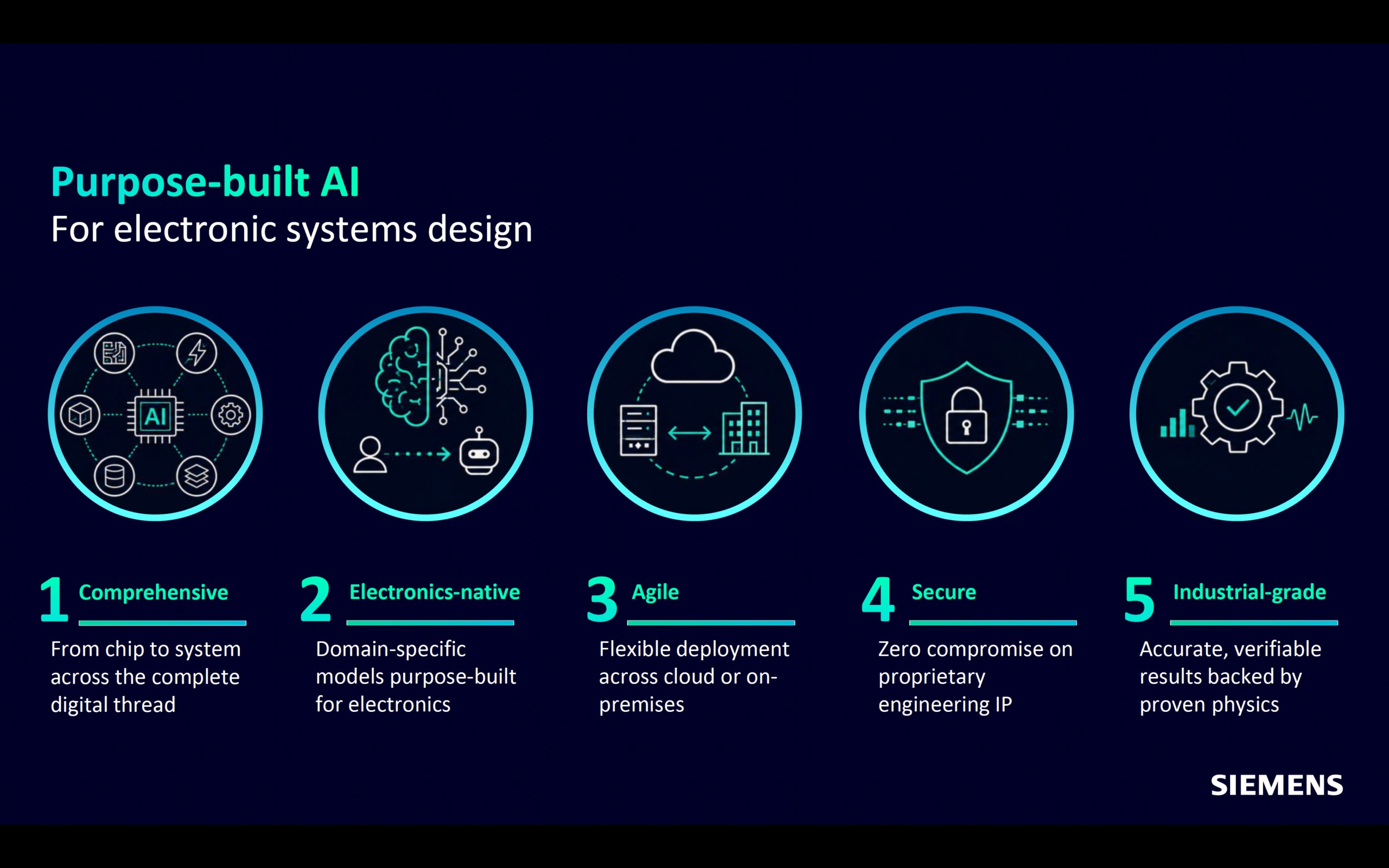
To bridge AI agility with physical precision, Siemens built the HyperLynx Agentic Toolkit on its Fuse EDA framework. To resolve the security concerns raised by 58 percent of survey respondents, the architecture supports fully on-premises deployment using fine-tuned open-weight models, ensuring proprietary design data never leaves the corporate firewall.
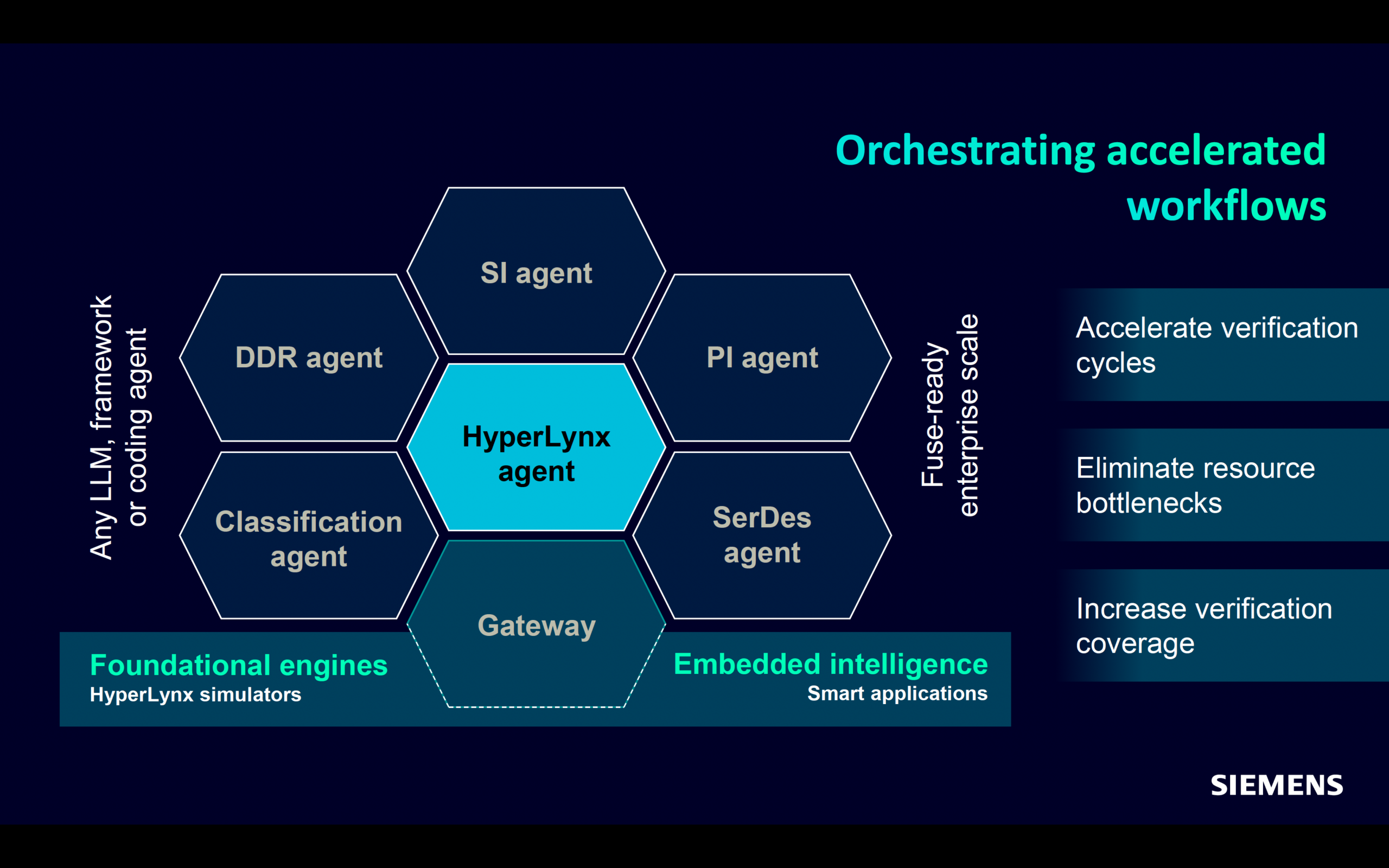
At the center of the system is the HyperLynx Orchestration Agent , which manages a team of specialized AI agents:
- Signal Integrity Agent: Inspects high-speed trace topologies, impedance profiles, and cross-talk risks.
- Power Integrity Agent: Evaluates power delivery network impedance, DC voltage drop, and decoupling capacitor placement.
- SerDes Agent: Manages high-speed link compliance, equalizer tuning (CTLE, FFE, DFE), and PAM4 eye diagram visual analysis.
- DDR Agent: Validates memory interface timing margins and JEDEC protocol compliance.
- Protocol Classification Agent: Scans netlists to automatically identify interface standards like PCIe or Ethernet and assign appropriate rule sets.
Crucially, these agents do not replace HyperLynx’s physics solvers. Instead, they connect via the open Model Context Protocol (MCP). The agents handle layout parsing, solver configuration, and diagnostic parsing, while the underlying simulation engines execute the exact physical calculations.
Production Impact and Early Access
The practical impact of this architecture was demonstrated on a production high-speed board featuring an AMD Versal device with 112 channels running at 56 Gbps and 112 Gbps . A comprehensive SerDes signal integrity evaluation that typically requires 3 to 4 weeks (160 engineering hours) of manual expert labor was completed by the agentic toolkit in just 2 hours .
Summary
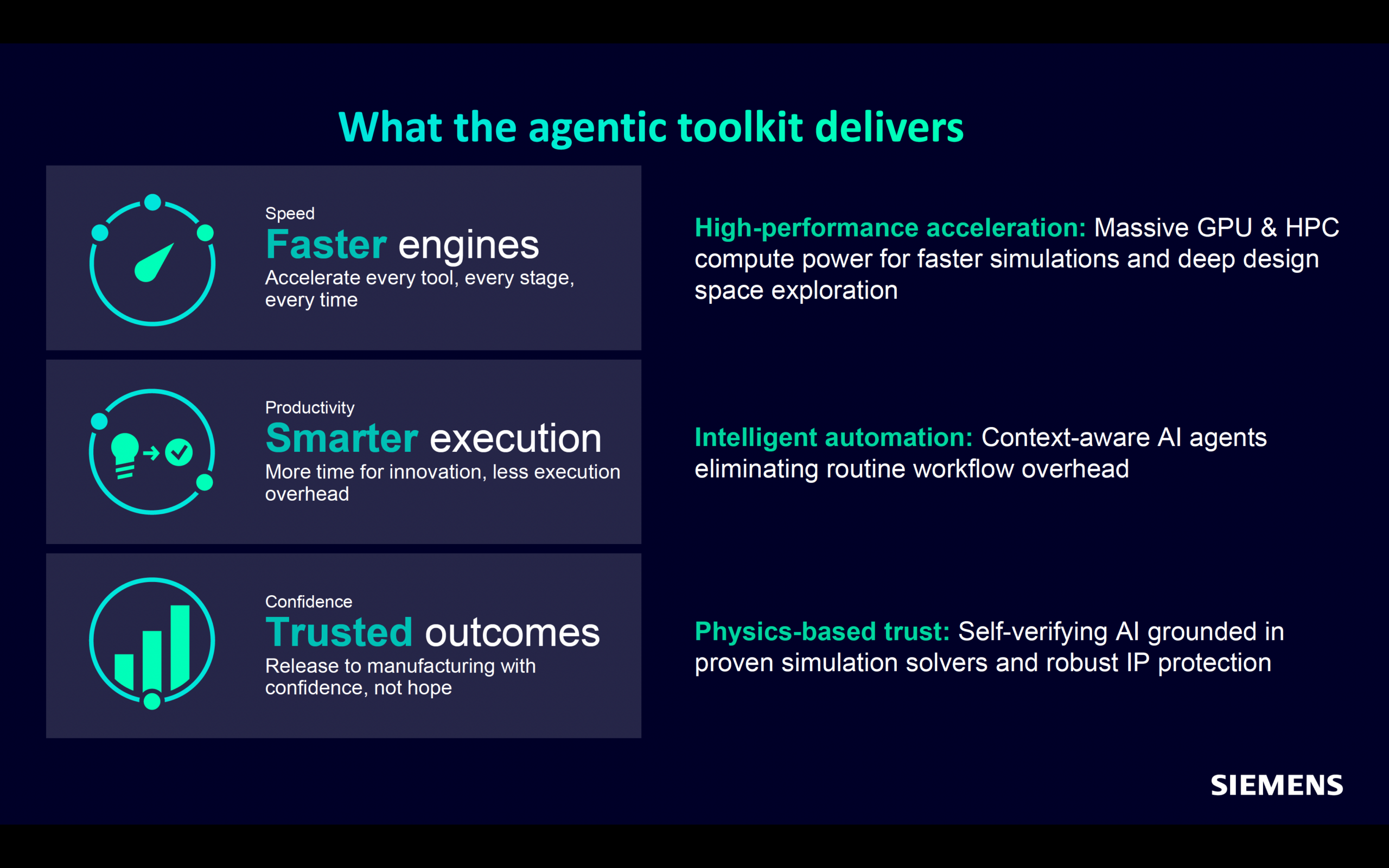
Siemens’ HyperLynx Agentic Toolkit marks a fundamental shift in how electronic systems teams approach post-layout verification. By pairing conversational AI orchestrators with proven, deterministic physics solvers rather than relying on probabilistic guesses, the toolkit eliminates the specialist bottleneck while maintaining full output accuracy and data privacy. With real-world benchmarks compressing 160 hours of high-speed SerDes verification down to just two hours, this physics-grounded approach provides a scalable foundation for complex hardware engineering ahead of its Q4 2026 rollout.
Early access for the HyperLynx Agentic Toolkit begins in Q4, 2026 . Siemens is targeting engineering organizations willing to commit specialist resources to benchmark the tool and establish peer-validated trust across the industry.
Read the entire press announcement here.
Teaser: Looking ahead beyond this announcement, Siemens is expanding the framework toward “self-verifying AI,” where generative design tools automatically trigger physics solvers to validate layout modifications before presenting them to engineers.
Also Read:
CTO Interview with Juan Rey, senior VP and general manager of Calibre and CTO of Siemens EDA
Curvilinear OPC and next-gen photomask optimization
Share this post via:


Comments
There are no comments yet.
You must register or log in to view/post comments.