





The industry is moving from simple documentation chatbots to agentic workflows capable of performing complex, multi-step tasks like design creation, verification, and library characterization. These agents are intended to enhance engineering productivity by roughly 50%. A panel of industry experts met at DAC to discuss these trends, how to make use of the new technology, what challenges exist and what methods are needed to improve the results.
The panel brought together IP providers and EDA suppliers. The IP providers discussed the challenges they face, and the EDA suppliers got to respond to those challenges. The question of what to buy vs. what to build was also discussed. And there were some interesting observations about how to make the process better as well. Let’s take a closer look at a discussion at DAC 2026 about who owns the intelligence behind tomorrow’s chips and how to make it better.
Panel Overview
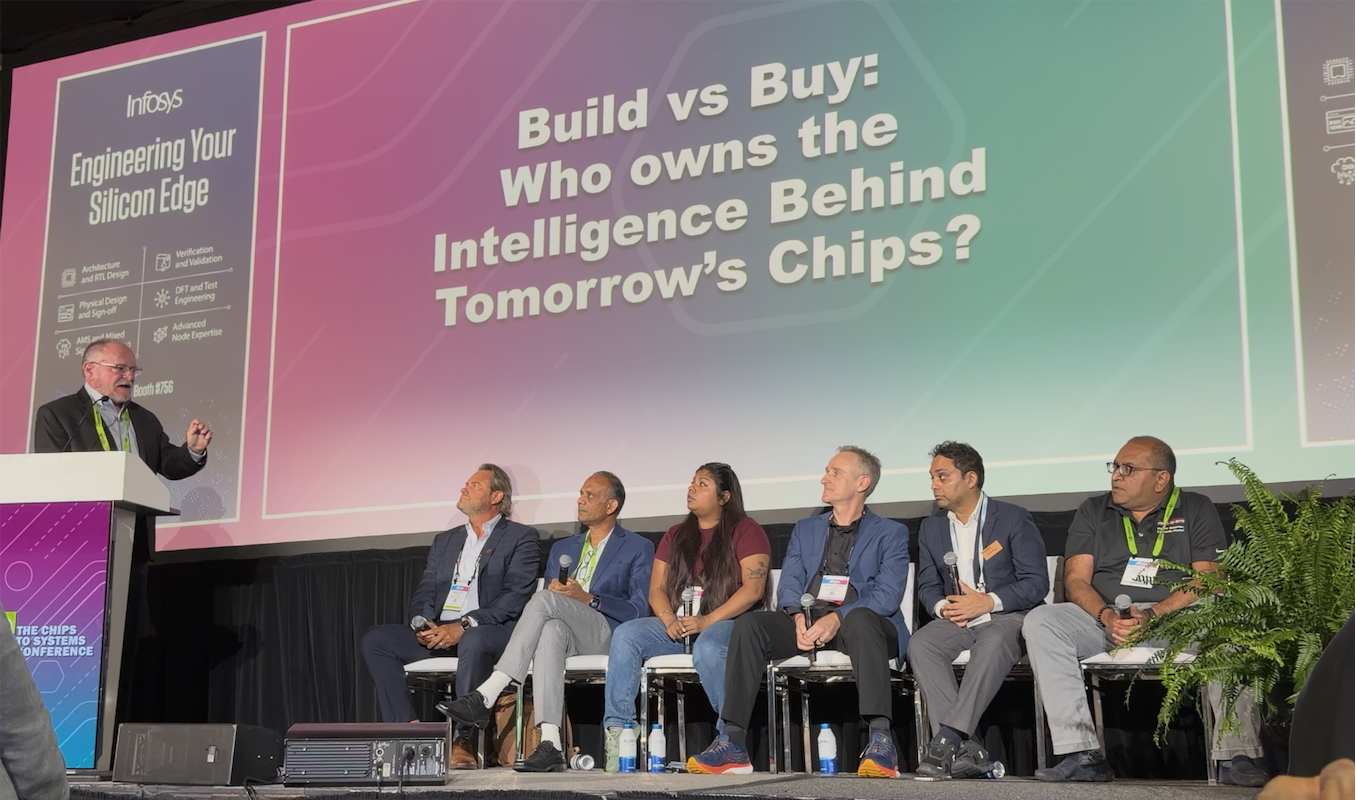
The panel was organized by llmda.ai, one of the new agentic AI technology suppliers. Daniel Nenni, founder of SemiWiki.com moderated the discussion. The group is shown in the photo above as Dan kicked off the discussion. You can access the complete panel description on the DAC site here.
The panel consisted of the following people, going left to right using the photo above:
- Simon Rance, General Manager, IP and Data Management Business at Keysight Technologies. A tool provider.
- Nagesh Gupta, Founder & CEO at llmda.ai. A tool provider.
- Rusafa Shahreen, Director of Technical Marketing, Alphacore Inc. An IP provider.
- Michal Siwinski, EVP, Chief Product and Marketing Officer at Arteris. An IP provider.
- Amit Gupta, Senior Vice President & GM of Solido Custom IC Division and Chief AI Strategy Officer at Siemens EDA. A tool provider.
- Mahesh Tirupattur, CEO of Analog Bits. An IP provider.
Dan kicked off the panel with a historical observation about the buy vs. build question. When Dan began his career in semiconductors there was no EDA industry. If you didn’t build it, you didn’t have it. I also remember those days. I began my career at RCA Solid State in a group that developed EDA tools (then called CAD tools) for the captive RCA design and manufacturing community. We’ve come a long way, but Dan pointed out that questions of what to buy vs. what to build continue. With that overview, let’s examine some highlights of the discussion.
Comments From the Panel
The discussion began with Amit Gupta, responding to the question, How does agentic AI fit into the EDA flow, and what impact do you see for IP development and integration?

Amit began with the observation that customers he talks to want to understand how to use agentic AI to improve design productivity and design quality. Amit mentioned the 50% productivity improvement goal. There are several ways to achieve this. One is making existing EDA engines faster with AI. The other is to employ an agentic orchestration layer to work alongside the engineer to enhance efficiency across the full design flow.
Amit pointed out that achieving this requires an open architecture so tools from multiple vendors can work together. This can be quite complex, and Amit explained that Siemens is committed to do the necessary work. Regarding make vs. buy, he said that the larger companies are building some differentiating technology, but smaller/mid-size companies count on their supplier to deliver to whole solution.
Next, the three IP providers responded to the question, What configuration and integration challenges do you encounter when delivering IP for complex systems, and what tools or technologies do you think would reduce those issues?

First up was Rusafa. She explained that there are many deliverables for the analog/mixed signal IP that Alphacore delivers. The complexity is going up, but complete, thorough validation of all deliverables is still a must-have. She explained that the IP delivery teams at Alphacore are using AI tools such as Claude to increase the speed at which complex designs can be examined and verified.
She said AI tools interacting with humans is a “build” kind of strategy, but the company also buys tools such as Cliosoft for IP and data management. As a side note, Cliosoft has been purchased by Keysight and Rusafa said they were very happy with the tool, which made Simon Rance smile.

Next was Michal. He pointed out that use of AI tools to improve productivity is widespread. He sees humans remaining in the loop for the foreseeable future since the complexity of the data is high and that finding errors can require very subtle insights. Michal went on the explain that Arteris provides the underlying infrastructure for data communication across many applications.
The company works with everyone. At one level, standard models can be deployed, but to maintain differentiation and competitive edge some level of customization of the models is needed. That will drive continued involvement of humans in the loop. Michal mentioned the development of the orchestration layer will be an interesting place to watch.

The last word from the IP providers was given by Mahesh, who pointed out that Analog Bits is enabling just about every AI device in some way. He explained that he has mandated high use of AI technology at the company. He also pointed out that deployment of advanced AI tools during product design has its challenges. Analog Bits designs on the most advanced processes, and the fabs carefully guard access to this technology. Bringing new, advanced AI tools into the fab isn’t allowed.
He explained that development of digital models is a good match for AI. Many companies doing analog design have very little digital design know-how. Advanced AI tools like Claude can help develop the required digital models for new designs. The combination of engineering oversight with tools such as this create an efficient methodology. He said, “AI is meant to accelerate good engineering.”
Dan then moved to the EDA suppliers and posed the question, What is your company doing to address the challenges the IP providers just described?

Simon Rance spoke first. He explained that Keysight focuses on best-in-class tools for multi-domain engineering such as multi-physics. The company recognizes those tools need to work with other vendor’s tools in the flow. Doing that right requires a strong foundation for trusted, secure data. The previously mentioned Cliosoft tool provides this foundation. Simon pointed out that without high-quality data and meta-data that is carefully managed and governed it is difficult to have a successful AI deployment.
He went on to explain that Keysight also helps deliver the right context for the massive data that is driving the design process. A trusted solution is critical. This was followed by a spirited discussion on overall trust. What should be trusted, and how does an organization decide what to trust. This blog is getting a bit long, so I won’t get into these details. I will only say there is a critical place for quality human engineering in the process.
The Final Word

The final speaker was Nagesh Gupta from llmda.ai, a company that focuses on AI tools for embedded systems development. Nagesh stepped back a bit and discussed a broad challenge that everyone on the panel shares – the need for first-pass silicon success. Said another way, efficiency without accuracy is not a winning strategy. Nagesh cited data from Siemens/Wilson Research that shows first-pass silicon success isn’t anywhere near as high as it needs to be. Projects are often late we well.
Nagesh explained that these are important items to fix. The approach here is not necessarily to focus on the tools and the flow but rather focus on the data that drives the tools and the gaps that exist there. He explained that system specifications often drift out of sync, resulting in critical data that is no longer accurate. Organizational silos, geographic dispersion and poor processes between insightful changes and the need to broadly communicate those changes all contribute to the problem.
He went on to explain that this is the domain llmda focuses on. Using a comprehensive AI platform, llmda ensures all forms of system specifications are verified to be accurate and tied to known good data. After listening to Nagesh, I became a bit more optimistic about the future. The panel made excellent points about how to use AI to improve the delivered quality of IP, and Nagesh added the technology to ensure the data that drives the whole process is correct.
To Learn More
This panel covered a very important topic at DAC. I learned a lot and left feeling good about the future. Each of the panelists are providing important technology for the future of chip design. I encourage you to learn more about them. Here are good places to start:
And that’s a discussion at DAC 2026 about who owns the intelligence behind tomorrow’s chips and how to make it better.
Also Read:
Must-See DAC Panel – Build vs Buy: Who Owns the Intelligence Behind Tomorrow’s Chips?
How to Free Yourself from Inconsistent Engineering Documentation Before It’s Too Late
How llmda.ai Coaxed Me Out of Retirement, an Interview with Kurt Shuler
Share this post via:



Comments
There are no comments yet.
You must register or log in to view/post comments.