


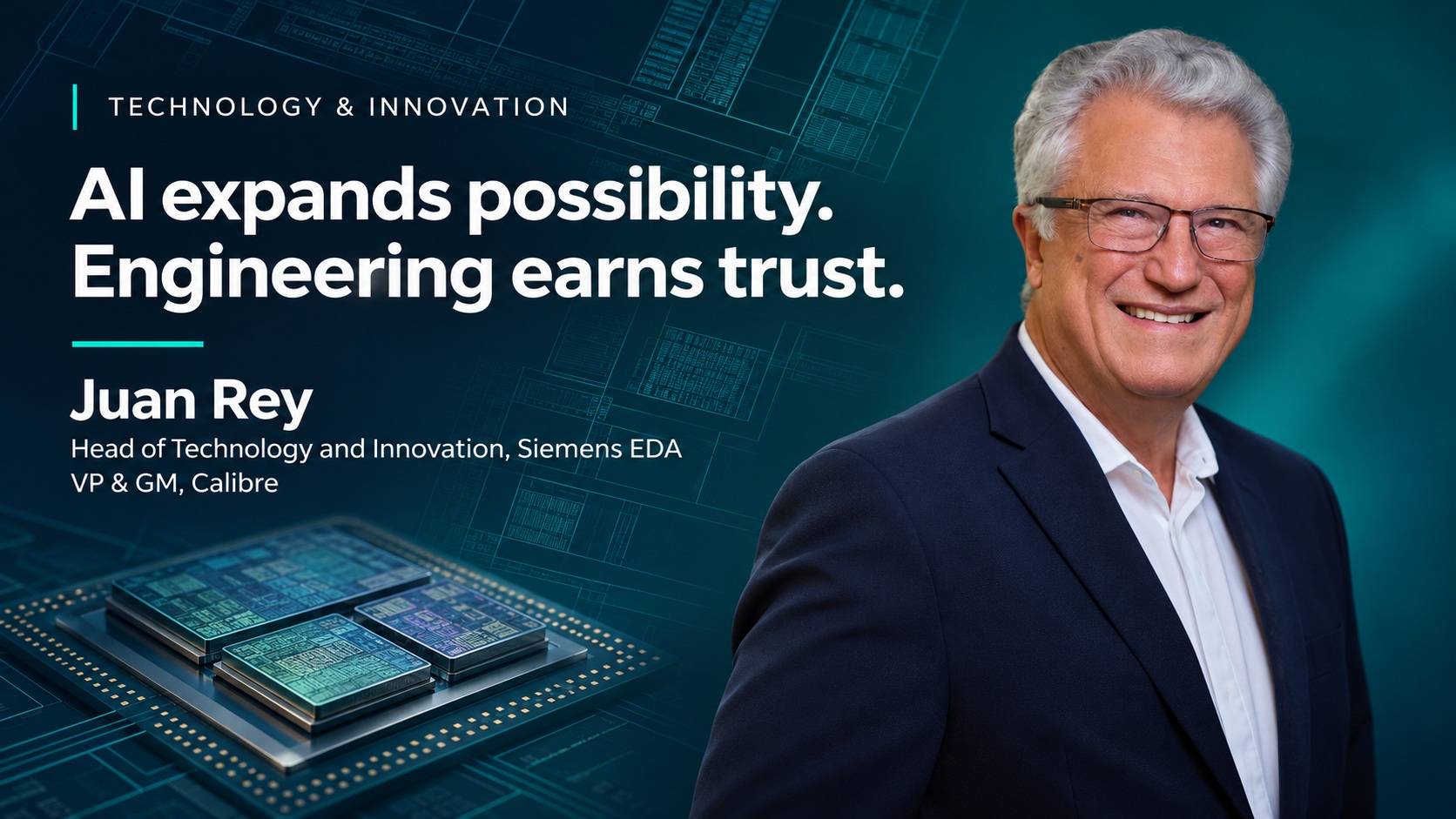

By Juan Rey, Chief Technology Officer, Siemens
Juan Rey is Head of Technology and Innovation for Electronic Design Automation (EDA) at Siemens and Vice President and General Manager for Calibre. He joined Mentor Graphics, now Siemens EDA, in 2001 and led engineering, research, development, and quality for Calibre before retiring in late 2021. He returned to the company a couple of years later to continue advancing semiconductor design and verification technology.
Rey’s work combines deep expertise in electronics design and manufacturing automation with a focus on AI and engineering productivity. He champions the use of AI to help engineers explore complex design challenges while preserving rigorous, deterministic verification and human accountability for design decisions.
What brought you to Siemens?
I joined Mentor Graphics, now Siemens EDA, in 2001. At the end of 2021, after leading engineering, research, development, and quality for Calibre, I stepped into retirement. Turns out, I couldn’t stay away, and I came back a couple of years later. Today, I’m Head of Technology and Innovation for EDA at Siemens and VP/GM for Calibre.
What keeps me here is that the work never stands still. Over the years, I’ve had to keep learning as technology evolves—from materials science and manufacturing to chip-design software. Moore’s Law keeps pushing the industry to reinvent itself, and that makes this a fascinating place to work. And it is not only Moore’s law, it is 3D integration, it is quantum computing, it is the many forms of AI that are changing our lifes and our work.
What is the biggest challenge your customer is facing?
The biggest thing our customers are dealing with right now is a complete, industry-wide reinvention. Everything is accelerating at once.
If you look at the technical side, the move to advanced node, going from 14 angstroms down to 10 and beyond, combined with the shift from traditional 2D to 2.5D and 3D integration, is creating entirely new physical and algorithmic problems that nobody had to solve a few years ago.
At the same time, power efficiency and sustainability have shot to the top of everyone’s priority list. It’s not just about making chips or data centers greener anymore; customers are under intense pressure to radically cut power consumption and conserve water and energy across the entire lifecycle of these massive systems.
And then, of course, you have the eternal crunch of exploding complexity versus time-to-market. Teams are building systems of unprecedented scale, but the schedules aren’t getting any more forgiving. Helping them navigate all of that without missing their windows is where the real friction is.
Why is your approach to solving this problem unique?
Our approach really comes down to pairing decades of deep domain expertise with actual software and AI leadership, having AI inside systems built by people who have spent their lives in electronics design and manufacturing automation. We aren’t just chasing temporary AI fads. We look at problems through rigorous, hierarchical methodologies, focusing on things like early specification, continuous quality, and robust validation.
And when it comes to AI, we don’t use it to blindly replace heavy-duty sign-off engines. We use machine learning to build fast surrogate models that let engineers explore large design spaces earlier and more efficiently, before final signoff.
For many years for Calibre we have been using AI to accelerate development and improve core algorithms. More recently, we are focusing, with Agentic AI, in improving our customer’s productivity, and this is were we will see the biggest changes
With designs becoming more complex, why does deterministic verification still matter for signoff and manufacturability?
Exploring a promising option is not the same as proving a design is ready for signoff or manufacturing. Teams need verification they can trust, grounded in the physics of the problem and rigorous about design-rule compliance and manufacturability. Calibre’s deterministic engines provide that foundation. AI can help engineers work through more possibilities, but it shouldn’t blur the line between a recommendation and a verified result.
What challenges will your customers face in the near future?
Near-term, the physical and manufacturing barriers are only going to get tougher as nodes shrink toward 10 angstroms and below, especially managing all the thermal and mechanical interactions in multi-die 2.5D and 3D setups.
Another big one that people don’t talk about enough is cognitive load and engineering productivity. AI lets engineers do way more in the same amount of time, but teams are facing mounting mental fatigue. There’s also a real risk of eroding foundational junior engineering expertise if people lean entirely on automation without building deep, hands-on training.
And then there’s the business side: dealing with rapidly shifting AI business models, heavy infrastructure costs, and constantly having to re-evaluate software ROI and licensing.
How has AI changed your business strategy?
LLMs and AI are enabling us to make EDA workflows more accessible and efficient. We’re exploring multi-agent approaches that can help engineers investigate physical-verification issues, gather relevant context, and surface possible next steps. The goal is to reduce routine effort and give engineers more time for higher-level problem solving—not to hand design decisions over to AI.
Engineers remain responsible for evaluating recommendations and deciding what changes to make. And an AI-generated recommendation is not a signoff result: final verification still relies on qualified, deterministic Calibre flows. Internally, AI is also helping our teams prototype and test ideas more quickly, but we expect every investment to demonstrate measurable value.
As AI takes on more tasks in EDA workflows, what should it help engineers do—and what should remain firmly in their hands?
AI can help engineers analyze more information, spot patterns, and explore more possibilities. But it should support engineering judgment, not replace it. Engineers need to remain accountable for decisions and outcomes. And AI-generated recommendations should be clearly distinguished from the qualified, deterministic results engineers rely on for verification and signoff.
Also Read:
Curvilinear OPC and next-gen photomask optimization
Reimagining 3D IC Design: From Architecture to Signoff
Agentic AI accelerates 3D IC engineering for the AI factory era
Share this post via:


Comments
There are no comments yet.
You must register or log in to view/post comments.