





As a 45 year semiconductor professional born and raised in Silicon Valley I grew up with Nvidia and Jensen Huang. Jensen has been my #1 semiconductor CEO for many years and he still is today. My wife and I have met Jensen and his wife Lori at different social occasions and we were always struck by how down to earth they were. I also married my college girlfriend in the 1980s so I know some of the challenges they have faced and I hope they continue on this journey together, absolutely.
One thing I would remind people is a quote that I live by: “To err is human; to forgive, divine.” by Alexander Pope, an English poet and satirist, known for his sharp wit and lasting observations about human nature.
An examination of public statements and published reporting available on November 12, 2026.
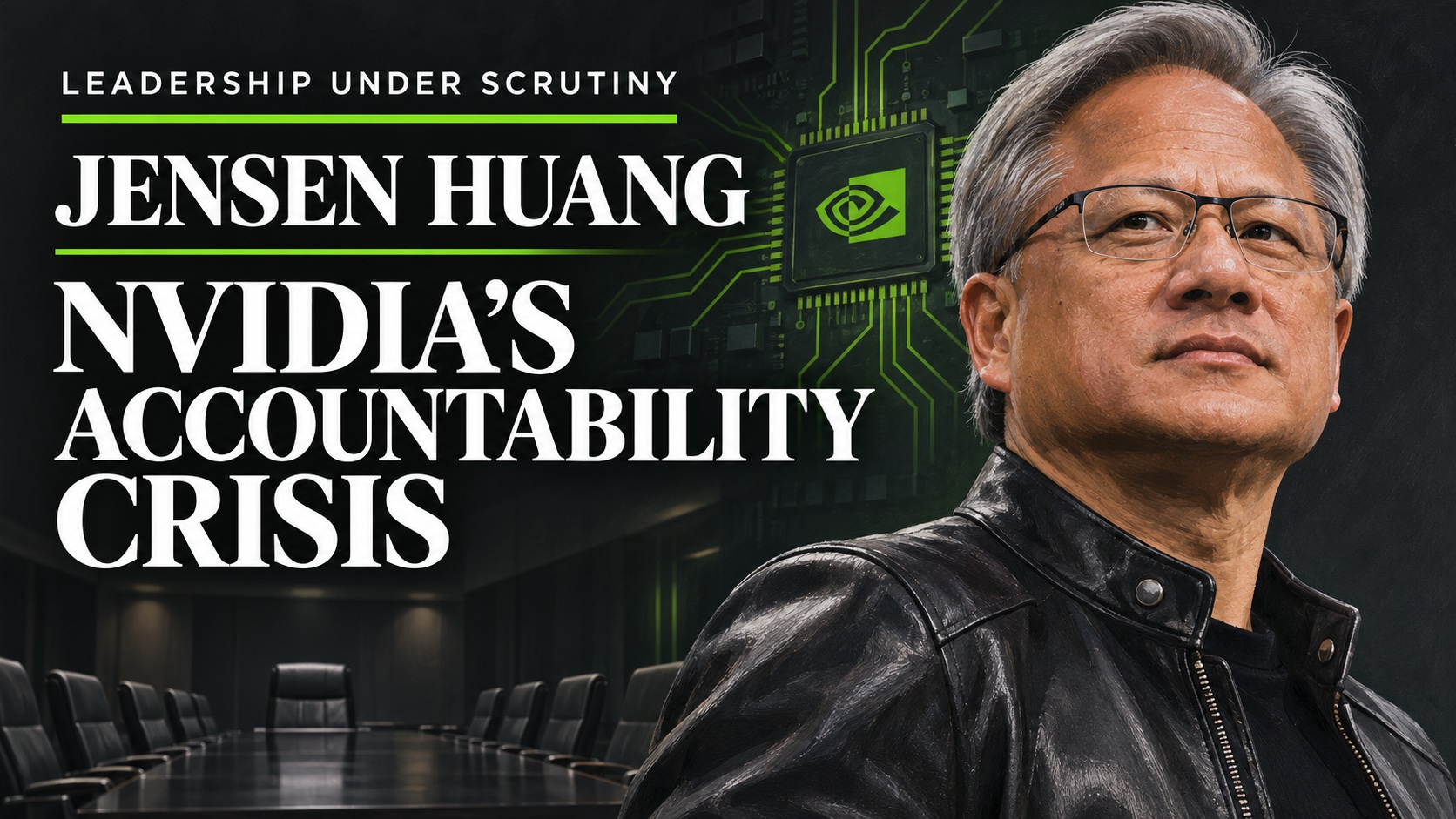
Jensen Huang helped build a company powerful enough to shape the ambitions of the technology industry. His departure from Nvidia on November 12, 2026, exposed the vulnerability beneath that achievement: an institution whose identity, authority and public credibility had become closely intertwined with one executive. Nvidia announced his immediate resignation as president, chief executive and director, appointed finance chief Colette Kress interim CEO, and named its first board chair, Harvey C. Jones.
The real story here is Harvey Jones.
Harvey C. Jones is a semiconductor industry icon. Harvey cofounded Daisy Systems in 1981, one of the three original EDA companies. We called them DMV (Daisy, Mentor and Valid Logic). He then spent 10+ years at Synopsys as President, CEO, and Chairman of the Board. After Synopsys Harvey cofounded Tensilica which was acquired by Cadence for $380M in cash in 2013. Harvey joined the Nvidia board in 1993 and served in a variety of roles before becoming the COB. It is safe to say that Nvidia is in good hands, absolutely.
The circumstances demand scrutiny, but also precision.
Four days prior to his resignation, Jensen publicly acknowledged marital infidelity and accepted responsibility for the harm he caused. Separately, Nvidia’s board opened an independent investigation into reports that he had been targeted by a foreign intelligence effort. The board expressly said it had no reason to believe national security or Nvidia’s secrets had been compromised. His admission establishes personal misconduct; it does not establish espionage, the disclosure of confidential information or any other unproven allegation.
The larger corporate question is how effectively Nvidia could scrutinize its celebrated founder. On November 10, independent directors retained former federal prosecutor Joon H. Kim and Wachtell, Lipton, Rosen & Katz to investigate. That step created a formal mechanism for examining the concerns. It did not resolve whether safeguards had worked, what directors previously knew, or whether their oversight had been sufficiently searching. The company statements reviewed here leave those questions unanswered.
Jensen’s management philosophy makes the question of oversight especially significant. In a 2024 interview with Stripe’s Patrick Collison, he described having sixty direct reports, avoiding conventional individual meetings with senior staff, and sharing information broadly. He argued that access to information should not confer organizational privilege. His approach offered a plausible advantage: fewer managerial layers between technical problems and decisions. It also placed exceptional demands on one person’s attention and judgment. The governance concern is whether such a system gives colleagues enough practical authority to challenge its central decision-maker. stripe.com
Beyond Nvidia’s offices, Jensen’s power rested on customers’ dependence on the company’s technology. In July 2024, Reuters reported that French regulators were preparing antitrust charges concerning alleged anticompetitive practices. France’s competition authority had highlighted dependence on CUDA, Nvidia’s programming software, and expressed concern about investments in AI cloud providers, including CoreWeave. These were regulatory concerns, not a final finding of illegality. Nevertheless, they identified an essential tension: an integrated ecosystem can make computing more useful while increasing the difficulty of choosing another supplier.
There is a firmer, documented basis for questioning Nvidia’s transparency. In 2022, the US Securities and Exchange Commission found that the company inadequately disclosed cryptocurrency mining’s contribution to gaming revenue growth during two quarters of fiscal 2018. That omission hindered investors’ ability to assess whether growth would persist. Nvidia paid $5.5 million to settle without admitting or denying the findings. The settlement concerned corporate disclosures and did not establish personal wrongdoing by Jensen, but it remains an accountability failure during his leadership.
His advocacy over China sales brought another conflict into view. In March 2026, Reuters reported that Senators Elizabeth Warren and Jim Banks sought an investigation into whether Jensen’s earlier remarks about chip smuggling had misled officials considering export licenses. Their request did not prove deception. It did illustrate the stakes when a company’s commercial advocate also becomes an influential voice in decisions involving national security. Shareholders’ interest in market access cannot, by itself, settle the public-interest question.
Bottom line: The strongest critical account of Jensen rests on these documented tensions: concentrated authority, customer dependence, disclosure failures and unresolved oversight questions. His technical and commercial achievements deserve recognition. They also explain why scrutiny matters so much. When an executive becomes central to an industry’s future, independent accountability becomes a condition of institutional strength.
On a personal side, the Huang family has a difficult journey ahead but from what I know about them they are well equipped.
Also Read:
US intelligence believes Nvidia CEO Jensen Huang had affair with Chinese spy
Jensen Huang’s Alleged Ties to a Suspected Chinese Spy: What Could Bring Him Down?
The best solution: NVIDIA merges with AMD, with Lisa Su serving as CEO.
Musk Says Hiring Jensen Huang Would Be an ‘Honor’
Share this post via:


The $725 Million Chip Development: Why Execution Risk, Not IP Cost, Now Dictates Advanced-Node Survival