




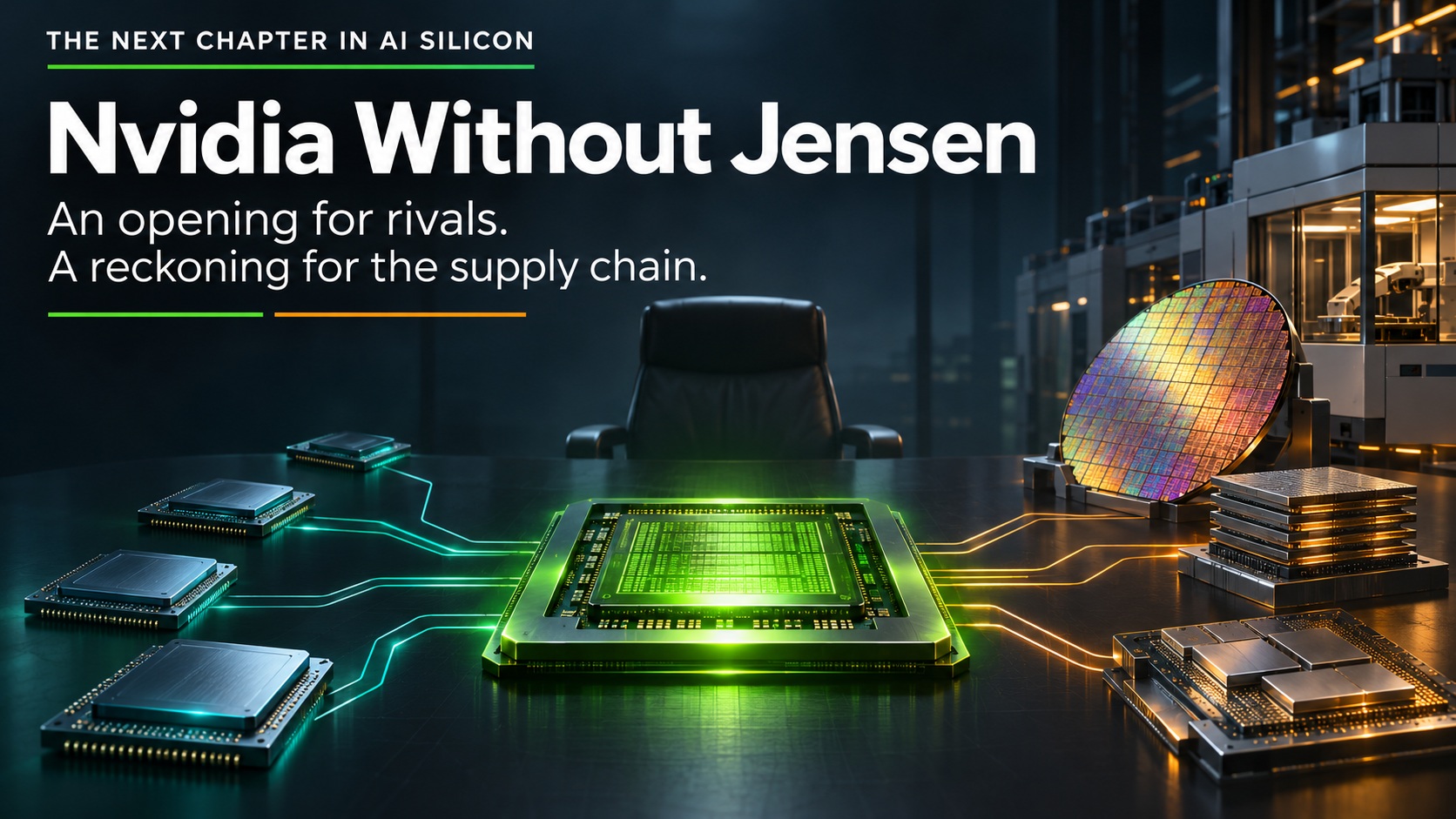
On November 12, Nvidia announced that Jensen Huang had resigned as president, CEO, and director, effective immediately. CFO Colette Kress is interim CEO, longtime director Harvey Jones becomes the board’s first chair, and on November 17 the company reports quarterly results without its founder for the first time.
The same day, SemiAnalysis published a long assessment, “Nvidia and the World Without Jensen.” It covers the board investigation, export-control politics in Washington, open-source AI, and succession. I leave the personal and political chapters to others. What stayed with me is the closing line: the departure is “really good for all Nvidia competitors, and really bad for Nvidia supply chain.”
I think that is right. It is worth working through why, because both halves of the sentence rest on the same mechanism.
A system with one arbiter
Nvidia was never organized like a company of its size. Huang had about 60 direct reports, held no one-on-ones, and kept the final word on every decision that mattered: architecture, allocation, pricing, investment. SemiAnalysis describes product definitions staying open until very late in the cycle, because one person could change direction and the whole organization would follow.
Any engineer recognizes the design. A single arbiter gives minimum latency and no contention. It also gives no redundancy. Remove the arbiter and the bus does not stop, but every request now goes through a negotiation that did not exist before.
Kress and the board promise continuity, and for products already in the pipeline I believe them. Rubin does not need a founder to ship. The question is what happens to the decisions not yet made.
Why rivals gain: supply
For two years, the gating item for anyone building an AI accelerator has not been architecture. It has been allocation: leading-edge wafers, advanced packaging, HBM, substrates. Nvidia got there first and bought deep. By SemiAnalysis’s count, its supply and capacity commitments went from $119 billion to $279 billion in a single quarter, most of it memory. The firm also estimates that Nvidia will pay materially less per gigabit for 2027 HBM4 than AMD, Broadcom, Amazon, or Google.
Those terms were negotiated CEO to CEO, in Taiwan and Korea. They are relationships, not just purchase orders, and relationships do not transfer with the title. SemiAnalysis expects suppliers to stop prioritizing Nvidia to the same degree, and projects that non-Nvidia silicon could take more than 70% of total capacity in 2028.
If that happens, AMD, Broadcom, the hyperscalers’ in-house XPUs, and a long list of startups finally get to compete on what they can build rather than on what they can get built.
Why rivals gain: demand
The second lever is financial. Under Huang, Nvidia acted as lender of last resort to its own customers. SemiAnalysis cites $530 billion of gross off-balance-sheet guarantees as of the fiscal second quarter, including $36 billion of take-or-pay floors under neocloud capacity, plus a $99 billion equity book. Neoclouds raised debt on the strength of that backing. The hardware choice came bundled with the financing.
A professional manager answering to a board in crisis mode is unlikely to extend that book. The precedent SemiAnalysis points to is Apple after Jobs: conservative operations, cash returned to shareholders. If the backstop shrinks, buyers must justify hardware the ordinary way, on performance per watt and total cost of ownership. That is a contest challengers can enter, particularly in inference, where the workload is narrower and the software barrier lower than in training.
Then there is cadence. CUDA lost money for years before it became the moat, and only a founder with a loyal board holds a bet that long. A caretaker protects the roadmap. A caretaker does not bet the company on the next one. Even a small slip in Nvidia’s annual rhythm is an opening that did not exist a week ago.
Why the supply chain loses
Here is the apparent paradox. If capacity is freed for others, the foundries, memory makers, and OSATs still sell their output. Why is this bad for them?
Because Huang was not only their largest customer. He was their forecast. Taiwan and Korea committed capital ahead of demand because one man told them the volume would be there and put a balance sheet behind the statement. SemiAnalysis credits his personal commitments with pushing suppliers into more aggressive plans than they would have accepted from anyone else.
Replace one buyer placing enormous forward commitments with a dozen placing smaller, hedged ones, and the picture changes. Visibility shortens. Volume fragments across more designs, more package types, more memory configurations, and each custom accelerator is its own qualification effort. Capacity expansion slows, because nobody builds a fab on a dozen maybes.
If the neocloud ecosystem contracts without Nvidia’s guarantees, the cuts travel upstream with the usual bullwhip amplification. Suppliers feel it first and hardest.
Export controls add a second risk. The Remote Access Security Act, which would extend export controls to remote access to restricted chips, passed the House 369–22 in January and awaits Senate action. Huang was the loudest industry voice against tightening, and SemiAnalysis expects restrictions to accelerate without him. Whatever one thinks of the policy, the AI hardware supply chain runs through China for components, boards, and materials, and it will absorb the friction.
The time constant
Some caution is in order. Nvidia shares fell only about 4% on the day. CUDA did not resign. Some 42,000 people still know how to build the most complex systems in the industry, and 2027 volume is largely contracted. None of the effects above will show up in next week’s numbers.
They will show up in the 2028 allocations negotiated during 2027, in the next round of neocloud financing, and in the first roadmap decision that needs a founder’s nerve and gets a committee’s compromise instead.
So the SemiAnalysis verdict holds, with a delay. For competitors this is a window, not a gift: silicon without a software stack still loses to CUDA. For the supply chain, the loss is immediate in one respect. The industry’s most aggressive forecaster, and the only one who backed his forecasts with his own balance sheet, is gone.
Disclosure: the author is an investor in VSORA, a developer of AI inference processors.
Reference:
Jensen Huang and the Cost of Unchecked Influence
Share this post via:


Jensen Huang and the Cost of Unchecked Influence