







While semiconductor design intellectual property (IP) is a $9.45 billion market, it acts as the absolute architectural bottleneck for the entire global semiconductor value chain. The choices made at the IP layer today dictate the cost, power, and security of a downstream technology economy rapidly marching toward a trillion dollars by the end of the decade.
According to the latest SemiWiki Design IP Report, the worldwide design IP market grew 12.7% in 2025 to reach $9,451.9 million. This robust double-digit growth in a complex macroeconomic landscape proves that design IP remains the critical baseline of silicon innovation.
However, looking at the headline growth rate misses a profound strategic tension pulling the industry in two different directions: the absolute consolidation of processing power and an accelerating market response to reclaim design control.
The 12 Sub-Categories of Silicon Design IP
To truly understand where silicon design capital is moving, we must look past broad market segments and examine the actual building blocks of a modern System-on-Chip (SoC). The $9.45 billion global design IP budget is distributed across 12 distinct sub-categories, heavily dominated by two primary pillars: CPU IP and Wired Interface IP, which together command 69% of the entire industry’s spend.
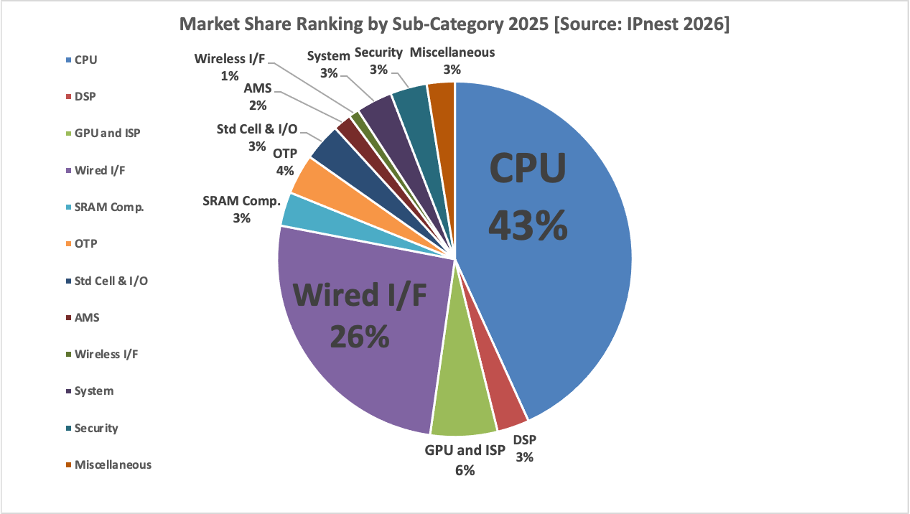
As this architectural breakdown reveals, while processing cores and high-speed data pathways ingest the vast majority of engineering budgets, the remaining 31% of the market is split among highly specialized blocks. Niche segments like General Purpose Analog & Mixed Signal and Wireless Interface IP may represent smaller slices of the pie, but they are increasingly becoming the primary battlegrounds for hardware differentiation.
The Production Surge: Volume Maturity Drives Royalty Growth
While Licensing revenues grew a steady 10.7%, Royalty revenues surged by 16.1%. This divergence is a milestone of production scaling. A massive wave of historical design wins has officially completed the multi-year design-to-tape-out pipeline and entered high-volume wafer manufacturing. This maturation of physical production is what triggered the trailing royalty payouts that outpaced new licensing activity in 2025.
The Arm CPU Monopoly and the “AGI” Co-opetition Crisis
Processor IP remains the primary engine of the design IP market, representing a commanding 52.2% share of total spend. Within this domain, Arm grew an impressive 26.4% to capture a 49.4% overall design IP market share and a staggering 93.3% of the CPU IP market.
But the strategic tension surrounding Arm has intensified with its entry into physical silicon production. Arm’s development of its own Arm General Infrastructure (AGI) chips signals a dramatic shift in company boundaries.
For system architects, cloud hyperscalers, and infrastructure providers, this transition from a pure IP partner to a commercial silicon supplier creates an acute strategic crisis. Licensees now face a reality where their primary CPU architecture partner is also a direct competitor in the infrastructure hardware market. This “co-opetition” anxiety is driving an aggressive industry push toward architectural autonomy.
The Alternative CPU Battleground
The primary vehicle for this defensive hedge is the open-standard RISC-V architecture. As companies scramble to escape vendor lock-in, the 2025 data reveals that custom RISC-V core providers are experiencing increasing momentum, though the market response remains highly polarized:
High-Growth Specialists: Dedicated RISC-V specialists are seeing explosive double-digit growth as chipmakers aggressively fund alternatives to reclaim design control. SiFive surged 34.6% in CPU IP revenue, while specialized core providers like Syntacore grew 35.3% and Semidynamics grew 22.2%.
Corporate Portfolio & Lifecycle Shifts: Conversely, established players saw their CPU revenues contract. Synopsys’ CPU IP revenues declined by 27.3% [strategic divestment of its CPU IP business to GlobalFoundries took place in 2026]. Meanwhile, RISC-V pioneer Andes Technology experienced a minor 6.2% slide, highlighting how much year-over-year performance in this tier is tied to the timing of major licensing contract milestones rather than long-term market trends.
This divergence indicates that the push for architectural autonomy is highly competitive, with design teams concentrating their alternative CPU budgets on specific high-performance, customized CPU specialists.
The Subsegment Divergence: Budgets Pivot to Security and Interconnects
Broad market averages hide where competitive advantages are being won or lost. While the overall market grew at 12.7%, individual subsegments performed on vastly different tracks:
Security IP grew 22.5%.
System IP grew 22.2%.
Conversely, Physical Library (Standard Cell & I/O) IP contracted by 4.6%.
As AI workloads migrate to the edge and data centers require secure, high-bandwidth interconnects, product teams are aggressively shifting their budgets toward hardware-level trust and advanced SoC fabric, while allocating less to standard-cell library licensing.
The Mid-Tier Battleground: Who Wins the Specialty Niches?
While Arm, Synopsys (holding 18.5% share), and Cadence (holding 6.4% share) control a combined 74.4% of the global market, a fierce war is raging among the remaining players.
Behind the industry giants, specialized mid-tier IP vendors are fighting for dominance in crucial high-speed interface, custom analog, and non-volatile memory niches. Certain specialty players rode the wave of system, security and mixed-signal analog demand to explosive double-digit growth in 2025, while others hit unexpected revenue plateaus as legacy nodes contracted.
Market Intelligence
Understanding which vendors are gaining market share and which are quietly losing their competitive edge is the difference between a resilient silicon supply chain and single-source vendor lock-in.
The latest Design IP Report provides the details. Authored by Dr. Eric Esteve, a world-renowned Design IP expert, and Kalar Rajendiran, a veteran semiconductor executive, it is the definitive resource for competitive intelligence.
To purchase, Contact Daniel Nenni: dnenni@semiwiki.com
Also Read:
Consolidation and Competition: Who is Winning the $4.5 Billion Interface IP Race?
AI Booming is Fueling Interface IP 23.5% YoY Growth
Share this post via:



TSMC’s AI Expansion Signals a Broader Shift in Computing