







The little-known decisions and breakthroughs—and the remarkable role of Robert Noyce—that helped shape the modern semiconductor industry
by Sunil Mehta
When people tell the story of how Silicon Valley came into being, they usually begin with a familiar sequence of events.
The transistor was invented at Bell Labs. William Shockley moved to California and founded Shockley Semiconductor. Eight of his brilliant young employees rebelled and left to form Fairchild Semiconductor. Fairchild pioneered silicon transistors and the integrated circuit. Gordon Moore formulated what became known as Moore’s Law, charting an exponential trajectory of transistor growth that would guide the semiconductor industry for more than six decades. Robert Noyce and Moore left Fairchild and founded Intel. And Intel went on to launch the microprocessor revolution.
It is a good high-level account. But history viewed from 30,000 feet can make events look almost inevitable. This is not quite the way it transpired.
While researching my novel, The Compass, which explores key episodes in the lives of Albert Einstein, Robert Noyce and Steve Jobs, I was fascinated to discover what lay beneath this familiar Silicon Valley narrative. What I found was a succession of chance encounters, risky decisions and technological breakthroughs—moments when events could easily have taken another course.
And one man was at the center of an extraordinary number of those pivotal moments: Robert Noyce.
The Transistor Comes to Iowa
The story begins far from California.
As an undergraduate at Grinnell College in Iowa, Noyce studied physics under Professor Grant Gale. Gale had previously studied with John Bardeen, who in 1947 had helped invent the transistor at Bell Labs with Walter Brattain. After learning of the invention, Gale wrote to Bell Labs asking for a couple of the new devices. There were none to spare, so Bell Labs instead sent technical monographs describing the transistor.
Gale and Noyce pored over them together. Noyce was enchanted. He later recalled that the concept hit him “like an atom bomb.”
That introduction to the transistor helped set the direction of Noyce’s career. He went on to MIT, where he earned a doctorate in physics and studied the emerging field of semiconductor technology, and then to Philco, where he worked on transistors. By the time Shockley began assembling an elite team for his new semiconductor laboratory in California, Noyce had become exactly the kind of young scientist he was looking for. He became one of Shockley’s first recruits.
It was one of the episodes that particularly intrigued me while researching The Compass: the transistor had reached a small college in Iowa not as a physical device, but through the technical ideas behind it—and helped put Noyce on the path to Silicon Valley.
The Morning Silicon Valley Began
Shockley was a brilliant physicist but a notoriously difficult manager. Within a year, a group of his young scientists had had enough.
Seven of them decided to leave and sought help from investment banker Arthur Rock in finding an established company willing to hire them as a group. But they wanted Noyce to join them. He was one of their strongest technical minds and had emerged as a natural leader.
They had tried repeatedly to persuade him to join them, but Noyce had declined, feeling an obligation to Shockley. On the morning the seven were heading to San Francisco to meet Rock, they made one final appeal. Noyce hesitated—and then made his decision.
He got into the car.
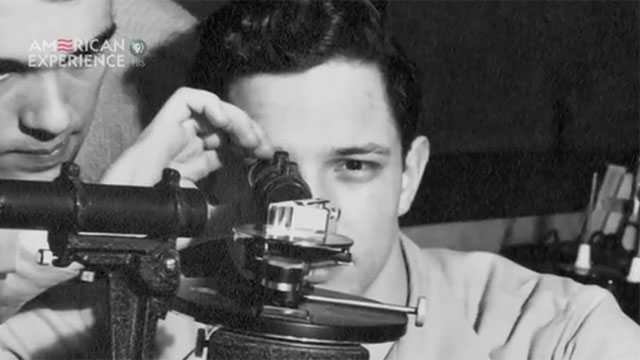
In the PBS documentary Silicon Valley, Michael Malone—noted author and historian of Silicon Valley—identifies the moment Noyce got into the car as the point when Silicon Valley began. The group now included the man who would become its leader and play a central role in the technological breakthroughs that followed.
The eight drove to San Francisco, where they met with Rock to discuss their future.
Rock then proposed something unusual. Instead of finding an established corporation willing to hire the group, why not build a company around the engineers themselves? He offered to find the financing.
The idea sounds obvious in Silicon Valley today. It was anything but obvious in 1957.
Rock approached dozens of potential corporate backers. None was willing to take the risk. Then came one more possibility: Sherman Fairchild, founder of Fairchild Camera and Instrument.
According to Michael Malone’s account in The Intel Trinity, Noyce made an impassioned presentation to Fairchild about the future of silicon transistors. He said that silicon and metal were inexpensive raw materials for the transistors; the real competition would lie in the ingenuity and manufacturing technology used to transform them into increasingly powerful electronic devices.
Sherman Fairchild later recalled that it was Noyce’s visionary presentation that ultimately persuaded him to invest. He agreed to finance the venture.
Fairchild Semiconductor was born.
Fairchild’s First Big Test
The fledgling company still had to prove that its eight talented scientists could actually build a business.
Its first major opportunity came from an unlikely customer: IBM.
IBM needed advanced silicon transistors for a navigational computer. Texas Instruments had already provided samples, but they could not meet the required specifications. Noyce and a colleague traveled to IBM’s facility in upstate New York, where they were asked whether their barely established company could supply a hundred.
Noyce’s answer was audacious: “Sure. We can do that.”
There was one problem. Fairchild had not yet made a single transistor.
Noyce organized two parallel development efforts, increasing the odds that one would succeed. Five months after the company was founded, Fairchild delivered the hundred transistors on schedule.
At the Wescon trade show the following month, the founders discovered that Fairchild had the only double-diffused silicon mesa transistors on the market. “We scooped the industry!” Noyce exulted afterward.
But mesa transistors were difficult to manufacture reliably. Their exposed surfaces were particularly vulnerable to contamination.
Another member of the Traitorous Eight, Swiss physicist Jean Hoerni, found a solution.
Hoerni developed what became known as the planar process, leaving a protective layer of silicon dioxide over the surface of the transistor. The technique made silicon devices far more robust and opened a path toward reliable, high-volume manufacturing.
In one memorable demonstration reported in Leslie Berlin’s biography of Noyce, Hoerni spat directly onto an unpackaged transistor. Contamination that could have ruined a mesa transistor left his planar device unharmed. It was a remarkable advance in making transistors.
Noyce would soon realize that the planar process could be used to make something much more revolutionary.
The Revolutionary Idea That Almost Stayed in a Drawer
Fairchild’s patent attorney, John Ralls, had been working with Jean Hoerni on protecting the planar-process inventions. As head of R&D, Noyce was involved in those discussions, and Ralls challenged him to think more broadly about what else the technology might make possible. Noyce later credited that question with helping stimulate his thinking.
His insight was deceptively simple.
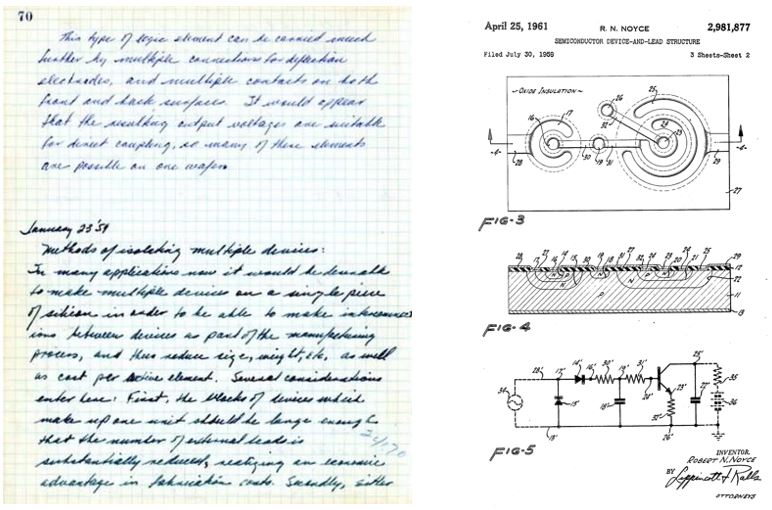
If multiple transistors and other components could be fabricated on the same piece of silicon using Hoerni’s planar process, why not connect them electrically by depositing and patterning metal interconnections directly on top of the insulating oxide layer? The individual components could be electrically isolated from one another using reverse-biased p-n junctions.
The result would be an entire electronic circuit fabricated as a single monolithic chip.
Noyce recorded the idea in his notebook in January 1959.
And then, remarkably, amid other pressing priorities at Fairchild, it sat in his drawer for months.
Meanwhile, Texas Instruments had been pursuing a similar goal. Jack Kilby had demonstrated that multiple electronic components could be fabricated from a single piece of semiconductor material, and in 1959 TI publicly announced what it called its “solid circuit.” But Kilby’s device connected its components with external “flying wires”—an approach that could not be scaled to the much higher levels of integration that would eventually be required.
As reported in the documentary Silicon Valley, a TI representative encountered then-Fairchild salesman Jerry Sanders at an industry conference and told him, “We’re going to crush you guys!”
That got Fairchild’s attention.
Noyce’s concept had been developed independently of Kilby’s, but it offered a crucial advantage. By combining Hoerni’s planar process with p-n junction isolation and patterned metal interconnections on the oxide surface, it provided a practical architecture for manufacturing monolithic integrated circuits. The interconnections could now be fabricated along with the devices themselves rather than added individually with external wires. This directly tackled the “tyranny of numbers” problem and opened the way to ever-higher levels of integration.
Now Fairchild had to turn the concept into reality.
Noyce pushed Jay Last and his team to move quickly enough to build a prototype IC and “show the flag” at the upcoming Wescon electronics show. Their early demonstration was crude, but it signaled that Fairchild was in the race. Last’s team then undertook the challenging work of turning Noyce’s concept into working monolithic circuits, eventually leading to Fairchild’s Micrologic devices and the commercialization of the silicon integrated circuit.
The chain of events leading to the development of the IC is striking: Hoerni’s manufacturing breakthrough, a patent attorney’s provocative question, Noyce’s conceptual leap, competitive pressure from Texas Instruments—and the engineering effort required to turn an idea into a manufacturable product.
It was precisely this unlikely sequence of invention, competition and human decision-making that made the episode such a compelling one to recreate in The Compass.
From Invention to Commercialization
Inventing the IC was only part of the challenge. The semiconductor industry also had to develop the technologies and business models needed to manufacture chips in enormous quantities at steadily falling prices.
Noyce played a role there as well.
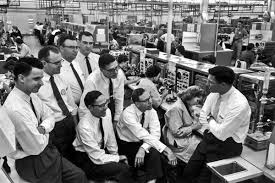
Fairchild engineers needed a way to reproduce microscopic patterns repeatedly across silicon wafers. Resourceful and hands-on as ever, Noyce helped build an early step-and-repeat photolithography system using matched 16mm lenses acquired from a local camera shop to print the fine patterns needed to fabricate integrated circuits—an ingenious precursor to the extraordinarily sophisticated lithography systems on which modern chipmaking depends.
Noyce also understood early that semiconductor manufacturing would become global. In the early 1960s, he sent Fairchild cofounder Julius Blank and manufacturing chief Charlie Sporck to investigate Hong Kong as a location for assembly. Their trip led Fairchild to establish a major operation there—an early milestone in the globalization of semiconductor manufacturing.
But perhaps Noyce’s most counterintuitive innovation involved price.
In 1964, he made a startling decision: Fairchild would sell some of its low-end integrated circuits for less than they cost the company to manufacture.
The logic was audacious: lower prices would increase demand; greater volume and technological progress would improve manufacturing yields and reduce unit costs; falling costs would stimulate still more demand.
In 1965, Noyce pushed the strategy even further. At a major industry conference, he stunned the audience—and even some of his own colleagues—by announcing that Fairchild would price its major integrated-circuit products at one dollar apiece.
Gordon Moore later called Noyce’s anticipatory pricing strategy an “invention” as important to the semiconductor industry as the integrated circuit itself. By deliberately pricing ahead of the cost curve, Fairchild could create the volume that would ultimately make those seemingly uneconomic prices profitable.
That same year, Moore published his famous article in Electronics magazine observing that the number of components that could economically be placed on an integrated circuit was increasing exponentially. What would later become known as Moore’s Law captured the technological and economic trajectory that would drive the semiconductor industry for decades.
Moore put that exponential trajectory on a graph. Noyce’s pricing strategy was already betting that falling costs and rising volumes would help make it possible.
Building Intel—and a New Kind of Company
By the late 1960s, Fairchild Semiconductor had become one of America’s most important technology companies. But friction with its East Coast parent was growing, and Noyce became increasingly frustrated.
In 1968, he decided to leave.
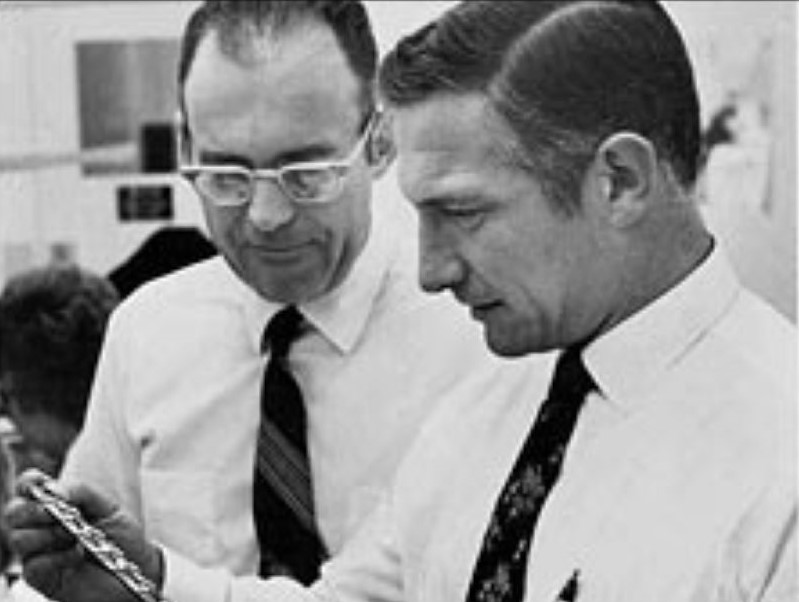
Gordon Moore dropped by Noyce’s house one spring morning while Noyce was mowing his lawn. The two discussed starting another company.
It was an echo of 1957.
Then, Noyce had been persuaded to join seven colleagues leaving Shockley. Eleven years later, he and Moore were walking away from the company they had helped create.
They envisioned a company initially focused on semiconductor memory and built around continuous technological innovation. Staying on the exponential trajectory Moore had identified three years earlier would be a guiding principle.
With financing again provided by Arthur Rock, the new venture was incorporated on July 18, 1968. Noyce and Moore initially called it NM Electronics before settling on Intel.
But they were creating more than another semiconductor company. Noyce helped give Intel a distinctly different culture.
Traditional corporations of the era were hierarchical, with private executive offices, privileges and visible symbols of rank. Noyce preferred informality and accessibility. He believed authority should come from ideas and competence rather than titles.
At Intel, Noyce famously worked in a cubicle rather than an executive suite, encouraged direct communication with the executive team and helped extend stock ownership more broadly among employees. In Tom Wolfe’s celebrated 1983 Esquire portrait of Noyce, he described this emerging Silicon Valley culture as a rejection of the “feudal” conventions of traditional corporate America.
That culture would become characteristic of much of Silicon Valley. Noyce was helping create not merely new semiconductor products, but a new model for a technology company.
And Intel was about to face another technological turning point.
The Idea Intel Almost Didn’t Pursue
In 1969, Japanese calculator manufacturer Busicom asked Intel to develop a complex family of custom chips for a new calculator.
Intel engineer Ted Hoff studied the proposal and saw another possibility. Rather than build many specialized logic chips, why not create a general-purpose processor whose functions could be changed through programming?
It was the fundamental concept behind the microprocessor.
Hoff brought the idea to Noyce, who immediately saw its potential. But Intel was a young company under financial pressure, struggling to bring its 1103 DRAM into reliable production. Resources were stretched, and Andy Grove initially resisted diverting people to a speculative processor project.
Noyce gave Hoff the freedom to keep pursuing it.
Turning the concept into working silicon was another challenge. Noyce enlisted Grove in recruiting Federico Faggin from Fairchild, and Faggin led the difficult implementation effort that ultimately produced a working processor.
One obstacle remained: Busicom owned the rights.
When the Japanese company’s financial difficulties led it to renegotiate its agreement with Intel, Noyce seized the opportunity. Intel returned Busicom’s $60,000 development investment in exchange for the rights to sell the processor for applications beyond calculators.
On November 15, 1971, Intel announced the 4004 general-purpose programmable microprocessor to the world.
The full story of the 4004’s development—and the remarkable team behind it—is one I explore in greater detail in my novel The Compass. But Noyce’s role highlights a different kind of contribution.
He did not invent the microprocessor. He recognized a potentially transformative idea, gave it room to develop when his company had plenty of reasons to focus elsewhere, brought in the talent needed to make it real, and ensured that Intel could take it to the broader market.
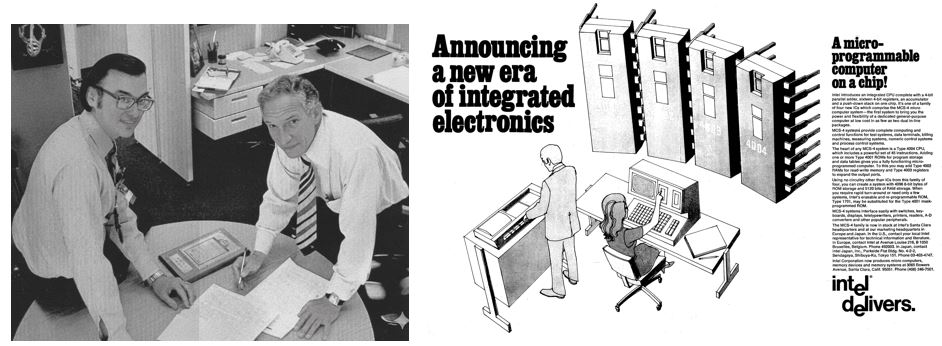
1971: The Year the Pieces Came Together
The 4004 was only one part of an extraordinary convergence.
Intel had introduced the 1103 DRAM in 1970. After stubborn early manufacturing and reliability problems were overcome, by the end of 1971 it had become the world’s largest-selling semiconductor device.
In 1971, Intel also introduced the 1702 EPROM, the first commercially available erasable programmable read-only memory—a practical form of nonvolatile semiconductor memory.
Processor. Working memory. Nonvolatile memory.
Three fundamental building blocks of modern digital electronics had come together at one young Silicon Valley company. It is why semiconductor veteran John East, writing in SemiWiki, has called 1971 “The Year Intel Changed the World.”
And 1971 brought one more historical coincidence.
On January 11, journalist Don Hoefler began a three-part series in Electronic News under the headline “Silicon Valley U.S.A.” His articles helped popularize the iconic name that would soon become synonymous with the technology industry itself.
The industry had spent more than a decade creating Silicon Valley.
Now the world had a name for it.
None of It Was Inevitable
Looking backward, Silicon Valley can seem like an inevitable progression: transistor to Fairchild, Fairchild to the integrated circuit, integrated circuit to Intel, Intel to the microprocessor.
But viewed up close, none of it looks inevitable.
The transistor monographs from Bell Labs might never have found their way to a small college in Iowa and sparked the curiosity of a young Robert Noyce. Noyce could have stayed with Shockley. Sherman Fairchild could have joined the dozens of others who had already said no. Noyce could have told IBM that his fledgling company was not yet ready to promise a hundred demanding silicon transistors when it had not built even one. His integrated-circuit idea could have remained in his drawer. Fairchild could have priced ICs conventionally. Noyce could have remained at Fairchild. Intel could have abandoned Hoff’s processor.
Noyce did not shape these events alone. Hoerni, Moore, Rock, Last, Hoff, Faggin, Grove and many others made indispensable contributions. But again and again, Noyce was there at the critical juncture—recognizing the possibility, taking the risk or helping turn an idea into reality.
That is why, when I wrote The Compass, I chose Noyce as one of its three central historical figures, alongside Albert Einstein and Steve Jobs. His story is not simply one of invention, but of also recognizing possibilities—and acting on them at moments when the outcome was far from certain.
Silicon Valley was built through breakthroughs, risks and choices. At each of its pivotal moments, someone had to make a critical decision.
Nearly every time, that someone was Robert Noyce.
About the Author
Sunil Mehta has spent more than forty years in Silicon Valley in technical and leadership roles at companies such as Intel and AMD. His recently published debut novel, The Compass, blends historical fact with imaginative storytelling to explore the lives and pivotal contributions of Albert Einstein, Robert Noyce and Steve Jobs against the backdrop of the origins of Silicon Valley.
Share this post via:



SEMICON West’s Autonomous Fab Vision Needs a Decision-Escalation Design