You are currently viewing SemiWiki as a guest which gives you limited access to the site. To view blog comments and experience other SemiWiki features you must be a registered member. Registration is fast, simple, and absolutely free so please,
join our community today!
Sandra Rivera, Chair of VSORA, joined Bloomberg’s The Close in July for an interview on the current state of AI. What follows is a summary of that conversation.
When a Silicon Valley veteran who once ran Intel’s Data Center and AI Group, and now chairs a French inference-chip challenger, sits down with a tech journalist from Bloomberg,… Read More
Intel’s strategic argument about enterprise AI is that the value of a model depends on the system that surrounds it. In an article by executives Bill Pearson and Anil Nanduri, the company positions open software as the connective tissue linking CPUs, GPUs, data, and business applications. The message is straightforward: accelerator… Read More
The little-known decisions and breakthroughs—and the remarkable role of Robert Noyce—that helped shape the modern semiconductor industry
by Sunil Mehta
When people tell the story of how Silicon Valley came into being, they usually begin with a familiar sequence of events.
The transistor was invented at Bell Labs. William Shockley… Read More
ASML is exploring how to produce more than 110 extreme ultraviolet lithography machines in 2028, reflecting the extraordinary investment flowing into artificial intelligence infrastructure. The Dutch semiconductor-equipment company expects to manufacture at least 80 EUV systems in 2027 and is considering another production… Read More
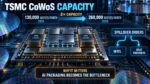
TSMC reportedly plans to double its Chip-on-Wafer-on-Substrate capacity from approximately 130,000 300mm-equivalent wafers per month at the end of 2026 to 260,000 by 2028. The estimate is not formal company guidance and should be treated as a supply-chain projection. Nevertheless, the direction is consistent with TSMC’s… Read More
Intel Foundry has a blog on LinkedIn that is worth a look. The blogs are by trusted Intel Foundry technical experts and are filled with content. I will cherry pick write a bit about them but be sure and subscribe to this, absolutely.
Intel 18A-P is not a new process node in the conventional sense. It is a performance-enhanced derivative… Read More
Intel’s next-generation 14A manufacturing process is showing unusually strong early progress, with defect density falling faster than the company expected. The improvement gives Intel a technical boost as it attempts to restore confidence in its manufacturing operation, win foundry customers and demonstrate that years… Read More
Phillip Stanley-Marbell is the founder and CEO of Signaloid. Up until September 2025, he was a full Professor (Chair of Physical Computation) in the Electrical Engineering Division of the Department of Engineering at the University of Cambridge, where he led the Physical Computation Laboratory. He completed his PhD at Carnegie… Read More
Akhilesh Kumar & Krishnakanth Sistla, Intel
Diamond Rapids is Intel’s next-generation Xeon processor, designed around the proposition that hyperscale performance increasingly depends on moving, processing, and protecting data as efficiently as executing instructions. The architecture replaces the conventional… Read More
Lance Hacking, Intel
Intel Core Series 3, code-named Wildcat Lake, is a mainstream client system-on-chip derived from the Panther Lake-based Core Ultra Series 3 architecture. Its design objective is not maximum feature density, but broad deployment of current-generation CPU, graphics, AI, memory, security, and connectivity… Read More