






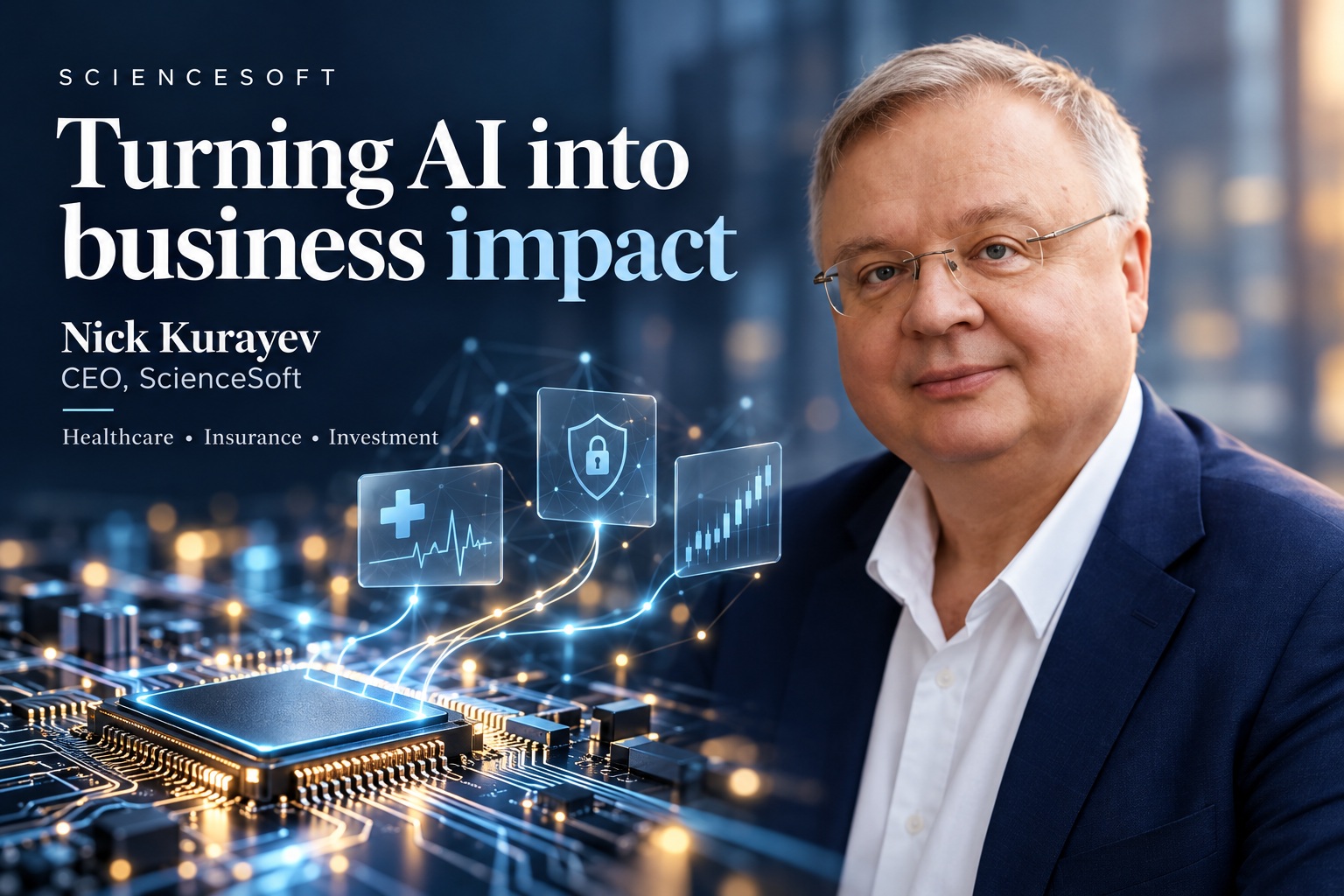
Nick Kurayev is the CEO of ScienceSoft, an AI transformation and software development company focused on regulated industries such as healthcare, insurance, and investment. The company has been in the market since 1989, delivering AI software solutions and supporting AI hardware implementation.
I spoke with Nick about how regulated sectors are approaching AI adoption and where he sees the biggest opportunities and hurdles. We also discussed how advances in semiconductor technology are shaping the pace and economics of AI transformation.
AI implementation has long been a major focus for ScienceSoft. Tell us about your work in AI and your current focus.
ScienceSoft actually started as an AI product company back in 1989. So we have lived through several generations of AI, from symbolic and semantic technologies through machine learning to generative AI and now agentic AI.
For more than a decade after ScienceSoft’s inception, we were the exclusive software development partner of the NILIM Cooperative (later IMC), a provider of an AI software product that simulated elements of human reasoning and supported computer-aided invention. We helped implement that product for Motorola, Procter & Gamble, Unilever, and other global brands across industries.
When ScienceSoft became an independent AI services company in the early 2000s, we narrowed our focus to regulated industries. We entered healthcare and financial services in 2005, and over time they developed into our major industry directions.
Today, much of our work in these sectors is centered on AI transformation at enterprise scale. Depending on the client, that may mean transforming one specific function or redesigning digital operations more broadly.
Looking ahead, our focus is on strengthening ScienceSoft’s leadership in AI transformation for healthcare, insurance, and investment management. Beyond AI expertise, complex AI programs need strong industry knowledge, architecture, data engineering, delivery management, and compliance competencies around them. So we are continuing to build out these skills across the company.
Has generative AI — and, more recently, agentic AI — changed what clients ask for and how AI projects develop?
Absolutely. Recent advancements have completely changed how we think and talk about AI.
I would say that compared to previous AI technologies, GenAI and agentic AI end up having more impact on the business process. We used to build AI like any other kind of application — just an isolated tool meant to do one job. But adding generative and agentic AI often means transforming the surrounding processes, and that, in turn, changes how the organization itself functions.
As GenAI and agentic AI have broadened the scope of transformation, businesses now formulate their AI needs differently. They no longer pick a model or tool and then look for someone to deploy it. Clients increasingly come to us for strategic support and with strategic questions: where can AI materially change our bottom line or operating model, which processes should we transform first, and how far can we safely automate?
The role of ScienceSoft has changed with that. Years ago, a client would come to us and say, “We need this technology,” and our job was to build it. Today, we often have to get involved much earlier. A client may know they want to use some AI, but not what exactly they should build. So our job is to understand the business problem, determine what kind of AI transformation actually makes sense, and work out what value it can realistically bring. Otherwise, you can build very impressive AI that has very little business value.
Technology choice now comes later, and it has become more complex. Sometimes traditional machine learning is still better than GenAI. And sometimes you can build a regular automation application, and it will be more reliable than agentic AI. We need to decide on where each technology is appropriate. Our AI architecture practice is quite old and seasoned at this point, but we are still learning every day.
ScienceSoft focuses particularly on healthcare, insurance, and investment. What makes AI transformation in these industries different?
I would say that these industries have almost ideal conditions for AI — and at the same time some of the hardest conditions for deploying it.
All three are extremely data-rich, and a lot of the work comes down to analyzing that information and using it to make decisions. Modern AI can process far more data than a person can, find patterns in it, and deal with complex processes where the right answer depends on many different factors. It can also handle complex automation and compliance rules with many exceptions much more flexibly than traditional automation. So the potential value is enormous, whether you’re looking at healthcare, insurance, or investment.
But AI-supported operations in these sectors also carry substantial legal, financial, and safety consequences. For ScienceSoft as an AI transformation partner, this means reliability, regulatory compliance, and accountability become part of the engineering problem.
To me, the real difficulty of working with regulated sectors is finding the maximum level of AI autonomy that balances economic benefits with manageable operational and regulatory risk. Healthcare probably demonstrates this most clearly. You have strict requirements around protected health data, clinical safety, interoperability, auditability, and, for certain AI-enabled medical software and devices, regulatory clearance and lifecycle monitoring. AI performance can also change with patient populations or clinical practices, so even if you manage to put an AI system into production, you have to keep re-validating it.
There is also unusual engineering complexity because healthcare AI often sits inside a large software-hardware environment with demanding security and availability requirements. So an AI model or agent can perform very well technically and still fail as a healthcare solution if it does not fit well into the surrounding system.
That is why in ScienceSoft projects for regulated sectors, we normally start small. We give AI a limited role, see how it performs in real work, and gradually give it more responsibility as we become confident that it works. It takes time, but there really isn’t a good shortcut.
In ScienceSoft’s experience, what separates AI transformation projects that have a lasting positive impact from those that ultimately fail?
The first dividing line is production-ready AI architecture. Companies rarely bring AI into a clean environment. They already have years of technology in place, and AI has to work with it. But adding AI shouldn’t mean rebuilding your entire IT environment around it. A good architecture lets you bring AI in without tying everything else too closely to it. If you don’t get that right from the start, problems tend to pile up later.
Plus, if you assume that the AI technology you choose today will work the same and cost the same in three years, you are setting yourself up for failure. You need the flexibility to change models and providers when something better or more economical comes along.
ScienceSoft’s architects increasingly favor layered AI architectures where AI components can work independently of core enterprise systems. In simple terms, this means AI models and agents sit in their separate environment, have their own shared integration layer, orchestration, and so on. Meanwhile, core business software can interact with AI without becoming entangled with it. This makes it easier to connect AI to older systems without having to rebuild them around AI. And if a model or vendor needs to change later, you can replace it without disrupting the rest of your software. That gives you more freedom to keep improving your AI.
The second success factor is whether the company is prepared to redesign its work around AI. This is becoming particularly visible with agentic AI. If you build a great AI agent but leave every existing approval and control unchanged, the system is still bottlenecked. In that scenario, AI will assemble a case file in five minutes instead of five hours, but then you will have to wait five days for someone to look at the notification and manually assign the case to a responsible person. So, successful AI transformation means reconsidering employee responsibilities, decision rights, escalation paths, and performance metrics. Without that, you’re just accumulating AI tools. But not many organizations are ready for change at that level.
Insurance illustrates this problem well. Insurers are very eager to experiment with AI, but most of the investment still goes into adding new technology rather than changing how the work is done. I recently saw a BCG report that put this into numbers: only around a third of P&C insurers said they were getting value from AI at scale across their core workflows.
In ScienceSoft’s work, we try to address that operating model question from the beginning. We define where human judgment remains necessary, what employees need in order to trust and use the new process, and how to foster AI adoption.
Much of the AI transformation we’ve been discussing depends on semiconductors. How do you see developments in the semiconductor sector affecting the speed of AI transformation in ScienceSoft’s target industries?
While the dependency is material, it’s not a simple one-to-one relationship like “faster chips — faster AI transformation.” Semiconductor progress sets the physical and economic ceiling for AI: how much computation is available, at what cost, with what latency and energy consumption.
There are real capacity constraints today, especially around high-bandwidth memory, advanced packaging, and the accelerators used for AI. Most of ScienceSoft’s clients don’t buy that hardware directly, so they feel those constraints through the cloud: how much computing capacity is available, how quickly they can get it, and what they have to pay for it.
But chips are still only one part of the equation. In ScienceSoft’s AI work in healthcare, insurance, and investment, we generally see that the bigger barriers sit inside the organization. Companies need to get their data, systems, and processes ready for AI, and that can make the path to AI longer even when better and more available chips are there.
In practice, this means semiconductor progress can continue very rapidly while enterprise AI transformation moves relatively slow. There is a natural lag between advances in hardware, improvements in models, falling costs, experimentation, and scaled deployment. That lag could easily be several years in regulated sectors, especially when emerging technologies could require regulatory authorization. Conversely, even if semiconductor progress slowed, organizations would still continue transforming for some time by adding AI capabilities that already exist but haven’t been adopted yet.
Healthcare seems to have a particularly strong dependency on semiconductors because of its extensive use of specialized hardware. What distinct AI transformation opportunities could that open?
I assume you mean hardware used in diagnostics, patient monitoring, robotic surgery, and similar fields. There, the semiconductor dependency is indeed direct. Stronger compute, higher memory bandwidth, and lower inference latency could bring genuine breakthroughs.
For example, more efficient edge processors could enable small ML models to run directly on medical devices, without sending every computation to the cloud. In patient monitoring, this local processing could reduce the delay between detecting an abnormal reading and alerting clinicians. It could also keep sensitive data on the device or within the hospital environment, giving healthcare providers more control over it. And because the device doesn’t need a constant connection to the cloud, critical functionality could continue even when connectivity is poor. Better hardware could therefore remove some of the cloud-related AI limitations healthcare providers face today, particularly around data privacy, reliability, and speed.
But AI is also being used in administrative medical use cases, like clinical documentation and patient communication. There, the chip dependency is much less direct because these applications don’t rely on specialized medical hardware and are not particularly compute-intensive.
So is it fair to say that, for insurers and investment firms, the main benefit of better chips will be lower AI costs rather than new AI use cases? Unlike healthcare, they don’t rely as much on AI running directly on devices.
For insurance, mostly yes: better chips mainly change the economics.
Today’s semiconductor technology can already support most core insurance AI workflows even at very high transaction volumes. Further progress could make more compute-intensive uses, including continuous agentic operations, economical at a larger scale. And as inference gets cheaper, these kinds of applications become realistic for smaller insurance companies.
Investment is much the same as insurance, except for latency-sensitive trading.
For a classic asset manager, saving a few milliseconds on AI response time will not change much. But for quantitative and high-frequency trading firms, even a very small reduction in the time it takes to process market data and make a decision can matter. That is where faster processors, memory, and networking can create a direct advantage.
We’ve seen this firsthand. ScienceSoft worked on an early AI-based stock trading system at a time when faster computing was opening up new possibilities for automated trading. Better hardware didn’t just make trading faster. It also made it practical to automate strategies that simply wouldn’t work at slower speeds.
What I take from that experience today is that in trading, hardware can still change what is technically possible. This is where I would expect further semiconductor advances to push firms toward new generations of hardware particularly quickly.
Also Read:
CEO Interview with Sunghyun Park of Rebellions
CEO Interview with Charlie Cheng of CEO of TeRAM
Executive Interview with Raghu Belur, Co-Founder of Enphase Energy
Share this post via:



Terafab’s Single Roof: Why Packaging, Not Lithography, Decides High Volume