





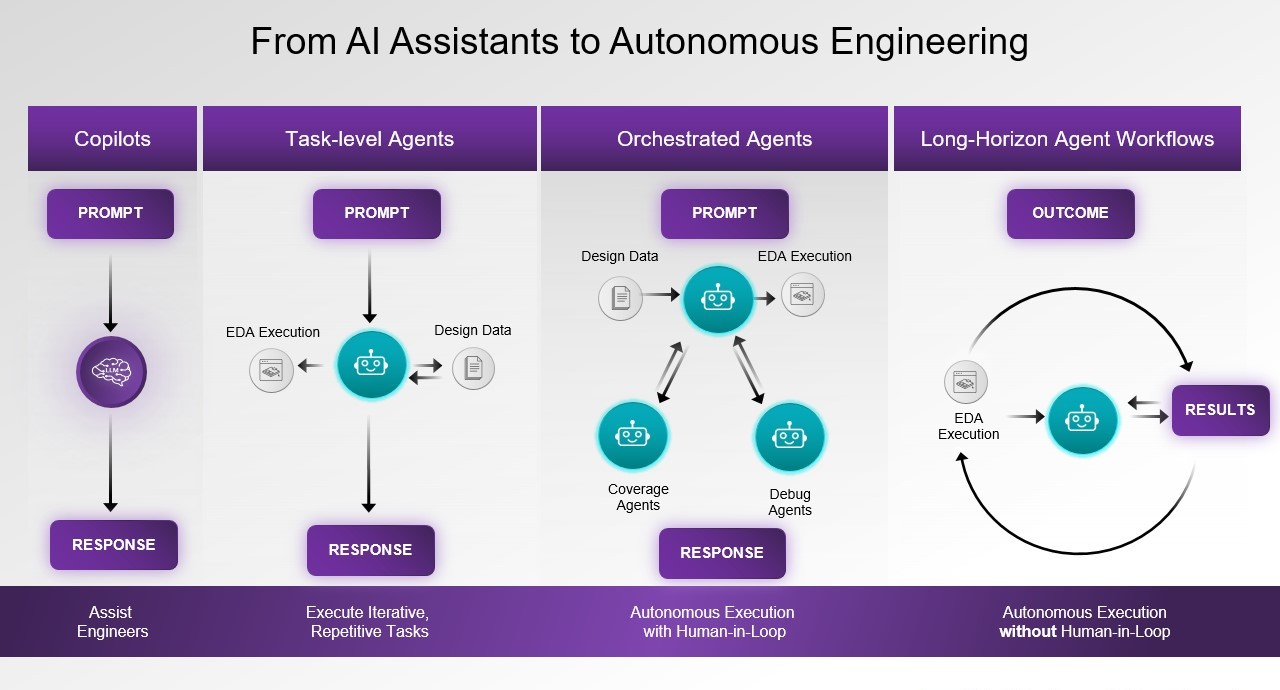
Synopsys today announced its AgentEngineerTM solutions portfolio and AutopilotTM Platform, advancing a fundamental paradigm shift in electronic design automation (EDA): moving beyond AI copilots toward autonomous engineering agents. Following a recent technical briefing with Thomas Andersen, Vice President of AI and Machine Learning at Synopsys, the trajectory of this evolution became clear. The ultimate benchmark is transitioning from engineering assistance to fully autonomous, closed-loop machine execution. Achieving this level of machine autonomy requires navigating four distinct evolutionary phases.
What Do “Long-Running” and “Long-Horizon” Actually Mean?
Complex back-end synthesis and physical verification processes routinely span days, if not weeks. Traditional automation breaks down when a tool hits a multi-day compute block because script execution lacks continuity.
An autonomous agent solves this. It maintains state, monitors background progress asynchronously, and makes contextual decisions across prolonged processing intervals without human intervention. Long-running signifies the structural autonomy of the agent layer. Synopsys AgentEngineer solutions are also classified as long-horizon, meaning they are guided by an engineering objective.
From Fixed Workflows to Reasoning
Instead of hardcoding every single step of a process, engineers can now equip a system with a toolkit of specialized skills and knowledge. AI then reasons through the problem to figure out how to piece those skills together.
The real shift here is that structural guardrails are moving from being rigid to adaptive. Instead of mapping out every single branch of a workflow ahead of time, the system analyzes the current situation to decide which tools and skills actually fit.
This flexibility is a game-changer. For instance, a failed verification check triggers a debugging phase. Debugging then requires looking closely at an entirely different section of the design. That inspection might lead to a quick modification, which immediately demands another verification run.
A traditional/rigid setup can only automate a fraction of this loop. An agentic workflow, however, evaluates the data and dynamically chooses the next best step.
NVIDIA Provides Important Building Blocks
Synopsys’ latest agentic AI collaboration with NVIDIA, which was announced around DAC, serves as a prime real-world example of this multi-vendor strategy. NVIDIA supplies essential building blocks like agent-creation infrastructure, Nemotron models, NIMs, and OpenShell, all running on top of their accelerated GPU computing hardware. The NVIDIA collaboration is an ecosystem partnership built on a robust technology stack.
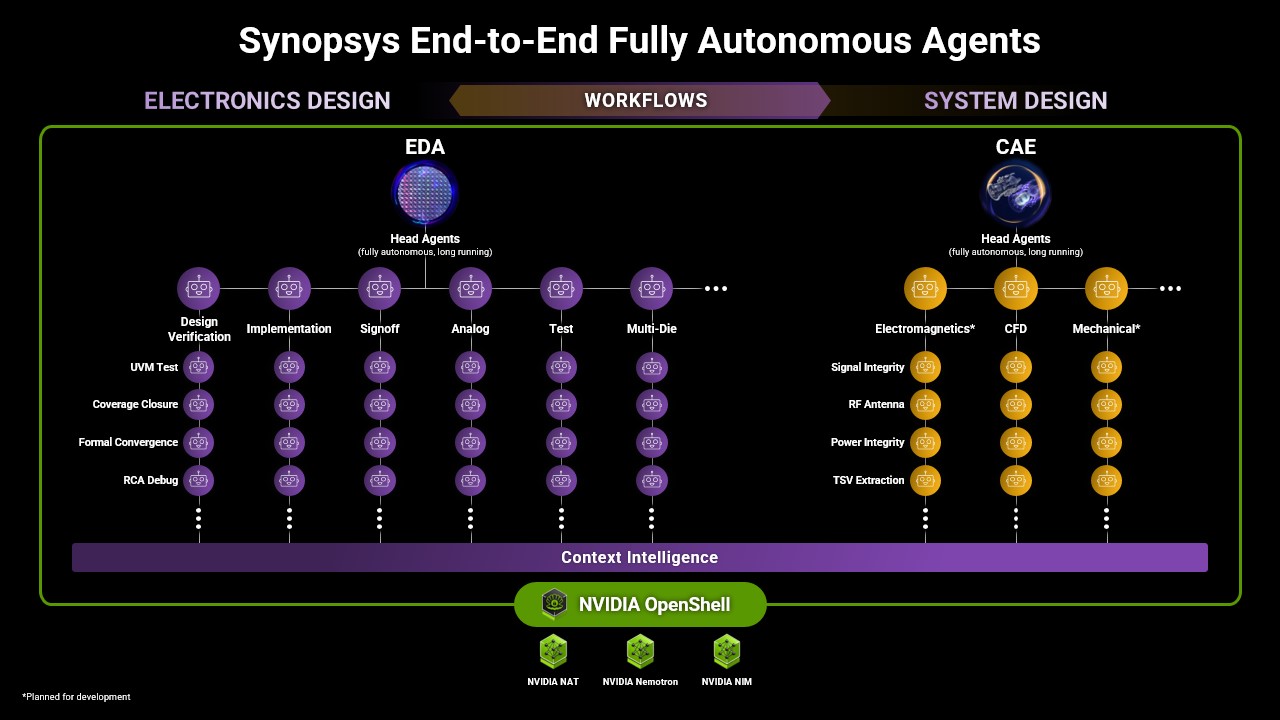
The real value of this deep integration lies in marrying AI infrastructure with high-performance engineering workloads. Smart reasoning makes an AI agent more capable, but that agent still needs to spin up simulations, run implementation tools, and weigh the outcomes. When these core engineering workloads run faster, the autonomous system can squeeze in far more design iterations.
A fully autonomous engineering setup requires both halves of that equation to succeed.
Synopsys Is Not Betting on a Single LLM
The company continuously tests a variety of large language models and tailors its recommendations based on real-world benchmark performance. Synopsys supports top-tier commercial models, as well as open-source alternatives.
This dual approach is essential for semiconductor clients with strict security or deployment limits. For chipmakers operating in highly secure, air-gapped facilities or on-premises servers, cloud-based models are out of the question. These teams manage their own hardware infrastructure because they cannot risk sending highly sensitive, proprietary chip blueprints to an external cloud. For these specific environments, open-source models are indispensable.
Economics also play a massive role in this strategy. When automated agent interactions invoke EDA tools many times for a single project, managing those underlying compute costs becomes a major financial priority.
Synopsys’ EDA-Specific Advantage
The Synopsys agents call upon the company’s underlying EDA and simulation and analysis engines to pull clean, structured data. This results in better quality of results and lower token cost of the agents relative to the messy alternative of forcing an LLM to guess what is happening through a user interface built for human eyes. By pulling data directly, the system slashes the sheer volume of text it has to feed into the model while delivering a much clearer engineering context.
How AgentEngineer Solutions and the Autopilot Platform Work Together
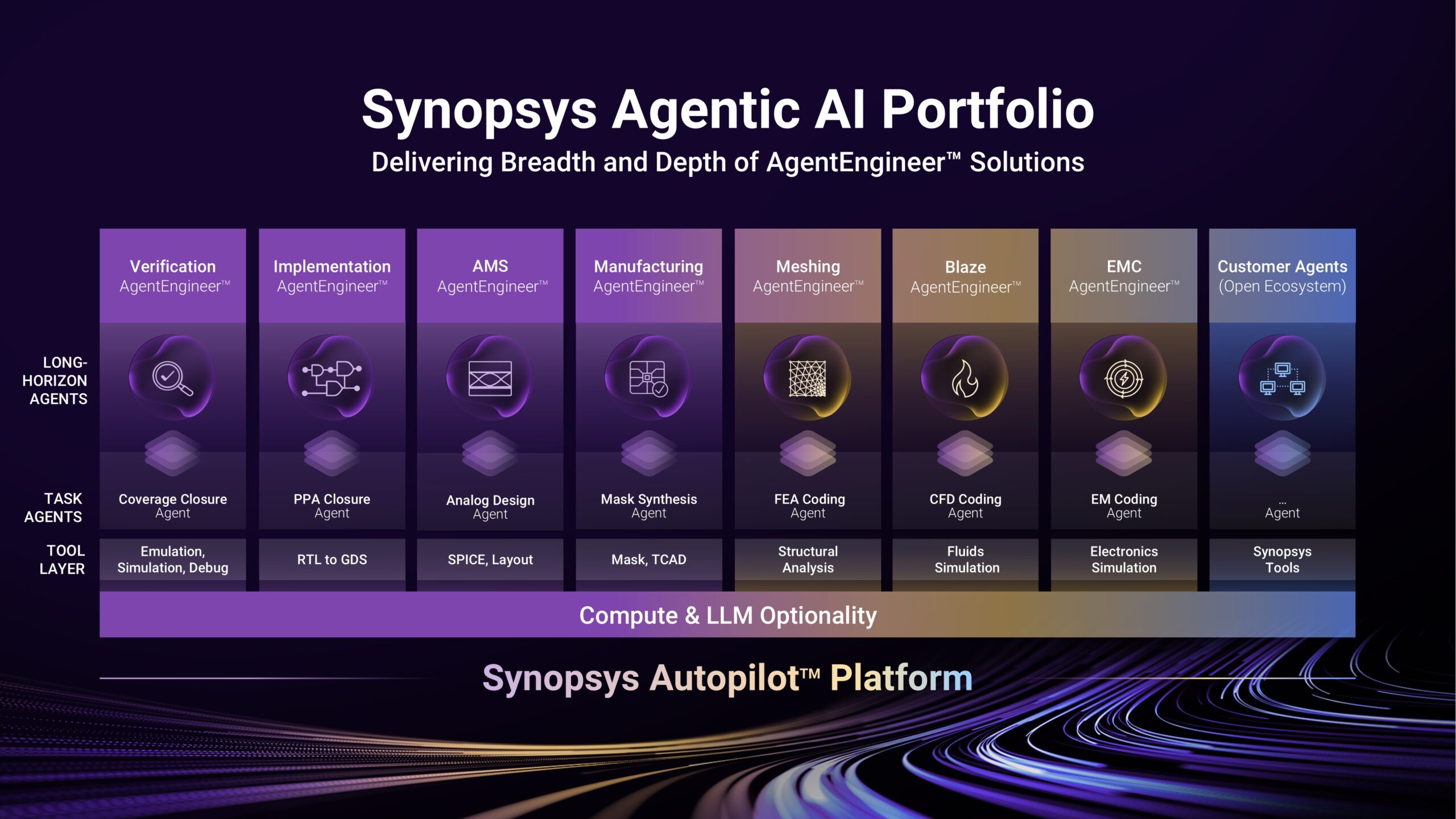
At the center of Synopsys’ strategy are two complementary components: the AgentEngineer portfolio, which provides domain-specific engineering agents, and the Autopilot Platform, which provides the orchestration, memory, context management, and governance required to coordinate those agents across complex workflows.
Based on this framework, the open architecture can be viewed as a tier system:
The foundation: Heavy-duty EDA and CAE tools handle the baseline math and modeling.
The middle layer: Domain-specific AI agents step in, each specializing in unique engineering workflows and tasks.
The command layer: Orchestration features manage these agents, allowing them to collaborate smoothly.
The top layer: A persistent system keeps track of context, memory, and knowledge gained across prior runs.
This open setup gives customers an opportunity to bake in their own secret sauce. Synopsys provides out-of-the-box agents and infrastructure as a launching pad. From there, companies can layer on their own hard-earned engineering knowledge and design methodologies.
By the way, Synopsys isn’t limiting this agentic approach to traditional EDA boundaries; they are scaling it across their Ansys portfolio.
Summary
As agentic systems hit their stride, trusted EDA tools will be increasingly critical computational engines providing engineering context, domain expertise, workflow intelligence beneath an autonomous system. The engineer’s new job will be to define the overarching objective, letting the AI handle the direct, tedious manipulation of the software below.
Synopsys isn’t claiming that a fully autonomous design environment will just materialize overnight. Instead, the company has been systematically building and rolling out the prerequisite pieces: standalone task agents, multi-agent workflows, and highly persistent autonomous loops.
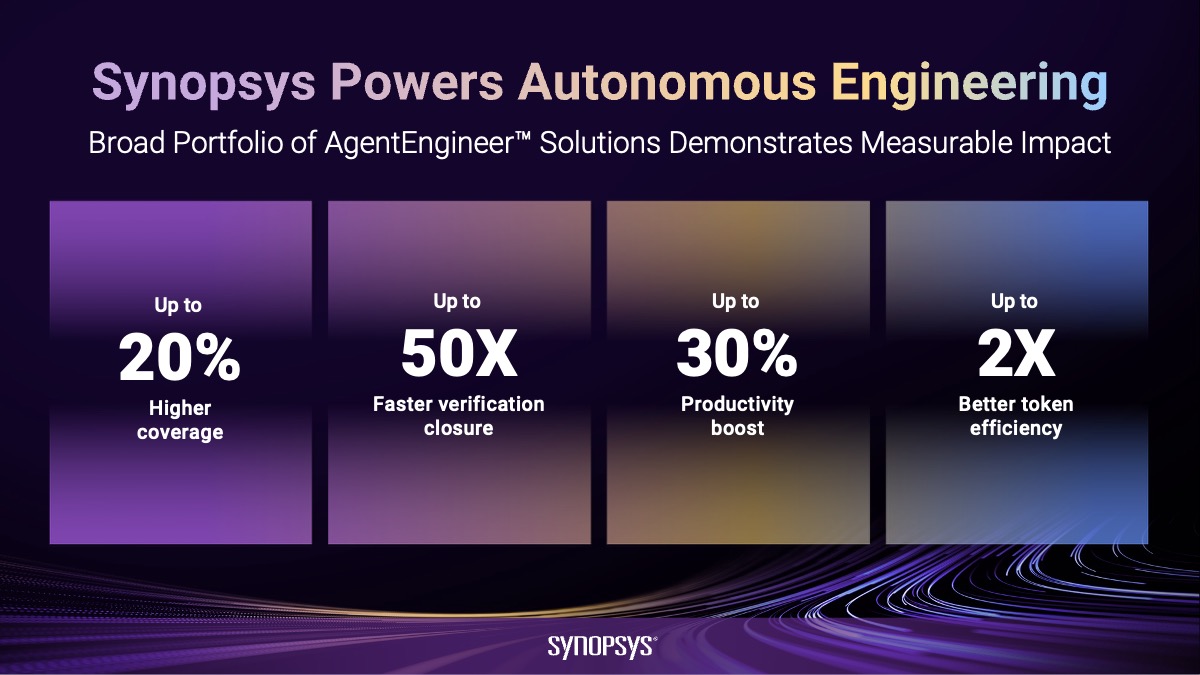
Some companies are adopting at a faster pace in the race to capture massive, immediate gains in engineering speed and productivity. Others are taking a cautious approach, experimenting with a single AI element in their existing workflow before expanding further. This staggered, gradual rollout will likely define the near future. With more than 50 engagements underway, Synopsys agentic AI solutions are demonstrating measurable impact.
The high-stakes question is just how much of the engineering loop the industry will comfortably hand over to autonomous systems and how quickly.
Also Read:
Unified Emulation and Prototyping: Pipedream or Reality?
Share this post via:



Comments
There are no comments yet.
You must register or log in to view/post comments.