





Purple was in fashion at the 2026 Design Automation Conference, where Synopsys reinforced its position at the forefront of AI-powered engineering. Under the conference’s “Chips to Systems” theme, the company showcased intelligent, end-to-end technologies designed to help the semiconductor industry manage unprecedented complexity. Its broad portfolio—spanning silicon design and verification, intellectual property, advanced packaging, and system-level development—demonstrated how AI is transforming every stage of innovation.
The semiconductor sector is entering an era defined by larger designs, heterogeneous integration, escalating verification demands, and relentless pressure to improve power, performance, and area. Traditional engineering methods alone cannot keep pace with these challenges. #Synopsys used #DAC2026 to make a compelling case for AI as an essential collaborator: one that can automate repetitive tasks, explore more design possibilities, identify risks earlier, and enable engineering teams to concentrate on higher-value decisions.
Central to the company’s presence was its vision for agentic and generative AI across the engineering workflow. Rather than applying intelligence to isolated tools, Synopsys presented a connected approach in which AI capabilities support designers from architectural exploration through implementation, verification, manufacturing readiness, and system validation. This strategy promises to reduce iteration cycles and strengthen continuity between disciplines that have historically operated in separate environments.
Synopsys also emphasized the importance of trustworthy results. In chip and system development, faster answers matter only when engineers can rely on their accuracy, traceability, and alignment with established signoff requirements. By combining AI techniques with decades of domain knowledge, proven algorithms, and production-grade workflows, the company is working to deliver productivity improvements without compromising engineering rigor.
Another major theme was the growing convergence of chips, packages, and systems. Modern products increasingly depend on chiplets, multi-die architectures, complex software stacks, and tightly coordinated thermal, mechanical, electrical, and manufacturing considerations. Synopsys demonstrated how integrated platforms can provide a more complete view of these interdependencies, helping teams optimize the full system instead of improving individual components in isolation.
The company’s leadership in silicon intellectual property further strengthened this chips-to-systems story. High-quality IP can shorten development schedules, lower integration risk, and give designers a foundation for differentiated products. When combined with AI-assisted design and verification, reusable IP becomes part of a broader acceleration strategy, enabling customers to address demanding markets such as high-performance computing, automotive, mobile, and intelligent edge devices.
DAC2026 also offered Synopsys an important venue for collaboration. Through technical sessions, demonstrations, customer discussions, and ecosystem engagement, the company connected researchers, chipmakers, systems companies, and engineering teams around a shared challenge: transforming rapidly expanding computational possibilities into reliable, manufacturable products. These exchanges matter because no single tool or organization can solve the industry’s complexity alone.
Attention also turned to workforce productivity and the changing nature of engineering expertise. AI can help newer designers navigate sophisticated workflows while giving experienced specialists more time for architecture, analysis, and innovation. By capturing knowledge within accessible, context-aware environments, Synopsys aims to help organizations scale scarce expertise across global teams, improve consistency, and preserve learning from one development program to the next.
Synopsys’ message was ultimately about expanding human capability. AI-powered engineering is not simply a way to make existing processes faster; it creates opportunities to reconsider how products are conceived, optimized, and delivered. Engineers can evaluate broader solution spaces, test assumptions sooner, and respond more quickly to changing requirements. Organizations, in turn, can pursue ambitious designs while managing cost, schedule, and technical risk.
Bottom line: By bringing together AI innovation, comprehensive engineering solutions, trusted IP, and deep industry expertise, Synopsys made a strong impression at the DAC2026 Chips to Systems Conference. Its presence illustrated a future in which intelligence is embedded throughout the development lifecycle and information flows more effectively across traditional boundaries. As semiconductor and system complexity continues to rise, that integrated vision positions Synopsys to help innovators move from bold ideas to differentiated products with greater speed, confidence, and precision.
Announcements:
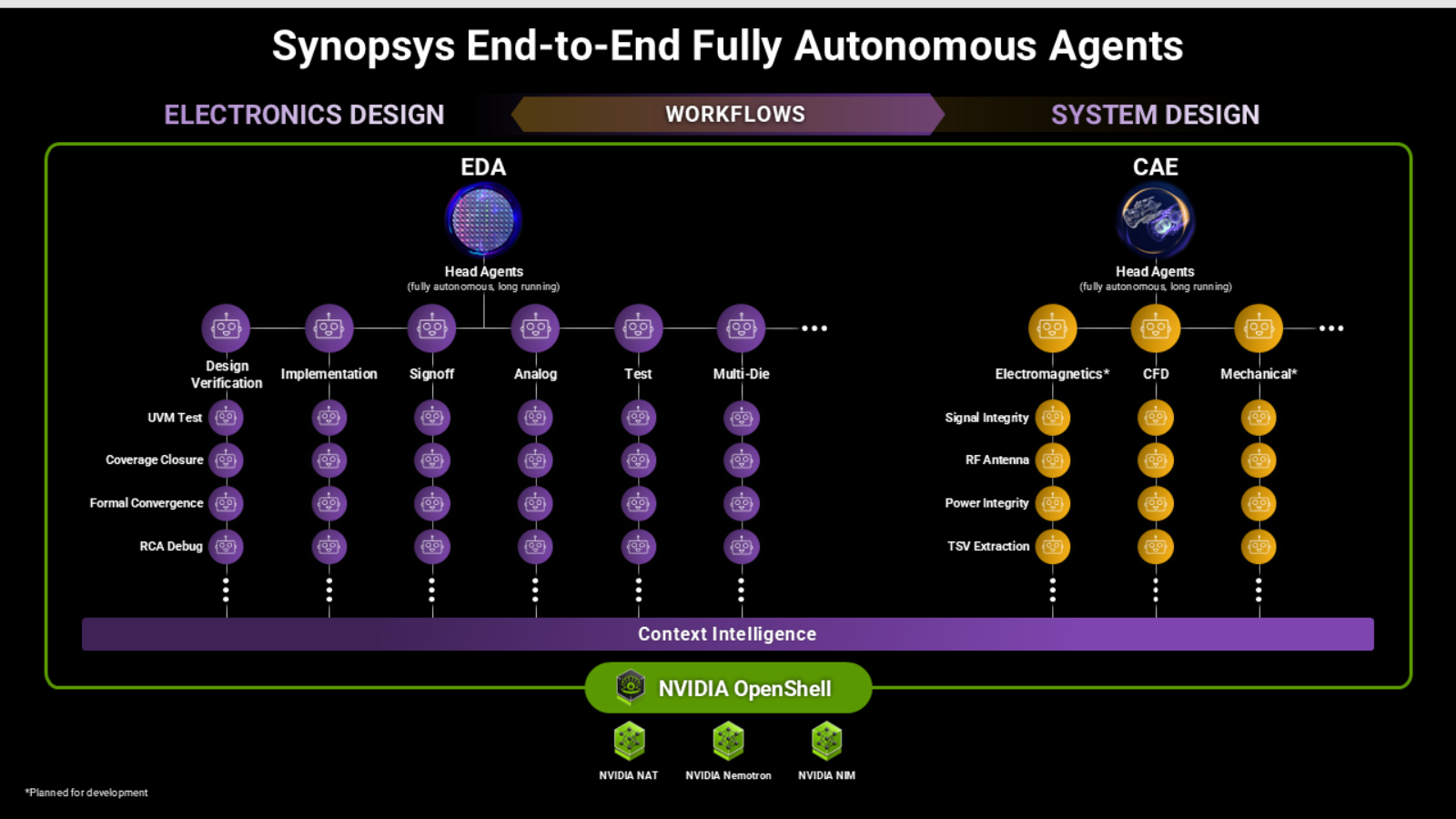
- Synopsys and NVIDIA unveiled new, fully autonomous, long-running agentic capabilities for chip design and electronics system design, powered by Synopsys AgentEngineer™ technology, enabled with NVIDIA Nemotron, NVIDIA’s accelerated computing platform, and secured by NVIDIA OpenShell runtime. Read the Synopsys press release to learn more.
- Synopsys advances agentic AI chip design with AMD and Microsoft, introducing the first autonomous EDA workflows on Microsoft Discovery to accelerate engineering from specification to silicon. Read the Synopsys press release to learn more.
- Synopsys and Intel Foundry expanded their collaborations to advance design enablement for Intel 14A process technology, including certified AI-powered EDA flows, integrated multiphysics analysis, and a broad IP portfolio. Read the Synopsys press release to learn more.
- Synopsys joins NVIDIA and industry leaders in the Open Secure AI Alliance. Learn more: https://blogs.nvidia.com/blog/open-secure-ai-alliance
Also Read:
Industry’s First Certified Automotive Grade PUF for Software Defined Vehicles
Synopsys at Design Automation Conference 2026
Share this post via:



Comments
There are no comments yet.
You must register or log in to view/post comments.