





Software defined vehicles (SDVs) are transforming the automotive industry. Today’s vehicles are connected computing platforms that rely on advanced processors, artificial intelligence (AI), over the air (OTA) software updates, cloud services, and vehicle to everything (V2X) communications. Every electronic control unit (ECU), zonal controller, and high-performance processor must establish a trusted identity before it can authenticate software, exchange encrypted data, or perform safety critical functions.
This growing dependence on digital trust is forcing the industry to rethink security. Traditional approaches store cryptographic keys in nonvolatile memory, creating potential targets for sophisticated attacks. A new generation of hardware security addresses this challenge by deriving trust directly from the silicon itself. Reinforcing this shift is the recent certification of what is described as the industry’s first automotive grade Physical Unclonable Function (PUF) IP. The milestone signals that intrinsic silicon identity is ready to become the foundation of next generation automotive cybersecurity.
Why Traditional Hardware Security Must Evolve
The rapid convergence of connectivity, electrification, and autonomous driving has expanded the automotive attack surface. Modern vehicles communicate with cloud platforms, smartphones, and other vehicles while receiving frequent OTA updates. Every interaction depends on cryptographic keys that verify identities, authenticate software, and secure communications.
For decades, these keys have been stored in flash memory, embedded secure elements, or electronic fuses (eFuses). While these technologies remain effective, permanently stored secrets continue to attract attackers using invasive probing, side channel analysis, fault injection, and memory extraction techniques. Long vehicle lifecycles make protecting cryptographic keys increasingly difficult.
The industry is therefore moving toward security architectures where keys are generated only when required instead of being permanently stored.
How Automotive PUF Technology Creates an Unclonable Silicon Identity
A Physical Unclonable Function takes advantage of a simple reality. No two semiconductor chips are physically identical. Manufacturing variations create microscopic differences in transistor characteristics, giving every chip a unique silicon fingerprint.
Instead of storing a secret key, a PUF derives one from these inherent physical characteristics. Synopsys’ Automotive PUF Premium IP uses an SRAM based implementation. SRAM cells exhibit unique startup behavior when powered on. Their combined response becomes the basis for cryptographic key generation.
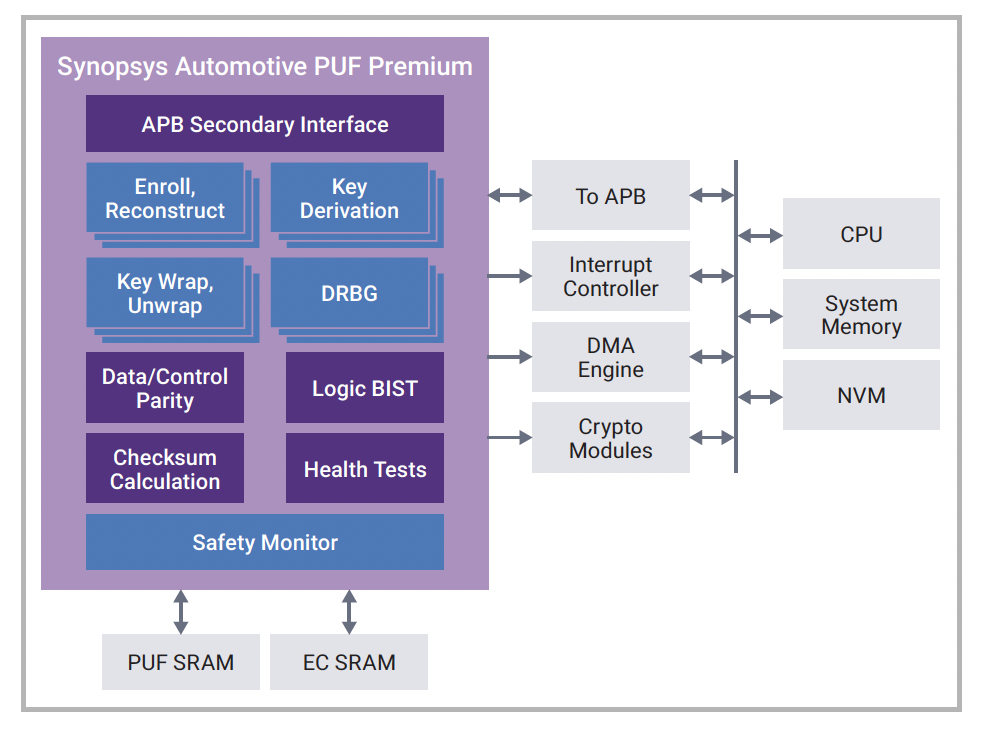
Error correction techniques compensate for variations caused by voltage, temperature and aging while reconstructing the same key without exposing it. The result is a hardware root of trust where cryptographic secrets are recreated only when needed.
This architecture offers several advantages. Root keys are never permanently stored, reducing the risk of memory extraction attacks. The unique silicon identity enables strong device authentication and protection against cloning. Because the technology uses standard SRAM found in modern SoCs, it is technology-node agnostic and can be deployed across foundries and process nodes without requiring specialized manufacturing steps or per-node re-qualification.
Building the Hardware Root of Trust
An intrinsic silicon identity becomes valuable because it supports security throughout the vehicle lifecycle.
During manufacturing, they enable secure provisioning without exposing permanent secrets on the production line. During startup, PUF derived keys establish secure boot and ensure that only authenticated software is executed. During operation, they support ECU authentication, encrypted communications, secure diagnostics, intellectual property protection, and trusted OTA software updates.
These capabilities become even more important as automotive architectures shift toward centralized computing and zonal controllers. A single processor may soon manage powertrain, ADAS, infotainment, and body electronics. Protecting the identity of that processor becomes essential because compromising it could affect multiple vehicle functions simultaneously.
Why the Industry First Certification Matters
Although PUF technology has existed for years, deploying it in production vehicles requires much more than strong cryptography. Automotive electronics must operate reliably across extreme temperatures tolerate electrical disturbances, and continue functioning safely throughout the lifetime of the vehicle. To meet these demands, the IP has been successfully characterized from -40 °C to 150 °C, making this recent certification an important milestone.
Synopsys’ Automotive PUF Premium IP is described as the industry’s first solution certified against the requirements of ISO 26262 for functional safety (ASIL B Random, ASIL D Systematic) and ISO/SAE 21434 for automotive cybersecurity. It demonstrates that silicon-based identity has matured for safety critical automotive applications.
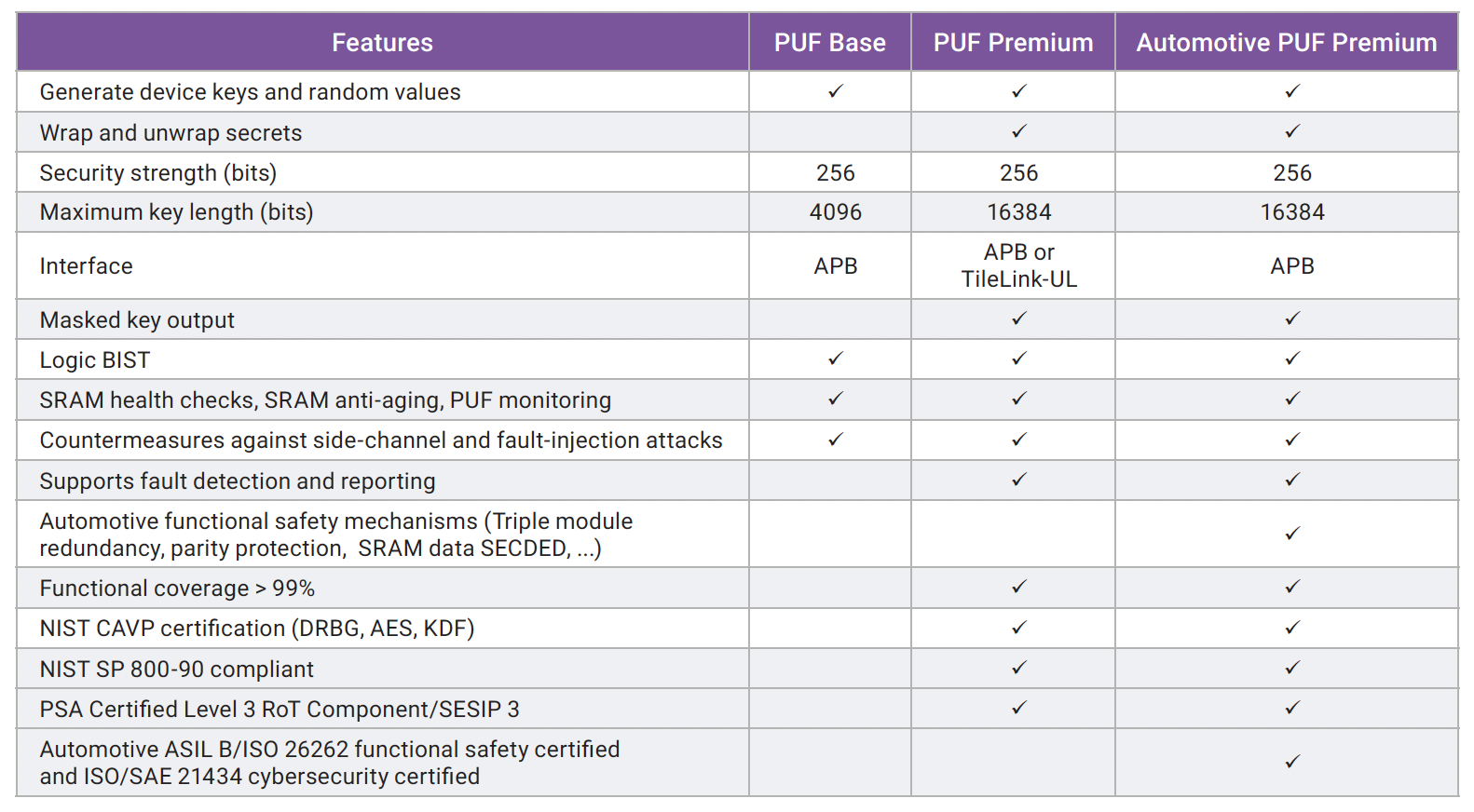
The achievement extends beyond cryptographic performance. Automotive implementations require comprehensive diagnostics, fault detection, integrity monitoring, and consistent key reconstruction under demanding operating conditions. Meeting these requirements gives OEMs, Tier 1 suppliers, and semiconductor companies greater confidence in deploying hardware-based roots of trust. It also reduces integration risk by providing a validated security building block aligned with recognized automotive standards.
Summary
The certification of the industry’s first automotive grade PUF marks an important milestone in automotive semiconductor security. It demonstrates that hardware-based silicon identity has matured for production automotive applications and can meet the rigorous requirements of functional safety and cybersecurity.
Unlike conventional approaches that store cryptographic keys in memory, PUF technology derives keys from the unique physical characteristics of each chip. This reduces the attack surface, strengthens device authentication, and provides a trusted hardware foundation for secure boot, secure provisioning, OTA software updates, and encrypted communications.
As software defined vehicles adopt centralized computing architectures and remain connected throughout their long lifecycle, trust must begin in hardware. The industry’s first certified automotive grade PUF signals a broader shift toward building security directly into the silicon, enabling a more resilient foundation for the next generation of connected vehicles.
Learn more at Synopsys PUF IP for Automotive Security.
Download Synopsys PUF Base/PUF Premium IP Datasheet.
Also Read:
Synopsys at Design Automation Conference 2026
From Detection to Safety: Reframing Fault Simulation for Functional Safety
Share this post via:



Comments
There are no comments yet.
You must register or log in to view/post comments.