





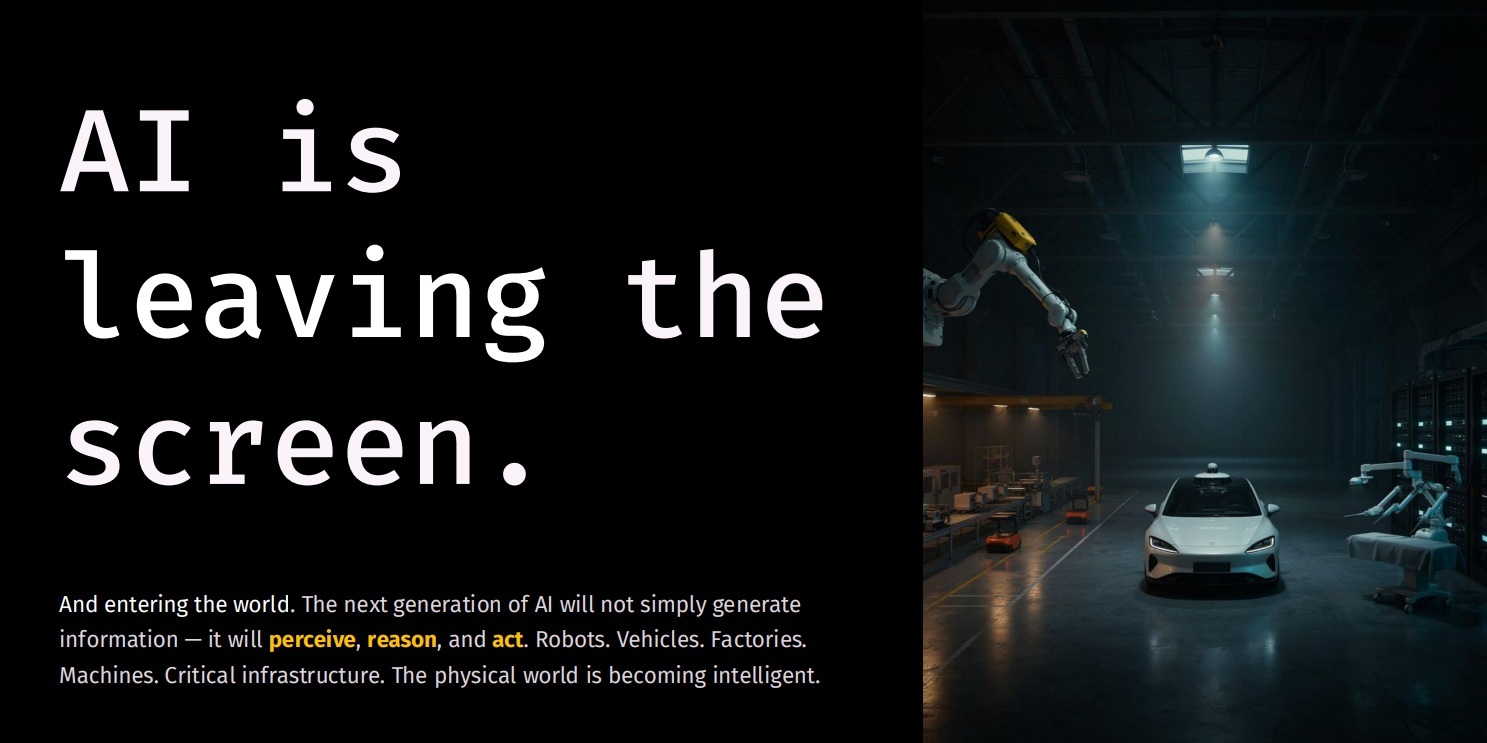
Artificial intelligence is moving beyond the screen. The attached presentation describes a shift from systems that generate text, images, and code to systems that can perceive their surroundings and take action. These systems could guide robots, vehicles, factory equipment, medical devices, and critical infrastructure. Their promise is substantial, but so is the consequence of a mistake: an incorrect answer can become a physical failure.
The presentation’s central question is how to train and test AI for a world that cannot safely supply every experience it needs. Generative AI benefited from enormous collections of human-created digital material. Physical AI needs examples of sensor failures, unusual weather, worn components, manufacturing differences, and unexpected human behavior. Many of those events are rare, costly, or dangerous to reproduce. A robot cannot learn every hazardous lesson by encountering it on a factory floor.
The proposed answer is simulation. Before a machine acts in one real environment, it can practice across many virtual ones. A useful simulation must do more than look convincing. The presentation calls for digital twins that model physical behavior, produce realistic camera and sensor readings, respond to an AI system’s actions, and run many scenarios in parallel. Such environments could expose an autonomous system to situations it might otherwise meet for the first time after deployment.
That approach also addresses the sim-to-real gap: behavior learned in a simulation may fail when real materials, sensors, or surroundings behave differently. The presentation argues that high-fidelity physics is essential to narrowing that gap. Thermal, structural, electromagnetic, and fluid effects can help determine whether a simulated outcome reflects what a machine would actually encounter. Physics can also give synthetic training data a reliable source of truth, including information about forces, temperatures, and sensor readings that would be difficult to capture completely in a real test.
The presentation places this idea within a proposed engineering stack. NVIDIA supplies accelerated computing, AI infrastructure, libraries, and tools for creating virtual environments. Synopsys contributes engineering and simulation capabilities spanning components through complete systems. Together, the two are presented as a foundation for a workflow that moves from design and simulation through training, validation, and deployment. The broader claim is that, as AI systems gain the ability to act, physics simulation becomes a core part of AI infrastructure.
Why does this matter? First, simulation could broaden testing. A physical prototype can face only the conditions engineers arrange during a test. Virtual environments can generate variations systematically, including rare combinations and dangerous failure modes. That gives developers a way to find weaknesses earlier, before people or equipment are exposed.
Second, it could improve how machines are trained. If simulated sensor data and outcomes reflect the underlying physics, developers can create targeted experience for conditions that real-world data barely represents. They can examine how a system responds when a sensor degrades, power fails, or a component behaves outside its expected range.
Third, it changes the role of engineering software. In the presentation’s vision, simulation is no longer used only to check a design before manufacture. It becomes an ongoing environment for teaching, evaluating, and updating the intelligence that operates the finished machine.
Bottom line: The case remains a strategic thesis, not proof that simulation alone makes physical AI trustworthy. Models must reflect reality closely enough for their intended use, and real-world testing remains essential. Claims about exhaustive validation or certification depend on how well a particular system and its risks are measured. Still, the presentation identifies a genuine challenge: physical AI needs relevant experience before it can act safely. If simulation can provide that experience with dependable physics and rigorous validation, it may help turn capable AI models into machines people can trust.
Also Read:
Unified Emulation and Prototyping: Pipedream or Reality?
Share this post via:



Comments
There are no comments yet.
You must register or log in to view/post comments.