



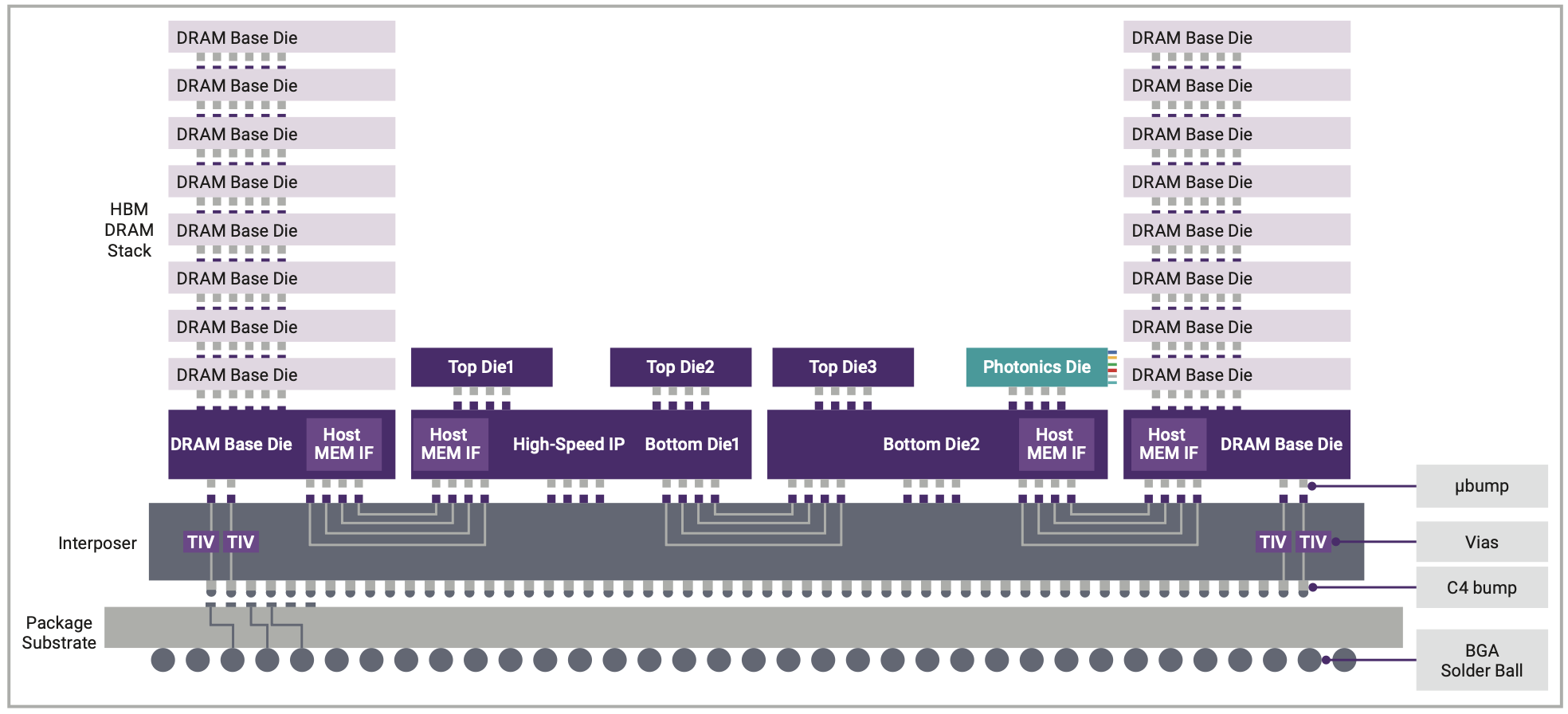
Power integrity has been a substantial design challenge for a long time. In the multi-die era, the problems associated with EMIR analysis must now move beyond the chip to consider interactions across the entire stack. The effects to be analyzed span a multi-dimensional, multi-material space. The graphic at the top of this post gives you a perspective on the complexity of the problem.
Synopsys has recently published an excellent white paper on this topic. It discusses why engineering teams must rethink how they analyze electromigration, voltage drop, and thermal reliability across complex multi-die systems. Excellent details are shared, and suggestions on the best approach to this multi-dimensional problem are offered. A link is coming so you can get your copy. First, let’s examine the challenges of power integrity for multi-die designs and why it’s like playing three-dimensional chess.
Power Integrity in the Multi-Die Era
The semiconductor industry’s shift toward multi-die architectures is transforming how high-performance chips are designed. By combining compute, memory, I/O, and specialized functions within advanced 2.5D and 3D packages, chipmakers can achieve unprecedented levels of integration and performance.
But this architectural evolution introduces a critical challenge: delivering enormous amounts of power reliably across multiple interconnected dies.
In its white paper, Synopsys explains why traditional approaches to electromigration, and IR drop (EMIR) analysis are no longer sufficient, and why power integrity must become a system-level discipline that begins early in the design process.
The Power Delivery Network Has Changed
In conventional single-die designs, power integrity analysis focuses on delivering current from package bumps through the on-chip power distribution network to individual transistors. Although technically demanding, the electrical boundaries are relatively well defined. Multi-die systems eliminate those boundaries.
Power now travels through package connections, interposers, through-silicon vias (TSVs), through-interposer vias (TIVs), micro-bumps, and hybrid bonds before reaching circuitry distributed across the stack. For advanced AI accelerators, these networks may carry kilowatt-class power. Even small increases in resistance can produce significant voltage drops, while inadequate vertical connections can concentrate current and threaten long-term reliability.
The result is a fundamental change: power integrity is no longer a property of an individual die. It is a property of the entire interconnected system.
A switching event on one die can also disturb the voltage delivered to neighboring dies through shared power-delivery resources. Consequently, analyzing each die independently can overlook interactions that emerge only when the complete stack is considered.
Five Failure Modes Threatening Multi-Die Reliability
The Synopsys paper identifies several recurring challenges that can undermine multi-die power delivery.
1) Missing vias and excessive resistance. Weak or incomplete connections increase effective resistance, creating voltage drops and forcing current through fewer available paths.
2) Insufficient TSVs. Too few vertical connections restrict current delivery between dies, increasing resistance and potentially creating localized hotspots.
3) Inadequate micro-bump connectivity. With millions of interface connections, insufficient micro-bump allocation can create bottlenecks that limit power delivery.
4) Redistribution-layer electromigration. High currents traveling through narrow redistribution-layer (RDL) structures can produce dangerous current densities, even when overall power delivery appears acceptable.
5) Thermal interactions. Heat generated by neighboring dies and interconnects increases resistance and accelerates electromigration, creating reliability risks that conventional temperature assumptions may miss.
These problems are interconnected. A poorly designed interface can simultaneously increase IR drop, intensify current crowding, and worsen thermal reliability.
Why Traditional EMIR Tools Struggle
Multi-die architectures also challenge the underlying analysis technology.
Advanced interposers incorporate irregular, non-Manhattan geometries that traditional extraction methods may model inaccurately, producing misleading IR drop or electromigration violations. Adaptive-mesh extraction techniques are needed to represent these structures correctly.
Capacity presents another obstacle. Modern multi-die assemblies may contain tens of millions of micro-bumps and hybrid bonds, creating electrical networks far larger than traditional single-die tools were designed to handle.
Accurate analysis therefore requires both sophisticated modeling and computational scalability.
Thermal modeling adds another dimension. Instead of assuming a uniform temperature, electrothermal analysis can calculate localized temperatures throughout the stack, including Joule heating within individual interconnects.
These temperature profiles can then inform electromigration analysis, producing more realistic assessments of reliability.
Find Power Integrity Problems Before Signoff
Perhaps the paper’s most important recommendation is to move EMIR analysis earlier in the design cycle.
Discovering insufficient TSVs, weak power grids, or excessive resistance near tapeout can force extensive redesign. Engineers may need to reopen power distribution networks, relocate connections, or modify signal routing, potentially disrupting timing closure.
Synopsys recommends a five-stage methodology:
- Architectural exploration: Evaluate die placement, stack configurations, interconnect allocation, and power domains.
- Interposer analysis: Verify the interposer power delivery network before detailed die designs are available.
- Early prototyping: Analyze simplified stack models to identify weaknesses while architectural changes remain practical.
- Concurrent static analysis: Identify resistance hotspots, missing vias, and insufficient connections across the complete stack.
- Concurrent dynamic analysis: Capture simultaneous switching, transient voltage drops, and interactions between neighboring dies.
This progression allows engineering teams to correct structural problems before undertaking computationally demanding dynamic analysis. The white paper goes into more detail about these steps and provides a useful graphic that summarizes the approach.
Balancing Accuracy, Capacity, and Design Schedules
Not every design requires the same analysis approach. Some engineering teams analyze representative vertical slices of repetitive 3D structures, reducing computational requirements. Others employ large compute farms to analyze complete assemblies at full detail.
Reduced-order models provide another option, preserving critical power network characteristics while limiting model complexity.
The paper also emphasizes the growing importance of automation. As multi-die development schedules compress, AI-driven analysis can help engineers identify hotspots, investigate root causes, and evaluate corrective actions more efficiently.
Accurate EMIR analysis can also reduce over-design, avoiding unnecessary power-grid margins that consume area, power, and cost.
Integrating Power Integrity into the Design Flow
Synopsys advocates integrating EMIR and thermal analysis directly into multi-die implementation rather than treating them as separate signoff activities.
Its methodology combines 3DIC Compiler with RedHawk-SC, Totem-SC, and RedHawk-SC Electrothermal to support concurrent analysis across digital, custom, memory, interposer, and package structures.
By bringing signoff-correlated analysis into the design environment, engineers can evaluate power delivery and thermal consequences while implementation choices remain flexible.
To Learn More
Multi-die integration has fundamentally changed the power integrity challenge. Delivering power reliably now depends on electrical and thermal interactions spanning the entire package.
The central message of the Synopsys white paper is clear: EMIR analysis must be concurrent, full-stack, and performed early—not postponed until final signoff.
For engineering teams developing next-generation AI accelerators and high-performance computing systems, this shift offers a path toward fewer late-stage surprises, faster design convergence, reduced over-design, and more reliable silicon.
If you are engaged in high-performance multi-die design, this Synopsys white paper is must-read. You can get your copy here.
And that’s a summary of power integrity challenges for multi-die designs and why it’s like playing three-dimensional chess.
Also Read:
Why Synopsys’ Role in AMD’s Instinct MI455X Matters for AI Infrastructure
Why AI Security Starts at the Chip Level
Share this post via:


Comments
There are no comments yet.
You must register or log in to view/post comments.