







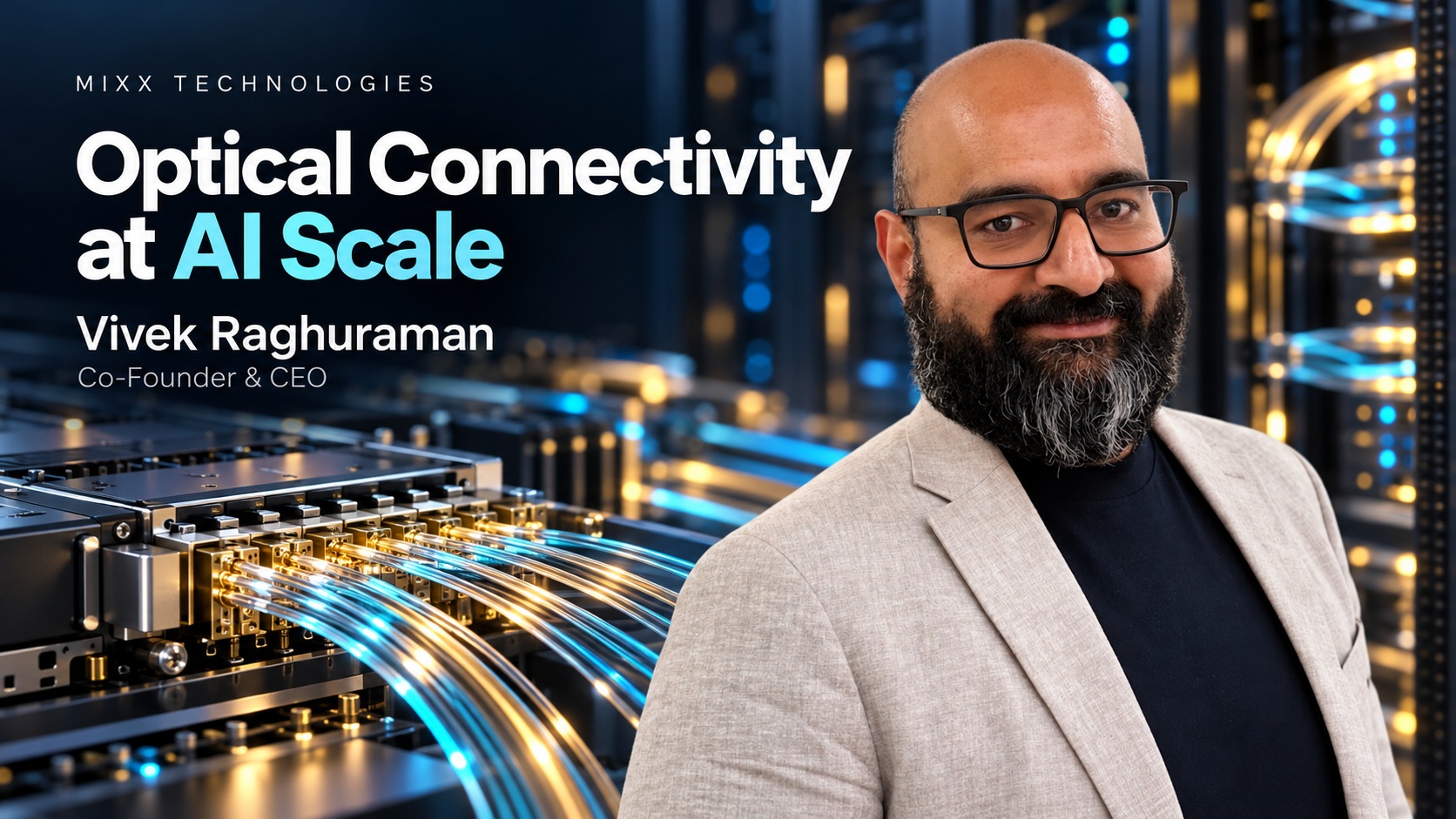
Vivek Raghuraman is co-founder and CEO of Mixx Technologies. At Intel, he led the first integrated silicon photonics transceiver to commercial release. At Broadcom, Raghuraman took two commercial generations of co-packaged optics through hyperscaler qualification in Meta’s environment. In 2023, together with Rebecca Schaevitz, Raghuraman co-founded Mixx to build optical interconnects that are deployable in hyperscale environments. He holds thirteen patents and has advised ARPA-E, the IEEE Photonics Steering Committee, and American Institute of Manufacturing (AIM).
Tell us about your company?
Mixx Technologies is a deep tech systems company focused on building optical connectivity for hyperscale AI infrastructure. Together with Rebecca Schaevitz, we co-founded Mixx in San Jose in 2023 after seeing firsthand the challenges optics faced in real-world applications. Between us, we had taken optical connectivity and silicon photonics products from zero to one at Intel, Corning, and Broadcom, and at Broadcom I took two generations of co-packaged optics through hyperscaler qualification. Those programs showed us where optics stalls. It is rarely performance. It stalls at the connector, in the laser supply chain, in packaging yield, and at the network operating system boundary.
We built Mixx to address these four points. The Mixx platform is the 5DS, which is an end-to-end optical signal chain. It includes HBxIO™ the optical chiplet, the SxC™ connector, STxIQ™ orchestration and link management, and standards-aligned packaging, designed together instead of sourced from four places. In December 2025, we closed a $33 million Series A funding round, led by ICM’s HPQC Fund with TDK Ventures, Systemiq Capital, and Ajinomoto Group Ventures. R&D runs in San Jose, India, and Taiwan. Our first product, the SxC™ Connector, launched this month at SEMICON Taiwan.
What problems are you solving?
Inference is changing what a scale-up network has to do. The connector has to do more to ensure that everything communicates monolithically. Mixture-of-experts and agentic workloads need every node to reach every other node, and that comes down to radix, the number of endpoints a single node can reach. Higher radix removes switching layers. Each layer removed takes its switches, transceivers, and cables with it, which means lower latency, lower aggregate power, and fewer components in the failure chain.
Optics can deliver that radix, but trust must be earned. Copper has earned a high level of operational trust copper over decades. Optics doesn’t yet have that level of trust. So we are not trying to make optics faster. We are trying to make optical scale-up something a hyperscaler can qualify and deploy on the lasers, standards, and network software they already run. At deployment scale, our architecture connects 256 GPUs in one all-to-all domain inside the latency and power envelope that copper-first systems reach at eight.
What application areas are your strongest?
Mixx delivers scale-up networks for AI inference, inside the box and at the box edge. The industry is incrementally moving to co-packaged optics in steps, through near-package optics, CPX, and similar socketed approaches, and each step needs more optical I/O out of the box than existing connectors can carry. A 200T switch brings thousands of fibers out of one chassis. Today the front panel runs out before the silicon does.
That is why our first product is a connector. The SxC™ Connector terminates up to 24,576 fibers in a single rack unit, four times the density of MMC-VSFF, the densest connector platform qualified for deployment today. It serves the front plane and the backplane in one form factor, and the form factor does not change with lane rate or optical power. Behind it is the engine we showed at OFC 2026, a 512-radix design at 100 Tbps on today’s 200G lanes.
What keeps your customers up at night?
It’s all about trust. Hyperscalers have decades of reliability data on copper and very little on optics at production scale, so the questions we get are about qualification, yield, second sourcing, and what happens to the network OS when the link changes. Nobody asks whether optics is fast enough.
The link budget is the other one that is keeping them up at night. The industry is realizing that roughly 99 percent of laser power is lost before the light signal hits the receiver. Most of that is spent at the connector and inside the photonics platform. That loss becomes electrical noise, then forward error correction, then power and cost. An operator who cannot close the link budget at deployment density cannot deploy at all, whatever the demo showed.
What does the competitive landscape look like and how do you differentiate?
There is a lot of good engineering in co-packaged optics, and much of it is aimed at the most impressive devices. At Mixx, we define success as a design win that survives qualification and anchors a generation of deployment. This is the basic idea driving our architecture and the HBxIO™ platform. We’ve chosen DR-based 1310 nm lasers from vendors hyperscalers already qualify, linear interfaces aligned to the 200G/400G Optical MSA and CPX MSA, passive fiber attach over active alignment, and network OS continuity over a new control layer. Each was the less glamorous option. We had watched the opposite choices fail at the system level, with real capital, in front of real hyperscalers. As I said, everything at this level is about trust.
At the connector layer we work alongside US Conec, Corning, Molex, and 3M, and are engaged with several of them through the Expanded Beam Optics MSA (EBO MSA). Mixx is building the optical engine and the connector, so the interface gets engineered once, in a single link budget, rather than negotiated across multiple vendors, as happens now. The connector is the point where process design, optical mode control, assembly, and system margin all meet. That is how SxC™ reaches under 1 dB waveguide-to-fiber against 2.5 to 3 dB in the field, and how the platform recovers roughly 60 percent of the link budget end to end.
What new features/technology are you working on?
The rest of the SxC™ family, first. One ferrule technology at the package, the external laser source, the backplane, and the front panel, so the connectivity problem gets solved once. Then manufacturing. The ferrule was half the problem; cable assembly is still largely manual across the industry, and we are automating it with robotic fiber assembly and automated visual inspection. On standards, the EBO MSA’s first connector specification is in development now, and our glass ferrule is built for the optical power that remote-laser and multi-wavelength architectures will require. GuardBand, our link management and telemetry layer, stays inside the network OS the operator already runs.
How do customers normally engage with your company?
At the system level, and earlier than you might expect. Hyperscalers come to us with a rack architecture and a qualification calendar rather than a component request. One told us, “We don’t look at you as a technology company. We look at you as a solutions company.” Engagements usually start with the connector and cabling architecture, because that is where the transition is decided, and extend into the engine and packaging from there. We are sampling with customers this year, with engineering-sample qualification in 2027 and volume production through 2027 and 2028. The fastest way in is to hold the hardware. We ran the SxC™ Connector live at SEMICON Taiwan, and we do the same in customer labs.
Contact us at mixxtech.io.
Also Read:
CEO Interview with Dr. Stefan Pastine of Thintronics
CEO Interview With Nick Kurayev of ScienceSoft
CEO Interview with Sunghyun Park of Rebellions
Share this post via:



Terafab’s Single Roof: Why Packaging, Not Lithography, Decides High Volume