




An investigative hypothesis for semiconductor ecosystem stakeholders, financial journalists, corporate-governance experts, institutional investors, and serious investigative sleuths. One that I’ve not heard anyone present since the Nvidia CEO reinstatement.
Consider the chronology. The questions it raises deserve answers.
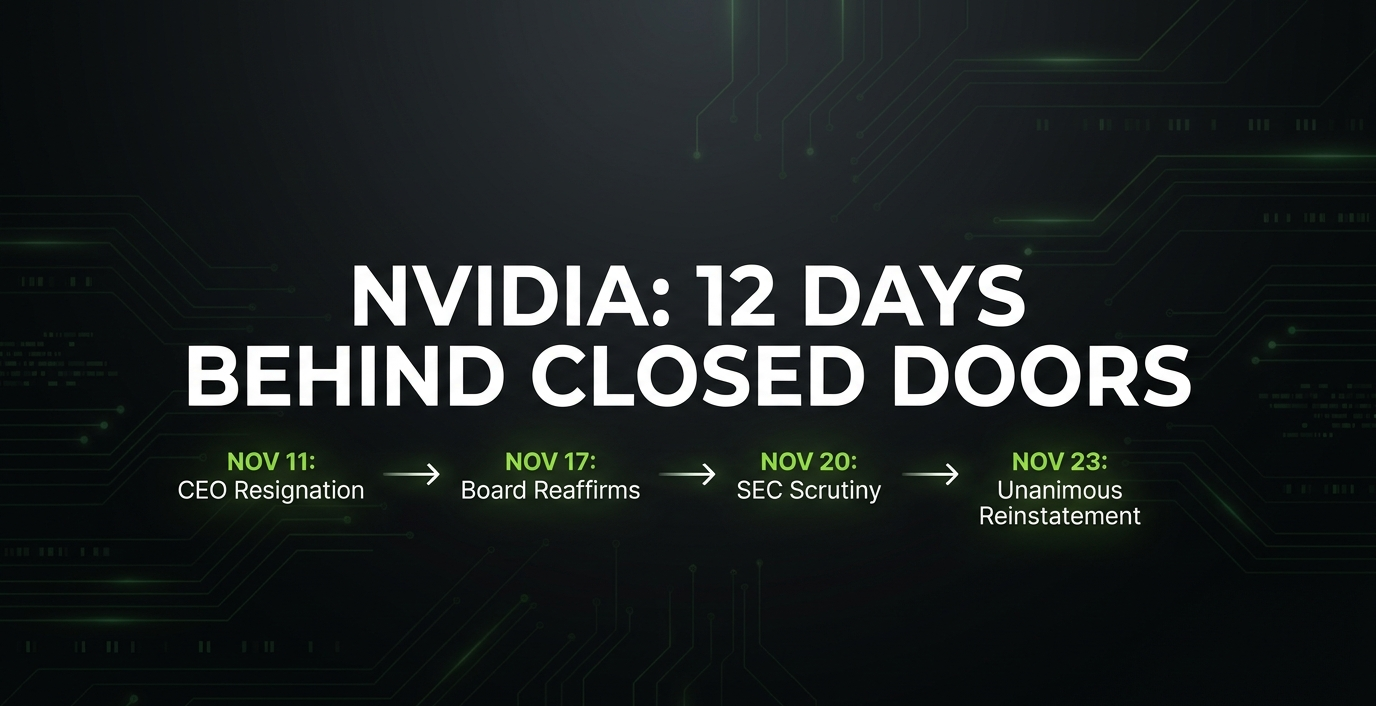
November 11–12: Huang resigns; Kress takes over.
NVIDIA’s board unanimously accepts Jensen Huang’s resignation and appoints Colette Kress, its long-serving CFO, as interim CEO.
The board knows both executives exceptionally well. It knows Huang’s extraordinary contribution to NVIDIA and Kress’s capabilities, experience, and financial responsibilities.
This was not a decision involving unfamiliar candidates. It was a deliberate succession decision made with full knowledge of both individuals.
November 17: The board reinforces its decision.
Chairman Harvey Jones publicly reaffirms that Huang will not be reinstated. He expressly endorses Kress’s leadership and confirms that a search for a permanent CEO is underway.
There is another important consideration: NVIDIA has just reported a blowout quarterly performance and provided strong forward guidance during its November 17 earnings call.
The business is performing exceptionally well. There is no publicly apparent operational crisis requiring an immediate change of CEO.
Kress has the experience, the board’s expressed confidence, and seemingly sufficient operational runway to lead the company while a permanent successor is identified.
This raises what may be the most fundamental question of all: If NVIDIA’s operational and financial outlook was sufficiently strong to support a permanent CEO search, what changed that made an immediate reinstatement of Huang necessary? What operational emergency justified reversing a decision the board had reaffirmed only days earlier?
November 20: SEC accounting scrutiny becomes public.
Reuters reports that SEC enforcement staff are examining NVIDIA’s accounting practices, including matters involving financial arrangements with AI customers.
There is another important dimension: Reuters had previously reported disagreements between Kress and Huang over certain customer-financing arrangements. Those arrangements are now part of the broader accounting scrutiny.
November 23: Huang is reinstated unanimously.
So, what changed between November 17 and November 22?
A hypothesis worth investigating
Did Colette Kress, having initially welcomed the opportunity to lead NVIDIA, reconsider continuing as interim CEO after learning of the SEC investigation and appreciating the potential financial, regulatory, and personal responsibilities involved?
Could the board then have faced an unexpected succession dilemma, with an external CEO search becoming considerably more complicated amid mounting accounting and governance scrutiny?
And did reinstating Huang become the most convenient way out?
Questions for investigative journalists and financial sleuths
- When did Kress first learn that the SEC was examining NVIDIA’s accounting
- Did she communicate any reluctance to continue as interim CEO between November 17 and November 22?
- Did the board discuss alternative interim leadership arrangements?
- Did the SEC investigation feature in the board’s succession deliberations?
- Given the company’s strong financial performance and forward guidance, what operational development actually necessitated reversing the succession decision?
- What precisely caused all ten directors to reverse a decision they had publicly reaffirmed just days earlier?
To be clear: I am not alleging that Kress asked to leave, that the SEC investigation triggered the reinstatement, or that the board acted improperly. These are hypotheses requiring evidence.
But the chronology, the reported financial disagreements, the absence of an apparent operational emergency, and the abrupt reversal warrant serious scrutiny. It’s worth noting that the stock dropped much harder in a single day (on Nov. 20) on news of the SEC investigation than it did when Jensen resigned and was away for over a week (Nov. 12 – Nov. 19).
The board knew both executives’ capabilities. It had reaffirmed its confidence in Kress. The company had delivered exceptional results and strong forward guidance. What new information or development could possibly have changed the board’s collective judgment so dramatically in less than a week?
Perhaps the most important story is not why Jensen Huang reinstated.
It is what happened inside NVIDIA between November 17 and November 22.
Investigative journalists: this deserves a closer look.
Share this post via:


Semiconductor Market Doubling in 2026 – Last Issue