


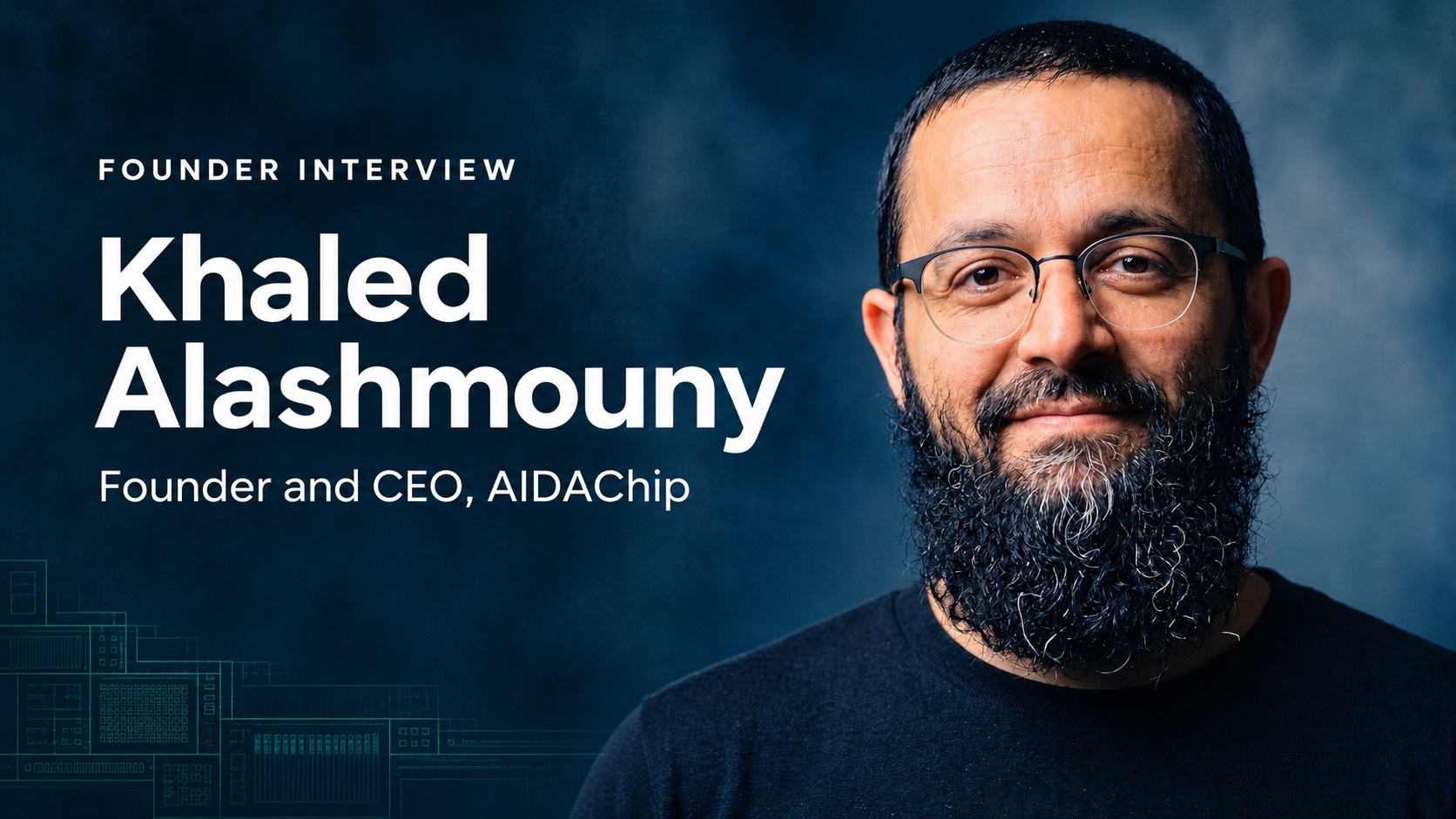


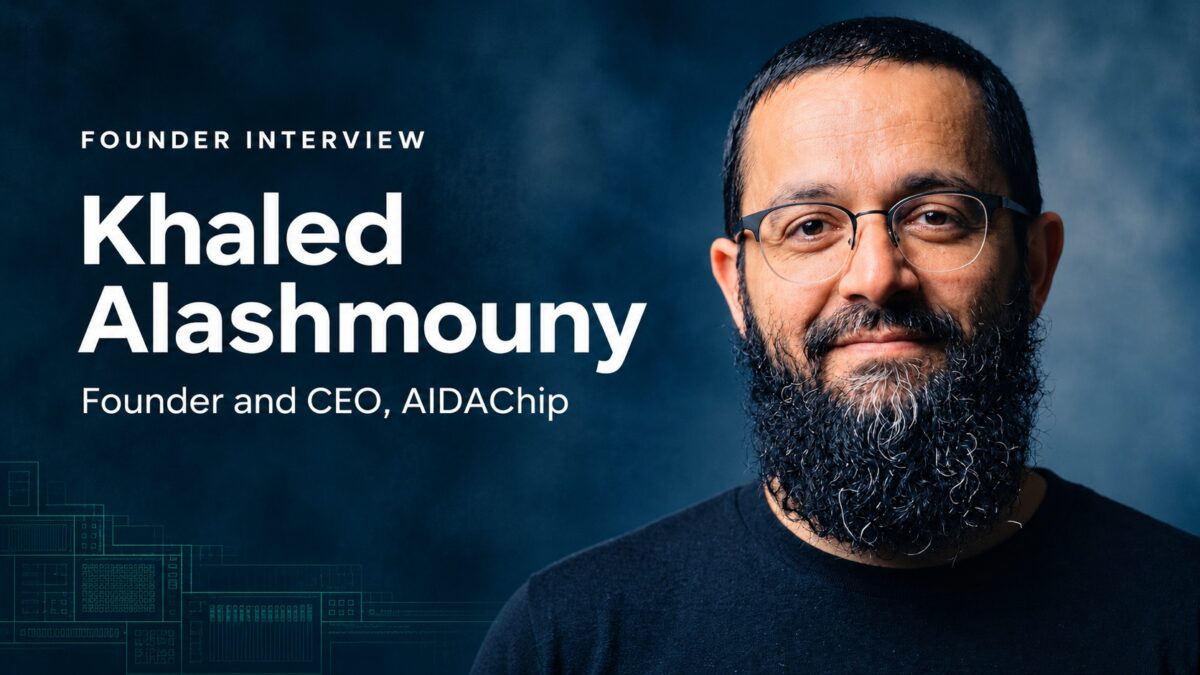
Khaled Alashmouny is the founder and CEO of AIDAChip. He spent 13 years at Apple leading analog and mixed-signal design teams and has about two decades of experience building silicon. He founded AIDAChip to solve the problem he saw on every complex program: talented teams losing time, and sometimes silicon, to misalignment across disciplines.
Tell us about your company.
AIDAChip is the multiplayer, AI-native chip development platform that keeps the whole engineering team aligned, from architecture to production silicon.
I know this challenge firsthand: I spent 13 years at Apple leading analog and mixed-signal teams, and about two decades building silicon. When asked, I usually describe chip design as a constant firefight. Handoffs that aren’t fully explained. Targets keep moving while teams fall out of sync. The same decision is explained a fourth time in another meeting. We don’t stop to name it, because handling it is “the job.” When I finally added it up, it was most of the working week. Not mine alone, the whole team’s. The people were brilliant. The time just disappeared into the space between them.
Right now, everyone is racing to speed up the individual engineer. That’s useful, but it’s not where schedules are lost. Schedules are lost in the handoffs, where intent slips between people, teams and tools. AIDAChip makes the team move as one body.
We’re based in Santa Clara. We’re in production pilot with a Tier-1 semiconductor design partner, used on 3+ real chip projects heading to tapeout, and our beta is open.
What problems are you solving?
Let’s start with the industry data. The 2026 Siemens EDA / Wilson Research Group study found that only 5% of IC/ASIC projects achieved first-silicon success, down from 14% in 2024. Siemens points to how much chip complexity has changed. In my view, that complexity shows up as more functional boundaries, and boundaries are where alignment breaks. Wilson’s 2024 data found that about 70% of respins come from design errors due to spec changes.
Inside a team, you feel this as an alignment tax: the meetings, the reconciliation, the chasing of context and knowledge. In our own customer discovery, more than 20 interviews so far, about 7 of 10 hours go to staying aligned.
When alignment slips anyway, you pile up alignment debt, the cost of being misaligned. A respin is that debt coming due at silicon. And it builds silently. A DV engineer tests against an obsolete spec or outdated model. A layout engineer does clean work on a floorplan that predates the last power-domain change. An assumption about a voltage or an interface quietly moves, and the analog and digital sides stop agreeing. Every engineer in the chain did their part well, to their own understanding, and the chip still comes back wrong. We call that silent divergence, and it’s what we’re built to catch early.
What application areas are your strongest?
We’re strongest where disciplines meet. Analog/mixed-signal is home turf for me, and the analog-digital handoff is where I’ve seen the most expensive surprises start: an assumption made in week three that surfaces as an integration failure a few months later.
Verification is the other big one, because coverage is only as good as the spec quality and details it checks against. If the spec moved and the testbench didn’t, 100% coverage tells you very little.
We’re also seeing strong interest from system companies building their own silicon, where architecture, design, verification and firmware teams are growing fast and often sit in different parts of the organization. In general, the more teams and handoffs a program has, the more value we deliver.
What keeps your customers up at night?
Schedule, and the feeling that they’ve lost visibility. Many leaders tell me they’ve rolled out AI tools to every engineer and still can’t point to a project that shipped faster because of it. They get more artifacts, more tests and more options, but the tapeout date doesn’t move, because someone still has to reconcile all of it.
The second worry is the change nobody heard about. Engineers often don’t escalate a concern because raising it feels more costly than absorbing the risk. So known problems show up later as crises. With first-silicon success where it is and experienced engineers stretched thin, nobody can afford to lose months that way.
What does the competitive landscape look like, and how do you differentiate?
It’s crowded, and honestly that’s a good sign. Everyone now agrees AI belongs in chip development. The big EDA vendors and a wave of startups are building agents that make individual tasks and tool chains faster, and some are going after specs or agent orchestration.
Our view is you need alignment before agentic AI. Give every engineer an agent without shared intent, and you get divergence, faster. So, we’re not another point tool, and we don’t replace anyone’s EDA flow. We sit across the whole team, with three engines, always in this order:
- Intent Engine. Keeps every requirement, decision and the reasoning behind it current and visible to every discipline, so a change reaches everyone it affects.
- Knowledge Engine. What one engineer learns, the whole team keeps. Each project’s lessons become shared memory that people and AI teammates can query, so the next project starts smarter.
- Execution Engine. Keeps work moving between teams without surprises: milestone gates, clean handoffs and governed spec changes, all checked against intent.
On top of that, AIDA-Agents are AI teammates in every discipline. They help drive the team’s existing EDA tools and work across all three engines. Copilots make one engineer faster; we make the team faster together.
What new features/technology are you working on?
We’re building toward a different shape of chip program. Today, disciplines ramp up one after another. Architecture goes first, then design, verification, layout, PD, packaging and test, and each one inherits assumptions it wasn’t in the room for. That’s where the misaligned specs, integration surprises and late ECOs come from. Everyone talks about shift-left, but you can’t shift left without alignment. Our goal is for every discipline to start on day one, aligned, and finish together, early, with the team already moving on to the next chip.
How do customers normally engage with your company?
Usually it starts with a team that has a hard alignment problem and is willing to throw it at the platform. Our first design partner didn’t give us a side project. They aimed AIDAChip at one of their hardest problems, the kind where alignment breaks down worst. From there we run a pilot on a live program. We connect to the tools, docs and agents the team already uses, and we work alongside the engineers while it gets set up. AIDAChip acts as connective tissue on day one and becomes a shared nervous system as the team uses it.
The best signal I’ve had so far: in our pilot, engineers asked to delay a server migration until AIDAChip could move with them. That told me more than any survey could.
Our beta is open, and teams can request access at aidachip.com.
Also Read:
CTO Interview with Dr. Valerio Tenace of ChipNexus
CEO Interview with Daisuke Okanohara of Matlantis
CXO Interview with Solaiman Rahim of ChipAgents
Share this post via:


Jensen Huang and the Cost of Unchecked Influence