





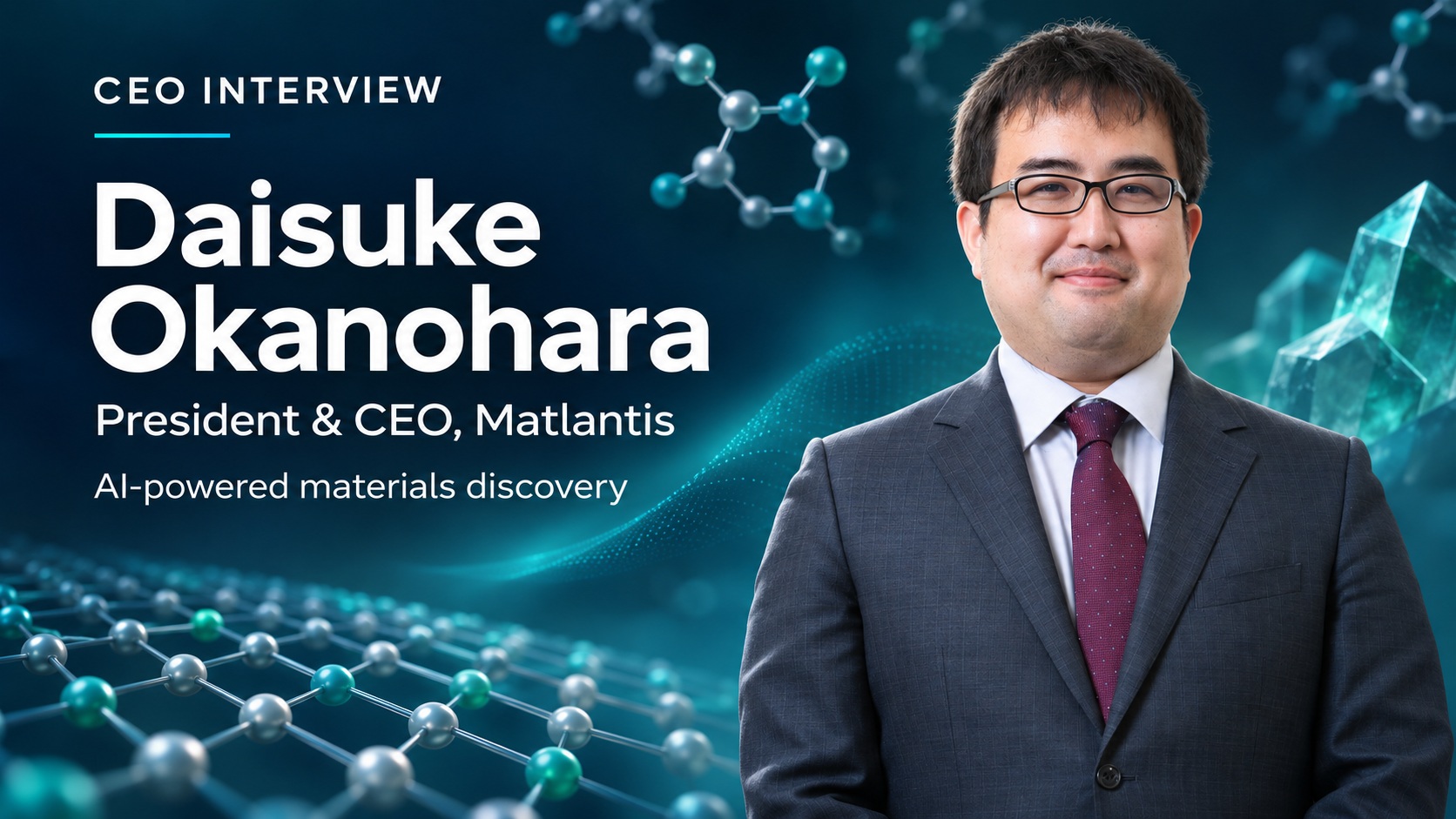
Daisuke Okanohara is President and CEO of Matlantis Corporation and Co-founder and CEO of Preferred Networks, Inc. (PFN). He received his PhD in Information Science and Engineering from the University of Tokyo in 2010. In 2006, while still in graduate school, he co-founded Preferred Infrastructure, PFN’s predecessor, and in March 2014 he founded PFN to accelerate the practical application of AI. As CTO, he led the research, development and commercialization of PFN’s core technologies, including the PLaMo™ large language model and the universal atomistic simulator Matlantis™. He became CEO of PFN in November 2025 and also serves as President and CEO of Matlantis Corporation, which provides Matlantis, jointly developed by PFN and ENEOS.
Tell us about your company?
Matlantis makes a cloud-based atomistic simulator for industrial materials R&D. At its core is PFP, a universal machine learning interatomic potential developed by Preferred Networks. One model covers all 96 elements from hydrogen to curium, and it runs calculations up to 10 million times faster than DFT.
We started in 2021 as a joint venture between Preferred Networks and ENEOS, with Mitsubishi Corporation also investing. R&D teams at more than 150 companies, universities and research institutions now use the platform, including Volkswagen and Hyundai Motor Company. Our global HQ is in Tokyo and our U.S. HQ is in Cambridge, Massachusetts.
I co-founded and spent most of my career in deep learning. What pulled me toward materials simulation is that every property we care about, whether a film adheres, a catalyst works, or a crystal cracks, comes down to how atoms behave. AI has made it practical to compute that behavior fast enough to matter.
What problems are you solving?
Density functional theory, which allows researchers to predict a material’s properties by calculating how its atoms interact, is accurate but slow. Simulating a system of a few hundred atoms, searching for a reaction pathway, or running a long molecular dynamics simulation can take weeks or months. So teams shrink their models, or skip simulation and go straight to the lab.
Last year, we surveyed 300 U.S. materials scientists and engineers. 94% said their team had abandoned at least one project in the past year because simulations ran out of time or compute. I think of that as an underlying crisis of R&D: the experiments that never happen.
PFP delivers near-DFT accuracy fast enough for simulation to run alongside experiments. The second problem is access. Simulation has three barriers: infrastructure, science and scripting. Running PFP as a cloud service took care of the first. Our recent work with AI agents goes after the third, so experimental chemists can run calculations without writing code.
What application areas are your strongest?
Our strongest application areas are catalysts, batteries, semiconductors, alloys, lubricants, ceramics and chemicals. Semiconductor process development is a growing focus for us. As devices shrink to the atomic scale, engineers have to control surface reactions in deposition and etching that are very hard to observe in the lab. Our semiconductor-related users include SCREEN and Resonac.
In ALD and ALE, Matlantis helps researchers understand precursor adsorption, surface reactions and interface formation, so they can screen candidates and tune process conditions before running experiments. In one published case, we studied how a cobalt ALD precursor reacts with a hydrogen-terminated Si(111) surface. We used a slab of about 200 atoms, compared with the roughly 20-atom cluster in earlier DFT work. Paired with GRRM20 for automated reaction path search, the full search took about a week. Comparing two precursors showed how a ligand change lowers the activation energy. Running the same calculations on other substrate structures could help researchers design precursors for area-selective deposition.
In another published case, we used LightPFP to simulate dry etching of SiO₂ with HF gas. Firing 1,000 HF molecules at a slab of about 72,000 atoms opened etching holes more than 2 nm deep within about 500 ps of simulated time, with Si–F bond formation and SiF₄ release, and the reaction pathways matched DFT-level accuracy.
On the catalyst side, ENEOS used PFP with NVIDIA ALCHEMI to evaluate about 100 million candidate structures for oxygen evolution reaction catalysts, cutting the discovery process from years to months.
What keeps your customers up at night?
I hope they sleep at night, but their main pain points at work are time and trust. R&D leaders are under tremendous pressure to bring new materials to market faster, and physical trial and error can’t cover the candidate space. But in our survey, only 14% of respondents felt very confident in the accuracy of AI-driven simulation, and every team raised concerns about protecting IP in cloud tools.
So customers want speed, but they need to believe the numbers and know their data is safe. That’s why we validate PFP against experimental values and public benchmarks, and why we maintain ISO 27001 and ISO 27017 certification.
Talent is the other worry. Computational chemists are scarce, and experimental teams often wait in line for their time.
What does the competitive landscape look like and how do you differentiate?
Customers usually compare us with three options: conventional DFT codes, open-source universal MLIPs, and models they train in-house for one material system. DFT is still the accuracy reference, and we see it as complementary. Open-source MLIPs have improved quickly, which is good for the field.
We differentiate in three ways:
First is accuracy across chemistry. Our PFP v9 tied for first overall on MLIP Arena, an open benchmark that tests whether AI models like ours behave realistically in practical simulations. We also judge PFP by how well it matches real lab measurements, and the newest version brings its predictions closer to experimental results.
Second is speed. PFP runs fast enough for simulation to keep pace with experiments instead of holding them up. And because one model covers every element, researchers don’t have to build a separate potential for each new material system.
Third is the support around the model. Everything runs in the cloud, so customers don’t need their own compute infrastructure. And they work directly with our technical team, experts in materials development and computational chemistry based in Tokyo and Cambridge. They help with everything from choosing a calculation method and setting up a model to interpreting results and working through hard research problems. On top of PFP, tools like LightPFP for large-scale simulation, GRRM20 with Matlantis for reaction paths, and Matlantis CSP for crystal structure prediction cover specific kinds of problems.
What new features/technology are you working on?
Most of our current work is about who can use simulation.
This spring, we released a public Skills library on GitHub that teaches general-purpose AI agents how to work with Matlantis: structure relaxation, molecular dynamics, reaction pathway exploration, crystal structure prediction and more. An installer now lets customers launch their own AI agent, such as Anthropic’s Claude Code, directly from the Matlantis terminal. Researchers can describe a simulation in plain language, and the agent writes and runs the script.
In September, we announced Matlantis Case Studio, co-developed with Resonac. An experimental chemist picks a relevant existing case and customizes it through dialogue with AI, with no programming. Across four demonstration rounds, researchers who don’t specialize in computation completed calculations on their first use. It will be offered soon as an alpha version, starting with companies that took part in the demonstration.
We’re also scaling throughput with NVIDIA ALCHEMI, and in January we launched Matlantis CSP to find previously unknown stable crystal structures.
How do customers normally engage with your company?
Matlantis is delivered as a cloud service, so there’s no hardware to set up. New customers go through onboarding with our technical team, and we run regular hands-on seminars. Our annual User Conference in Tokyo brings the community together, which we’ve used as an opportunity to poll our customers who already use fast simulation about using AI in their research. At this year’s conference, we found that nearly 70% of respondents are using AI for simulation and calculation, and approximately 38% now tackle calculations that were previously impractical.
Some customers work with us more deeply through co-creation programs, as Resonac did with Case Studio. Their researchers tested prototypes, and their feedback shaped the feature in short cycles.
The easiest way to start is to download the Matlantis Portable Guide or contact us at matlantis.com.
Also Read:
CXO Interview with Solaiman Rahim of ChipAgents
CTO Interview with Ed Plowman of Imagination Technologies
CEO Interview with Mark Rushworth of Finchetto
Share this post via:


Jensen Huang and the Cost of Unchecked Influence