





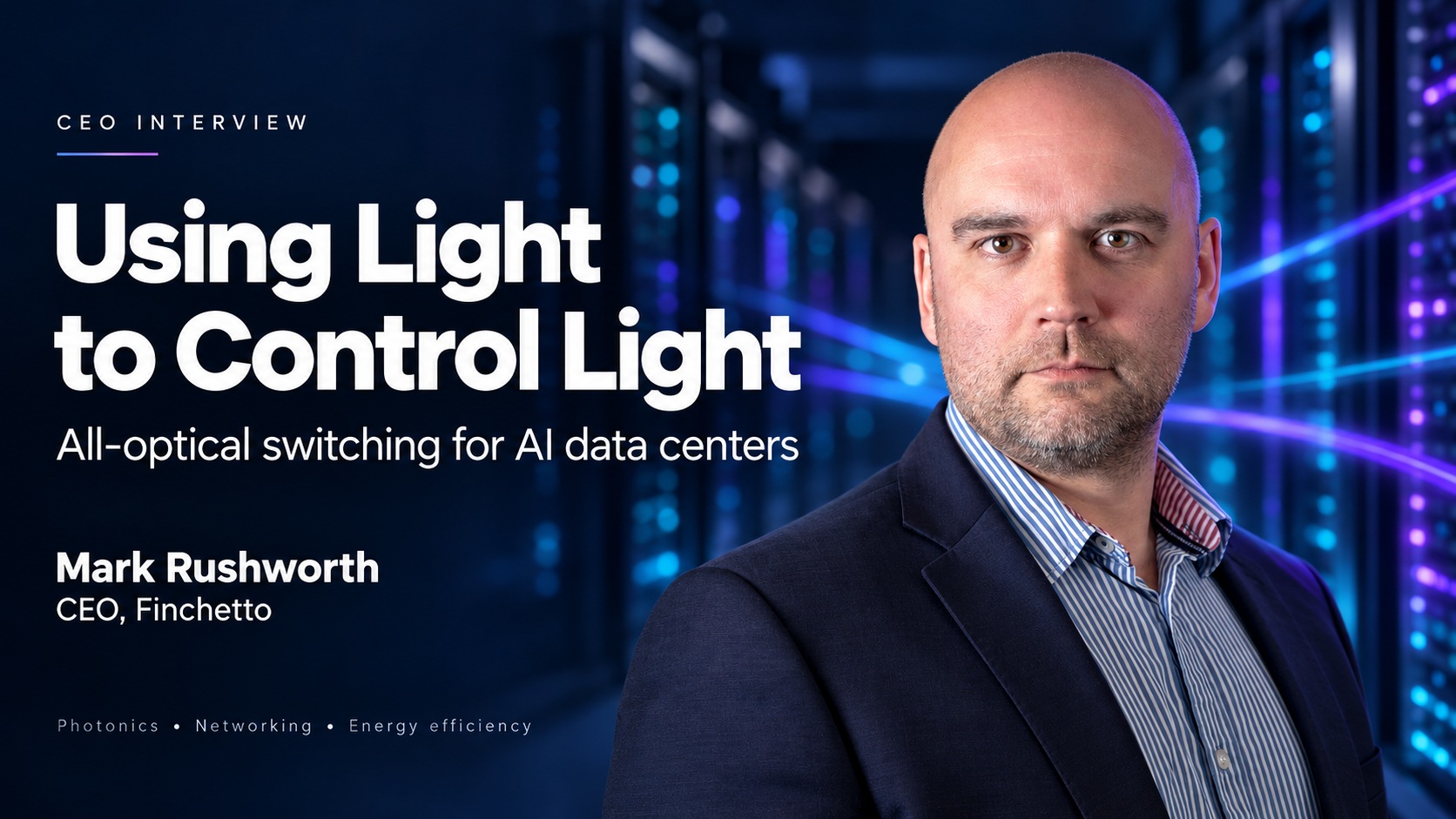
Mark Rushworth is CEO of the all-optical network switch company, Finchetto, a photonics startup developing fully optical network switching technology for AI and hyperscale data centers. He specializes in integrated photonics and optical networking, with a focus on reducing the power consumption and latency of modern computing infrastructure. Mark is a regular speaker on the future of photonics, AI infrastructure, and sustainable computing.
Tell us about your company?
Finchetto is a photonics company with an office and lab at Surrey Research Park in Guildford and an office in Cardiff. We’re building the world’s first fully optical network packet switch, which moves data as light from input to output, with no conversion to electricity along the way.
Co-founder Mike Pearcey invented the core technology, and I lead the company as CEO.
What problems are you solving?
AI’s biggest constraint is energy, and the network is a bigger part of that bill than most people expect. Network switches are a power-hungry component of the data center, accounting for as much as 10 percent of its power. As the industry works to make AI more efficient, data has to move more efficiently too, especially in clustered AI training, where thousands of GPUs exchange huge volumes of data with tight timing. If the network cannot keep up, expensive silicon will sit idle and the power it draws goes to waste.
The switch is unavoidable, and has become a bottleneck. Link speeds are moving from 400 Gb/s to 800 Gb/s, with 1.6 Tb/s on the near-term roadmap, and a switch that is marginal at 400 becomes a ceiling at 800. Building around it with point-to-point links multiplies the laser sources and drives power up nonlinearly. Electronic switches hit limits at that scale. As power dissipation grows, the latency floor does not move, and every switch converts incoming light to an electrical signal, reads the packet, and converts it back to light at every hop.
Our technology removes the conversion, and with it, many of the transceivers that fail most often. A light-based control signal is sent in parallel with the data packet and is set to a frequency based on the packet destination. On reaching the switch, the control signal interacts with the data signal and sets its route. This approach means the data never leaves the optical domain. Our design for a 48-port Ethernet switch is modeled to cut latency by 700x and power by 20x against conventional electro-optical switches. We have a working 4×4 Ethernet demonstrator that switches at line rate. That is how we are tackling part of AI’s energy problem: with a new technology that uses light to control light.
What application areas are your strongest?
AI and high-performance computing data centers, where latency and power per port matter most. Training clusters move huge volumes of data between GPUs with tight timing, and those customers pay for performance first. Telecoms equipment makers are a second target market. What we have patented is a method for switching data using nonlinear optics, not one narrow implementation, so the same principle can extend to other kinds of network and, in the longer term, to quantum-adjacent and optical compute systems.
What does the competitive landscape look like and how do you differentiate?
The incumbents are electronic switches from companies such as Nvidia, Arista and Cisco.
Optical circuit switches are already in the market. A circuit switch, however fast, sets up a path between two endpoints ahead of the data and relies on electronic control and software to decide which paths to set. We can make that decision for every packet as it is sent, using light to control light, so there is no electronic control in the path.
That matters for AI because the traffic does not sit still. Training clusters move huge volumes of data between GPUs with very tight timing, and the pattern shifts as workloads move between training and inference. Deciding per packet lets the network follow that traffic as it happens and spread the load across a large fabric, instead of depending on paths planned ahead.
Designing an all-optical packet switch is hard and brings its own challenges. There is no buffer memory, for example, and flow control needs to be managed in a different way from a traditional network with electronic switches. However, the benefits are huge in terms of power and latency and offer other benefits. Whereas electronic switches are limited to operating at the line rate for which the processor was designed, our switch, being passive, is agnostic to line rate, so moving from 800 Gb/s to 1.6 Tb/s and beyond does not mean replacing the switch.
What new features/technology are you working on?
Our prototypes and demonstrator have been built using discrete optical components. This allowed fast iteration on proving the physics, testing and refining designs and proving the architecture, but bulk optics are not cost-effective for mass manufacture.
Our next step is to put the switch onto photonic integrated circuits. We already have designs and prototype PICs and have started a ten-month program to establish a manufacturing process for thin-film lithium niobate (TFLN) chips in Cardiff University’s Institute for Compound Semiconductor cleanrooms. It is supported by a grant through the Investor Partnerships Programme and investment from Development Bank of Wales. This is an exciting step, not only in terms of our development but also for increasing capability in the UK for developing photonic devices for utilization in data centres, AI and quantum.
How do customers normally engage with your company?
No data center will rebuild around a new switch, so we have designed engagement to be incremental. Ours interoperates with existing transceivers, GPUs and network protocols, and it drops into familiar spine-and-leaf architectures. A customer can start with a targeted deployment, such as a new AI pod or a performance-critical part of the fabric and grow in phases while existing assets stay in service.
Before that, we work closely with technology partners on the system itself. Pilot Photonics, the Irish tunable-laser company, is an example. Packet-level switching depends on a laser that can retune in nanoseconds, and we had not found a faster one on the market. We have demonstrated our switching approach using Pilot’s lasers, and our two engineering teams are now designing them into our next generation of demonstrators.
Also Read:
Share this post via:


The $725 Million Chip Development: Why Execution Risk, Not IP Cost, Now Dictates Advanced-Node Survival