





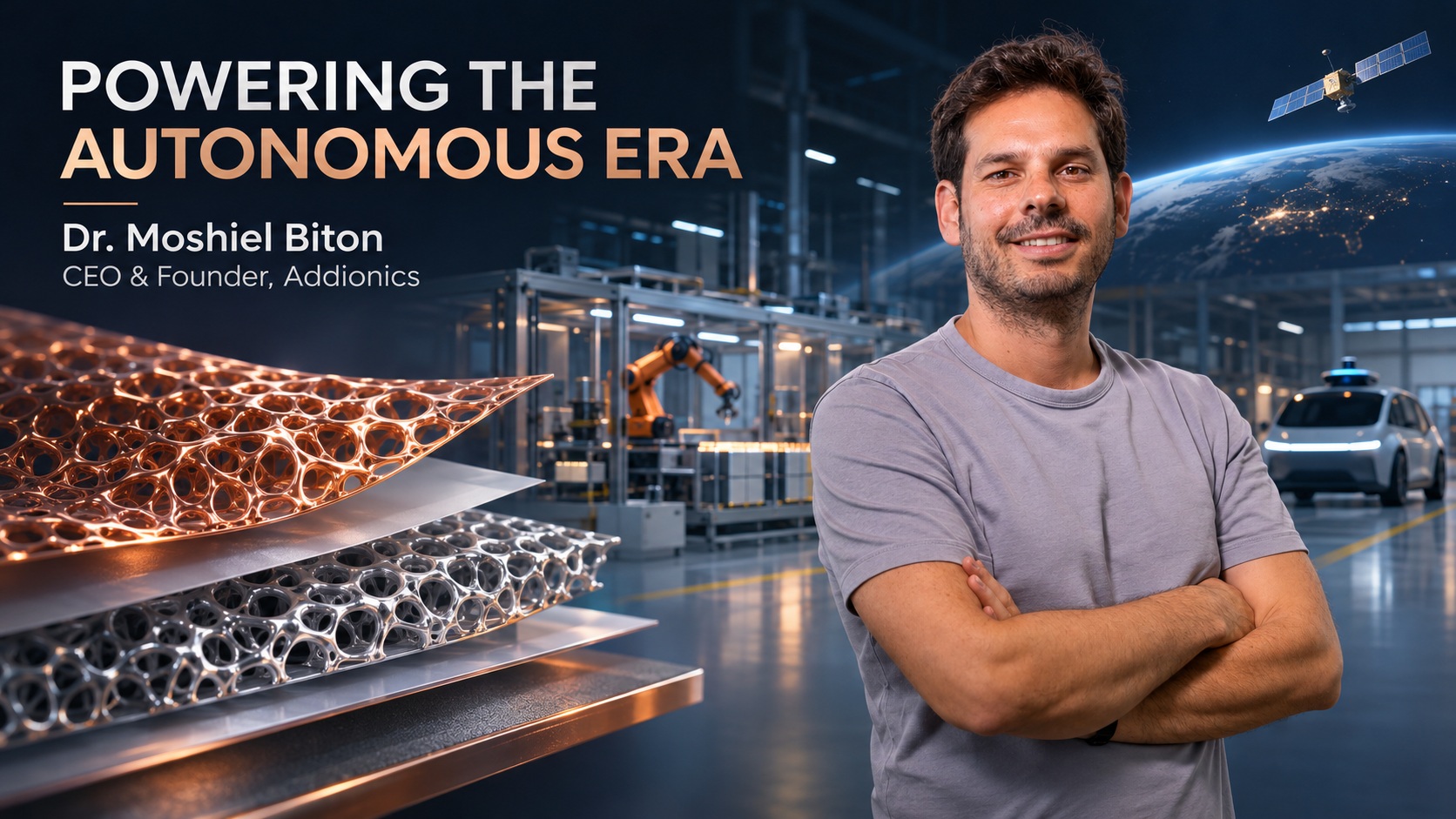
Dr. Moshiel Biton is the CEO and Founder of Addionics, a pioneer in battery innovation. Under his leadership, the company has raised over $85 million, built partnerships with global industry leaders, and established the world’s first manufacturing facility for its 3D Current Collectors. With a Ph.D. in materials science, Moshiel is redefining battery architecture for next-generation applications across mobility, AI infrastructure, robotics, defense, space, and future human advancement.
Tell us about your company?
AI is moving into the physical world through autonomous vehicles, robotics, and advanced defense and space systems. Making these systems intelligent is only part of the challenge. Their batteries must make sustained, reliable operation possible.
Addionics develops and manufactures Smart Metals for batteries. Our Smart 3D Porous Current Collectors replace conventional flat metal current collectors with engineered three-dimensional structures, changing how the layers interact to create a unified cell system.
I often say we are bringing semiconductors to the battery industry. I studied semiconductors before doing my PhD in batteries, and that perspective shapes our approach: using advanced structures and precision design to unlock better battery performance and more efficient manufacturing.
What problems are you solving?
The autonomous era demands sustained power, repeated fast charging, and continuous operation with minimal rest. At the same time, the industry needs more energy, longer life, and lower cost.
We redesign the internal metal architecture to address the battery limitations holding back longer missions, greater payloads, and more productive autonomous fleets. The objective is to make these systems more capable and resilient, with stronger unit economics, rather than simply adding more battery capacity. Our technology is designed to integrate into existing production lines.
What application areas are your strongest?
We are strongest where better batteries mean less downtime, longer missions, and stronger unit economics. That includes electric and autonomous vehicles, defense, drones, and robotics, where charging speed, power, and endurance directly affect operations.
Space is particularly important. Battery failure can end an otherwise viable satellite’s mission and leave it as space debris. Longer battery life can mean years of additional service and revenue from the same asset in orbit, changing the business model.
We also see strong potential in energy storage for AI infrastructure, where power delivery, reliability, and lifetime matter.
What keeps your customers up at night?
They worry about whether battery limitations will undermine their business or mission. For autonomous fleets, charging downtime means lost revenue. In space, battery lifetime can determine how long an asset remains productive.
In defense, the stakes go beyond economics. Power, endurance, and reliability affect mission success. Better batteries can help determine who wins on the battlefield.
Our customers need sustained high performance, resilience in demanding conditions, and viable unit economics. Their batteries must enable all three.
What does the competitive landscape look like and how do you differentiate?
Much of the battery industry focuses on chemistry. We focus on physics. Our approach is designed to complement different chemistries rather than depend on one winning. Compatibility and performance benefits are evaluated for each cell design and application.
Our differentiation is industrial as well as technical. We combine engineered structures with industrial manufacturing capabilities developed for precision, consistency, and scalability. Our products are designed to integrate into existing battery production lines.
While others are betting on a horse, we are betting on the race.
What new features or technology are you working on?
We are advancing our Autonomous Architecture for 24/7 operation, with repeated charging and discharging and little or no rest between cycles. The goal is sustained performance and long life under continuous use, across autonomous vehicles, robotics, drones, defense, and space.
Our Low-Temperature Architecture has demonstrated promising performance improvements in cold conditions, with the potential to reduce battery-heating requirements and improve energy efficiency.
Intelligence enables autonomy. Better batteries make continuous operation practical, reliable, and economically viable.
How do customers normally engage with your company?
Customers come to us for more performance from their batteries and applications, alongside improvements in manufacturing.
Battery production demands precision and consistency at industrial scale. Our Smart 3D Current Collectors are designed to improve both battery performance and production efficiency within existing manufacturing lines.
We begin with the customer’s performance targets and production constraints, then work through product samples, cell evaluation, and qualification toward commercial supply. The objective is a better battery and a better way to produce it.
Also Read:
Share this post via:


The $725 Million Chip Development: Why Execution Risk, Not IP Cost, Now Dictates Advanced-Node Survival