




Money fuels a high-tech bubble. Early money comes from investors betting on a market that doesn’t exist yet. Mike Markkula put up roughly $250,000 to incorporate Apple and launch the Apple II, and marquee investors like Venrock followed. AI got its jumpstart when researchers found a new use for graphics processors, the chips that build the 3D worlds where gamers kill off bad guys ad infinitum. Programmed to run in reverse, taking in the real world instead of rendering it and turning it into the math of neural networks, the GPU became the engine of a new industry. Boom! Then came the money: hundreds of billions a year from hyperscalers and VCs, until token processing outstripped the boring data processing that had paid the bills for half a century.
But refining raw data into tokens for training, then processing tokens to answer queries — the raw material and finished goods of an AI factory — demanded massive investment in GPUs and the high-bandwidth memory needed to feed them. The chips went onto boards, the boards into racks, and the racks into data centers with footprints the size of several football fields. And the costs compounded. A single AI rack now draws more than 100 kilowatts, a campus hundreds of megawatts, and all of it needs rivers of water to keep from overheating. AI investment was no longer just about chips. It had become a bet on land, water, and power, the stuff of utilities and railroads, with capital requirements to match.
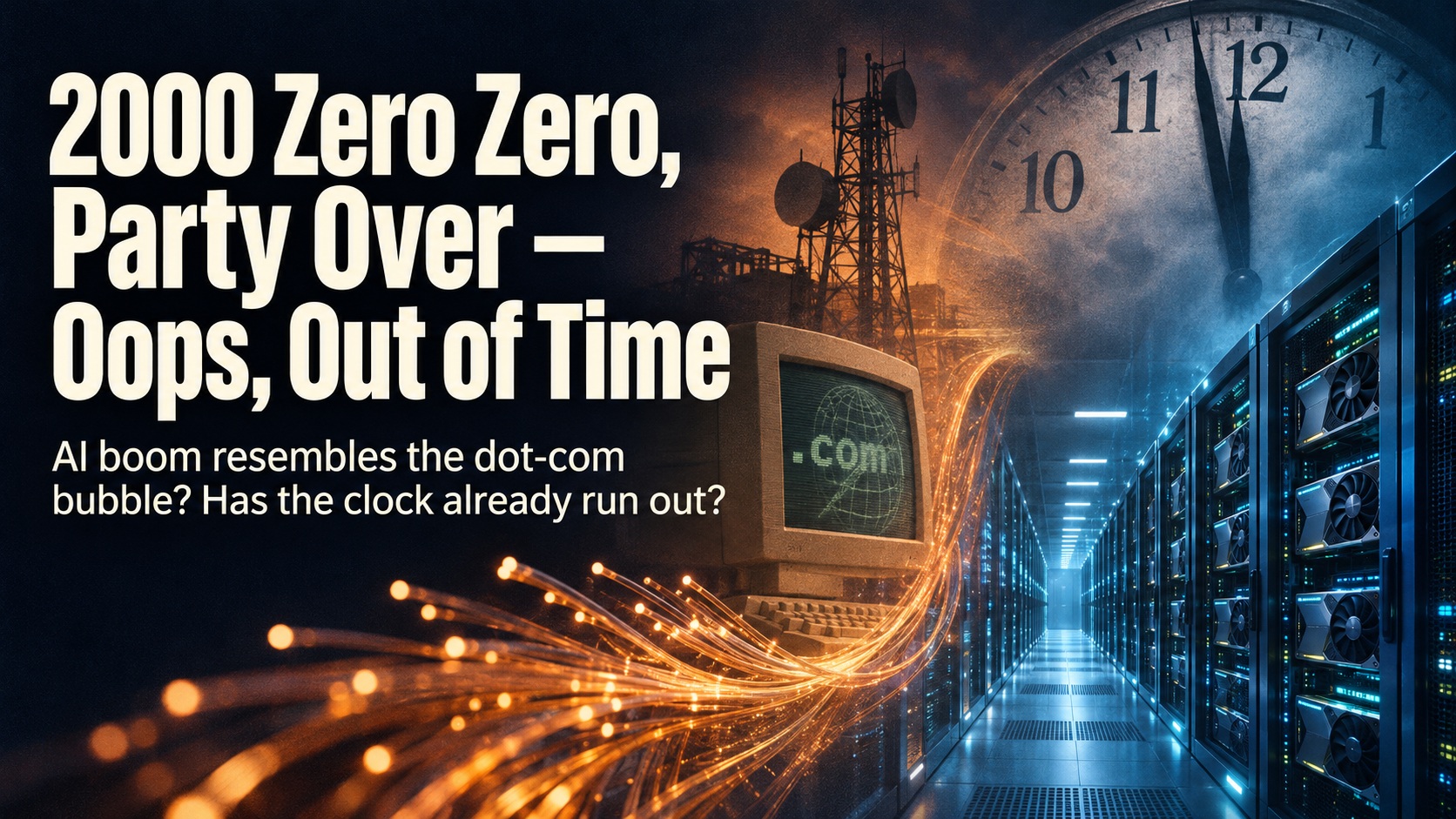
Viewed in the mirror of the past, the AI boom looks a lot like the dot-com bubble at the turn of the century. Now look back at the late 1990s. The Internet had arrived to connect the PCs that had filled homes and offices since Markkula’s bet on Apple, putting them on what Washington liked to call the Information Superhighway. At the same moment, the Telecommunications Act of February 1996 opened local phone markets to competition by requiring the Bell monopolies to lease their lines to newcomers. A gold rush followed. Long-haul fiber builders such as Global Crossing, Level 3, and WorldCom, along with hundreds of local challengers known as Competitive Local Exchange Carriers (CLECs), rushed to lay high-speed fiber across the country and then the world. Equipment makers Lucent, Nortel, and Cisco raced to sell them the switches and routers to light it. And much like Nvidia today, the vendors were willing to lend their customers the money to buy it.
Investor presentations repeating a claim spread by WorldCom’s UUNET unit, that Internet traffic doubled every 100 days, fanned the flames of speculative equipment and fiber deployment. Even the U.S. Commerce Department repeated it in a 1998 report. The real rate, as researcher Andrew Odlyzko showed, was closer to doubling once a year. Then came the reckoning. Revenue at the heavily financed upstarts never caught up with what they had spent on switches and fiber. Carriers went bankrupt by the hundreds, WorldCom and Global Crossing among them, leaving much of the new fiber dark. The vendors who had lent them the money wrote off the loans, and Nortel’s stock fell from more than $100 to under a dollar. Across the market, the bust erased some $5 trillion in Nasdaq value between March 2000 and October 2002.
The same movie, new cast
Hold the two eras side by side and the casting is uncanny. The hyperscalers had a head start, building AI factories and renting out their GPU farms to anyone who wanted to run large language models. Demand outran even their supply, and anyone sitting on power, buildings, or GPUs saw an opening. First into the fray were the crypto miners. Ethereum miners, left with warehouses of idle GPUs after Ethereum stopped using mining in 2022, rented out the hardware. CoreWeave began that way. Bitcoin miners, whose specialized chips were useless for AI, turned out to own something more valuable: power hookups and buildings ready for GPU racks. Presto, a new business out of the shell of an old one, as I described in “The Accidental Infrastructure” (SemiWiki, July 6, 2026).
These neoclouds are today’s CLECs: upstarts building capacity with borrowed money, betting that demand will arrive before the loan payments do. Today’s Lucent and Nortel is Nvidia, which has taken stakes in its own customers, from CoreWeave to OpenAI, and in some cases promised to buy capacity they can’t sell. The 100-day doubling has become the token forecast: projections of exploding demand for AI inference, repeated in investor decks until they sound like settled fact. And dark fiber has a modern counterpart in the GPU, with one important difference. A strand of glass laid in 1999 still carries traffic today. A GPU bought in 2024 may be outdated within a few years, so if demand stalls, the hardware loses value faster than any fiber ever did.
The spending dwarfs anything the telecom boom produced. Amazon, Alphabet, Microsoft, and Meta have guided to roughly $720–745 billion of capital expenditure for 2026, and in the third quarter alone the four spent a combined $208.7 billion, up 84% from a year earlier.
Where the mirror cracks
The parallel isn’t perfect, and the differences matter. The CLECs were small companies borrowing against hope. Today’s biggest builders are the most profitable companies on earth, paying mostly out of cash flow. And AI has real revenue in a way the CLECs never did: businesses pay for AI because it does work for them, while the CLECs were selling capacity nobody was using yet. The question is not whether AI demand is real but whether it can grow fast enough to justify the capacity being built. The financing is starting to look familiar, though. The hyperscalers have turned to the bond market and to off-balance-sheet partnerships to pay for data centers, and the neoclouds carry debt loads the CLECs would recognize. The cash-flow cushion is getting thinner, one bond deal at a time.
Two forces are now working against the AI build-out. The first is revenue chasing breakeven. The model makers’ sales are growing at rates the CLECs could only dream of, yet the finish line keeps moving. Anthropic raised its 2026 revenue forecast but pushed back the date it expects to turn cash-flow positive. Every new model costs more to train, and price cuts to win customers eat into the gains. The second is the physical world. There is only so much land near substations, so much power on the grid, and so much capital willing to wait years for a return. Even Microsoft’s CFO has said third-party capacity it expected in the quarter arrived late. The CLECs could trench fiber almost anywhere. Today’s builders need gigawatts that utilities can’t deliver for years. That cuts both ways. Power shortages may prevent the kind of glut that sank the CLECs, but they also stretch out the time between spending the money and earning it back, and that gap is where bubbles burst.
The clock is running
If the pattern holds, the clock is already running. ChatGPT arrived in November 2022, almost exactly four years before the Nasdaq’s October 2026 high, the same span that separated the Telecom Act from the March 2000 peak. And a blockbuster Anthropic debut wouldn’t break the pattern. It would complete it. Palm went public on March 2, 2000, and was briefly worth more than its parent, 3Com. Eight days later the Nasdaq peaked.
Also Read:
Who Owns the Voice in Your Head?
Containing AI Agents With a Will of Their Own
The AI Genie Is Out of the Bottle and Won’t Go Back
Share this post via:


Jensen Huang and the Cost of Unchecked Influence